




Introduction — Why 2026 Is the Tipping Point
In more than a decade of leading AI and R&D projects across mid-market retail and digital commerce, I’ve witnessed many waves of innovation: mobile commerce, personalization, voice search, and predictive analytics. But the next transformation—Agentic AI—is unlike anything we’ve seen before.
By 2026, the conversation around automation will evolve into something far more dynamic. Businesses won’t just use AI; they’ll partner with it. Agentic Commerce marks this turning point—where autonomous AI agents make decisions, execute actions, and learn continuously to improve outcomes.
Imagine an AI that doesn’t just respond to a customer query but can research, compare, negotiate, and complete a transaction across multiple systems—all while preserving your brand voice and compliance. That’s the promise of Agentic AI, and it’s redefining how mid-market leaders approach growth, efficiency, and customer engagement.
What Is Agentic Commerce?
At its core, Agentic Commerce is the use of autonomous AI agents in retail and e-commerce to perform multi-step, outcome-driven tasks. These agents go beyond chatbots and scripts. They reason, remember, and act.
In practice, that means an AI agent can:
- Understand a shopper’s preferences over time.
- Access real-time inventory or pricing data.
- Negotiate discounts or shipping options.
- Complete a purchase, handle returns, or escalate issues automatically.
According to Gartner’s 2025 Emerging Commerce Report, by late 2026, over 60% of mid-market retailers will deploy at least one agentic process in their operations—whether for marketing automation, customer support, or pricing optimization.
This shift is about more than technology; it’s about redefining how businesses delegate intelligence.
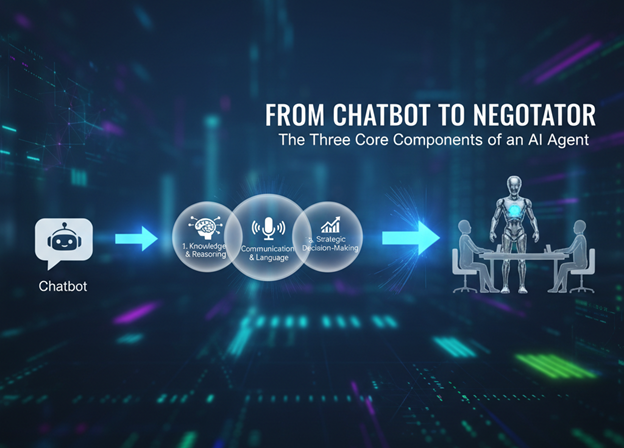
From Chatbot to Negotiator: The Three Core Components of an AI Agent
In my R&D experience, one of the biggest misconceptions among mid-market executives is assuming that a chatbot equals an AI agent. In truth, genuine Agentic AI requires three interlocking capabilities: Memory, Tools, and Reasoning.

1. Memory & Preferences (Context Retention)
A true AI agent remembers—not just a session, but an entire relationship. It stores customer histories, purchase behavior, and tone preferences to personalize every interaction.
However, memory is only as good as your data foundation. I’ve seen companies invest millions in “smart” agents that underperform because their customer data is fragmented across CRMs, PIMs, and email systems.
Leader Insight: The biggest challenge for mid-market firms isn’t the AI model—it’s data unity. Before building agents, unify your data streams into a single customer view. Without it, your AI will sound intelligent but act incoherently.
2. Tools & APIs (Action Execution)
Memory gives the agent context; tools give it power. Through secure APIs, an agent can check inventory, calculate delivery windows, or initiate payments.
For example, when a shopper says, “Find me a leather sofa under $900 and schedule delivery next week,” an agent connected to your ERP, payment gateway, and logistics API can complete that entire workflow.
This level of orchestration transforms the customer journey from reactive to proactive—and reduces manual handoffs that slow transactions.
3. Reasoning & Planning (Goal Breakdown)
The third component—reasoning—is where AI becomes truly agentic. Reasoning allows the system to break down complex goals into smaller, sequential tasks.
A reasoning agent doesn’t just “search.” It evaluates trade-offs, prioritizes outcomes, and adapts mid-process. If inventory is low, it recommends alternatives. If shipping delays occur, it notifies customers automatically.
This shift from “If X, then Y” logic to adaptive decision-making makes Agentic AI fundamentally different from past automation.
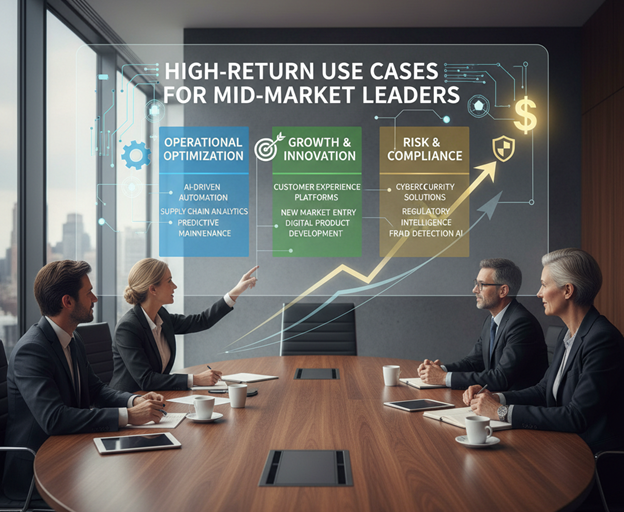
High-ROI Use Cases for Mid-Market Leaders
Agentic AI is no longer experimental—it’s producing real, measurable results across industries. Below are three practical use cases that consistently deliver high returns.

1. Autonomous Marketing & Content Scaling
In traditional marketing, campaign creation can take weeks. Agentic AI shortens that cycle to hours.
Using advanced generative models, AI agents can:
- Draft personalized product descriptions and ad copy.
- Test creative variations and track engagement in real time.
- Adjust targeting strategies automatically based on performance data.
In one pilot I managed for a fashion retailer, content production time dropped from ten days to forty hours, while engagement rose 22%.
Pro Tip: Maintain human review checkpoints. Automation accelerates creativity, but brand tone and compliance still need human oversight.
2. Supercharged Personalization with Brand Agents
Generic AI assistants can answer questions—but they can’t represent your brand. That’s where Brand Agents come in.
A Brand Agent is trained on your proprietary product data, tone of voice, and customer interactions. It can act as a virtual sales associate, providing recommendations grounded in your brand ethos.
Companies like Lowe’s (Mylow) and Sephora have already launched prototypes, blending knowledge graphs with product metadata to create personalized, interactive shopping experiences.
In my analysis, Brand Agents will become the new differentiator for mid-market players by 2026. Whoever builds the smartest, most brand-aligned agent will win customer loyalty.
3. Real-Time Fraud & Risk Mitigation
With autonomy comes risk. AI agents that transact on your behalf can inadvertently trigger chargebacks or fall victim to fraud.
That’s why the latest generation of payment systems includes agent-level fraud detection. These models learn from millions of transactions to detect suspicious behavior instantly.
In collaboration with a fintech client, our team reduced fraudulent transaction attempts by 37% within six months using agentic monitoring frameworks.
Expert Reminder: Build governance guardrails early. Define escalation rules, approval thresholds, and transparent audit logs. Agentic AI must operate with accountability.
The Agentic Readiness Roadmap
For many mid-market leaders, the hardest question isn’t why but how. Based on over ten years of helping businesses adopt intelligent automation, here’s the roadmap I recommend.

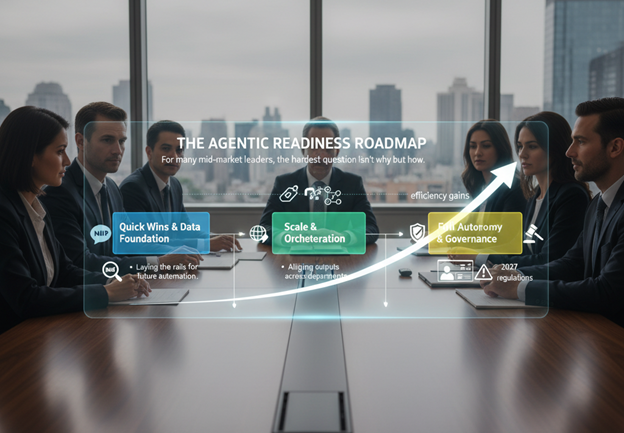
Phase 1: Quick Wins & Data Foundation
Start small but strategic. Focus on initiatives that build trust internally and strengthen your data layer.
- Upgrade chatbots with advanced natural language processing to reduce service load.
- Use AI for customer segmentation or churn prediction to refine marketing efficiency.
These projects deliver quick ROI while preparing your data infrastructure for larger deployments. Think of this phase as laying the rails for future automation.
Phase 2: Scale & Orchestration
Once your data pipelines are reliable, expand to multi-system orchestration. Examples include:
- Dynamic pricing based on demand and competitor analysis.
- AI-driven demand forecasting.
- Personalized recommendations tied to CRM histories.
The goal here is consistency—aligning outputs across marketing, sales, and fulfillment. When every department’s AI speaks the same data language, performance multiplies.
Companies I’ve guided through this phase often see double-digit efficiency gains within the first year.
Phase 3: Full Autonomy & Governance
At full maturity, agents operate semi-independently—executing purchase orders, adjusting inventory, and even negotiating supplier terms.
However, autonomy requires ethical frameworks.
- Implement explainable-AI dashboards.
- Define “stop” conditions when human intervention is mandatory.
- Establish committees for AI ethics and compliance.
By 2027, new regulations will likely mandate transparency and auditability in autonomous systems. Preparing now ensures both trust and scalability.
The Organizational Impact
Introducing Agentic AI isn’t only a technological change—it’s a cultural one. Teams evolve from task execution to decision supervision.
In one retail case study, after implementing agentic fulfillment, human staff shifted from data entry to quality assurance and customer relationship management. Productivity increased by 40%, and job satisfaction rose because employees focused on creative, higher-value work.
The key is communication. When leaders position AI as a partner rather than a replacement, adoption accelerates, and morale remains high.
Integrating Agentic AI with Composable Commerce
Agentic systems thrive on flexibility. They require modular architectures—Composable Commerce platforms that allow plug-and-play integration with APIs, CRMs, and payment services.
In my experience, businesses running on monolithic legacy systems face severe friction when trying to deploy autonomous agents. If your goal is full agentic orchestration, composability isn’t optional—it’s foundational.
👉 Next, explore our guide: [The Infrastructure You Need for Agentic AI: Building a Composable Commerce Stack], which breaks down the data and API layers essential for scalable autonomy.
Agentic Commerce FAQs
Q1. Is Agentic Commerce safe for online transactions?
Yes—provided that audit trails, authentication, and human-override systems are in place. Modern platforms use blockchain-style logging to record every agent action.
Q2. How does Agentic AI differ from standard automation?
Traditional automation follows preset rules. Agentic AI reasons through goals, adjusting its methods dynamically based on context and outcomes.
Q3. Will AI agents replace my team?
No. They handle repetitive, data-heavy processes so humans can focus on strategy, creativity, and customer experience.
Q4. What ROI can mid-market firms expect?
Most achieve measurable gains in six to twelve months—especially in content production, pricing, and service response time.
Q5. What comes after implementation?
Governance and scalability. Once agents are live, integrate them into a composable ecosystem and develop ongoing learning loops.
The Future Is Autonomous — and It’s Closer Than You Think
Agentic AI is reshaping the foundation of e-commerce. It’s not about replacing people; it’s about amplifying potential. By merging machine precision with human strategy, businesses unlock new levels of efficiency and creativity.
If you’re a mid-market leader, your next steps are clear:
- Audit your data environment.
- Pilot low-risk, high-ROI agentic projects.
- Build governance from day one.
The companies that act now will lead 2026’s transformation. Those who wait will spend the next decade playing catch-up.
After ten years in AI R&D, I can say this with confidence: the future of commerce isn’t automated—it’s agentic, autonomous, and aligned with human intent.


1 Comment
Pingback: Future-proof e-commerce with composable commerce for 2026 AI - futureecommerce.online