


For nearly 50 years, the humble 1D barcode—UPC and EAN—has powered global commerce. Every supermarket checkout beep, warehouse scan, and retail inventory update has relied on this familiar system. But as commerce becomes smarter, more transparent, and increasingly data-driven, the traditional barcode is reaching its limits.
A major transformation is now underway.
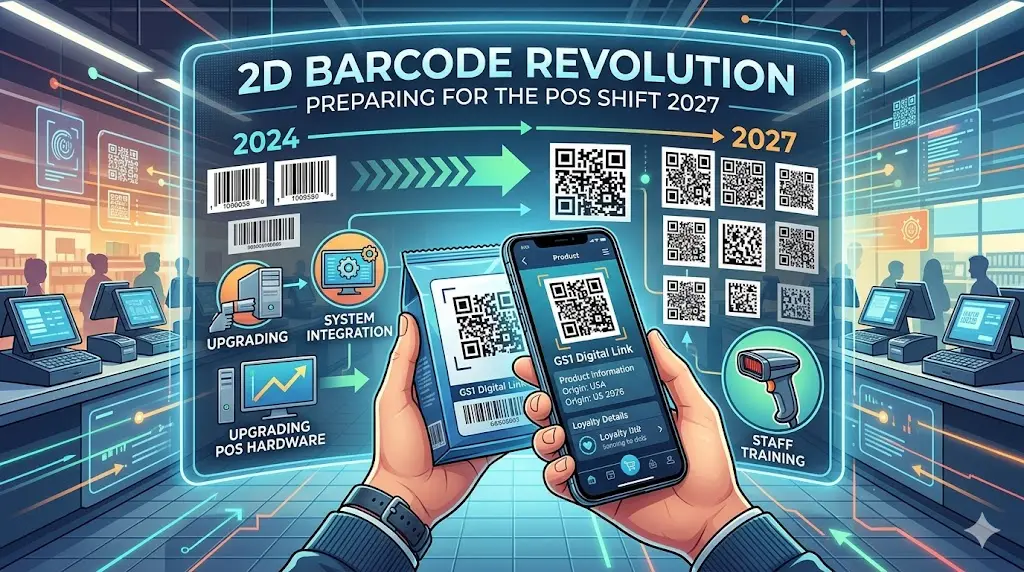
By the end of 2027, global retailers are preparing their point-of-sale (POS) environments to support 2D barcodes alongside traditional 1D codes, a milestone widely known as the 2027 global 2D barcode readiness milestone. According to GS1, this global transition is already being tested across 48 countries representing 88% of global GDP, making it one of the most important infrastructure shifts in modern retail and supply chain technology.
For brands, retailers, logistics leaders, and technology executives, this is far more than a packaging update. It is a strategic opportunity to unlock richer product data, stronger traceability, smarter recalls, better compliance, and more engaging consumer experiences.
In this advanced guide, we’ll explore what the 2D barcode revolution means, why the 2027 POS shift matters, and how organizations can prepare early to gain a competitive advantage.
Why the World Is Moving Beyond 1D Barcodes
Traditional 1D barcodes were built for one core purpose: product identification and price lookup.
That model worked perfectly in an era where retailers only needed a SKU number at checkout. But modern commerce now demands much more.
Today’s products require access to:
- expiration dates
- batch and lot numbers
- serial numbers
- country of origin
- sustainability data
- allergen and ingredient details
- recall alerts
- authenticity verification
- digital product passports
- customer engagement links
A standard UPC simply cannot store this level of intelligence.
2D barcodes, including GS1 QR codes and DataMatrix symbols, solve this challenge by storing significantly more structured data in a compact space.
This means a single code can support checkout, warehouse operations, healthcare validation, and smartphone-based consumer experiences.
That convergence is what makes this revolution so powerful.
What the 2027 POS Shift Really Means?
One of the most important clarifications for business leaders is this:
2027 is not the end of 1D barcodes. It is the readiness milestone for POS systems to scan 2D codes.
In practical terms, by the end of 2027, retailers are expected to ensure that:
- scanners can read both 1D and 2D formats
- POS software can parse GS1 application identifiers
- ERP and inventory systems can consume richer data fields
- packaging teams can support dual-marking during migration
- mobile apps and customer touchpoints can use the same code
This “dual compatibility phase” is critical because most businesses will operate with both barcode types simultaneously during the transition.
For readers, this means now is the ideal time to modernize—not wait until migration becomes urgent.

The Real Business Benefits of 2D Barcodes
The shift is not happening just because the technology is newer.
It is happening because it delivers measurable operational and commercial value.
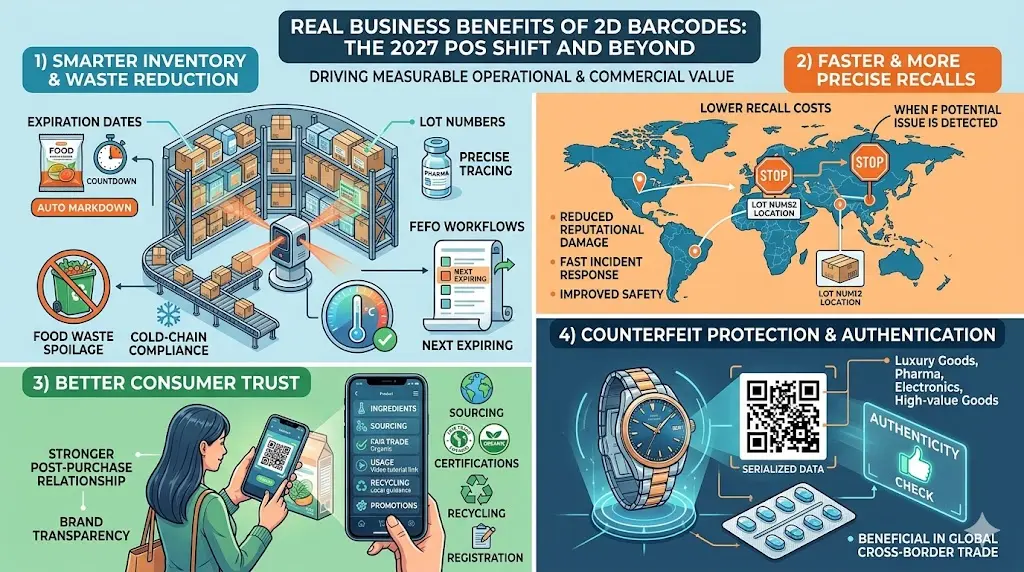
1) Smarter Inventory and Waste Reduction
Retailers can scan expiration dates and lot numbers directly from the barcode.
This enables:
- first-expiry-first-out workflows
- reduced spoilage
- automated markdowns
- better cold-chain compliance
- warehouse-level product rotation
For food, pharma, and cosmetics, this can dramatically reduce waste.
2) Faster and More Precise Recalls
Instead of recalling every unit of a product line, companies can isolate specific affected lots.
That means:
- lower recall costs
- reduced reputational damage
- faster incident response
- improved consumer safety
3) Better Consumer Trust
A shopper can scan the same code with a smartphone and instantly access:
- ingredients
- sourcing
- certifications
- usage instructions
- recycling guidance
- promotions
- product registration
This creates a stronger post-purchase relationship and improves brand transparency.
4) Counterfeit Protection and Authentication
Luxury goods, pharmaceuticals, electronics, and high-value consumer products can embed serialized data for authenticity checks.
This is especially beneficial in global cross-border trade.
How 2D Barcodes Transform the POS Experience
The point-of-sale environment is no longer just a checkout lane.
It is becoming an intelligent decision and data capture layer.
With 2D barcode support, POS systems can:
- validate age-restricted items more accurately
- detect product freshness rules
- apply location-specific pricing logic
- identify recalled batches instantly
- support automated promotions
- reduce cashier exceptions
- improve self-checkout reliability
For large retailers, this creates significant gains in throughput and operational accuracy.
For readers in retail leadership, this is where the true ROI becomes visible.
Industries That Will Benefit the Most
While retail is the headline story, the 2D barcode revolution extends much further.
Food and Grocery
Freshness, allergens, country of origin, and sustainability claims become easier to verify.
Healthcare and Pharma
Medication verification, bedside scanning, serialization, and expiry control become safer and more compliant.
Fashion and Luxury
Authentication, resale traceability, and digital ownership records become possible.
Manufacturing and Logistics
Cases, pallets, and serialized assets gain stronger end-to-end visibility.
Consumer Electronics
Warranty activation, anti-counterfeit workflows, and product support journeys improve significantly.
The Biggest Challenges Businesses Must Solve Now
The transition is exciting, but it requires serious preparation.
Key challenges include:
Legacy Scanner Hardware
Older laser scanners may not support 2D imaging.
POS Software Parsing
Systems must correctly interpret GTINs, expiry dates, lots, and additional identifiers.
Data Governance
A richer barcode is only valuable if backend product data is clean and synchronized.
Packaging Design Constraints
Teams need to balance scannability, design aesthetics, print quality, and code placement.
Cross-Channel Consistency
The same code should work across retail checkout, warehouse scanners, mobile apps, and consumer devices.
These are solvable problems—but only with early planning.
A Practical Roadmap to Prepare Before 2027
To make this guide truly beneficial, here is a strategic roadmap organizations can act on now.
Phase 1: Infrastructure Audit
Review:
- scanner fleets
- self-checkout hardware
- POS firmware
- warehouse devices
- mobile scanning apps
Phase 2: Data Model Upgrade
Ensure ERP, PIM, and product master systems can support:
- GTIN
- lot
- serial
- expiry
- origin
- sustainability attributes
Phase 3: Packaging Pilot
Start with one category such as perishables, healthcare, or premium SKUs.
Phase 4: Consumer Experience Layer
Use the same 2D barcode to power product education, support, and loyalty journeys.
Phase 5: Global Rollout Governance
Coordinate packaging, retail ops, compliance, and IT under one transformation program.
This phased approach minimizes risk while maximizing learning.
Why Early Movers Will Win
The most forward-thinking organizations are not treating Sunrise 2027 as a compliance exercise.
They see it as a digital transformation lever.
Early adopters gain:
- stronger consumer trust
- faster recalls
- lower waste
- better traceability
- richer first-party engagement
- more efficient checkout systems
- future readiness for digital product passports
By acting now, businesses can turn a standards shift into a competitive growth engine.
Final Thoughts
The 2D barcode revolution is one of the most practical and high-impact changes coming to global commerce.
What appears to be a small square on packaging is actually becoming the digital identity layer for every product.
By 2027, POS systems around the world will be expected to recognize this new reality. The organizations that prepare early will not only remain compliant—they will build smarter supply chains, better customer experiences, and more resilient retail operations.
For business leaders, the message is clear:
The future of product intelligence begins with the next scan.
And that future is arriving faster than most organizations realize.


