

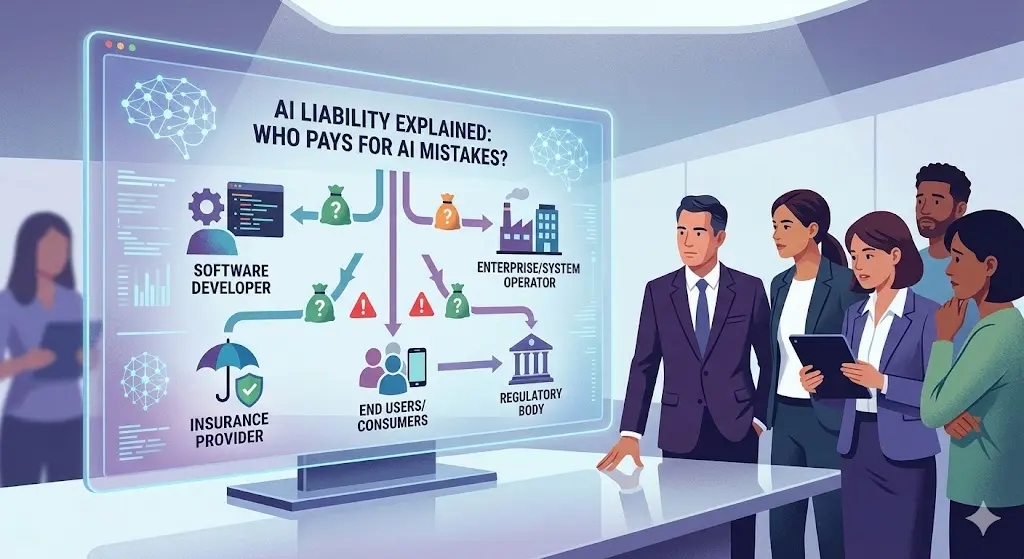
As autonomous AI agents take on increasingly complex roles—approving transactions, optimizing supply chains, managing customer interactions, and even executing financial decisions—the margin for error becomes more consequential. A $10,000 mistake may seem like a manageable loss, but it highlights a deeper structural issue: accountability in systems that act without direct human intervention.
The challenge is no longer about whether AI can make decisions—it clearly can. The real challenge is determining responsibility when those decisions go wrong.
The Shift from Tools to Decision-Makers
Traditional software operates within rigid, predictable rules. If something breaks, the cause is usually traceable to a clear input or coding flaw. Autonomous AI systems, however, behave differently. They:
- Interpret data dynamically
- Adapt based on patterns
- Make probabilistic decisions rather than deterministic ones
This means errors are not always caused by a single failure point. Instead, they often emerge from a combination of:
- Imperfect training data
- Unforeseen real-world scenarios
- Ambiguous instructions
- Complex system interactions
As a result, assigning blame becomes far more complicated than in traditional systems.

Understanding the Chain of Responsibility
When an AI agent makes a costly mistake, responsibility rarely falls on a single party. Instead, it is distributed across multiple layers.
The Deploying Organization
In most real-world scenarios, the organization using the AI system carries primary responsibility. This is because they:
- Decide to adopt the technology
- Define how it is used
- Integrate it into business processes
Legally, AI is still treated as a tool. Just as a company is responsible for errors made by its employees or internal systems, it is generally accountable for AI-driven outcomes.
However, this model is being tested as AI becomes more autonomous and less predictable.
AI Developers and Vendors
Responsibility may partially extend to developers or vendors if the issue stems from:
- Faulty model design
- Inadequate testing
- Misleading system capabilities
That said, most vendors protect themselves through contracts that:
- Limit liability
- Define acceptable usage conditions
- Transfer operational responsibility to the client
This creates a shared-responsibility environment where accountability exists—but is often difficult to enforce.
Human Oversight and Governance
A significant portion of AI-related failures can be traced back to human decisions—not at the moment of error, but during system design and deployment.
Examples include:
- Allowing full automation without review checkpoints
- Failing to monitor outputs in real time
- Ignoring known system limitations
In these cases, the issue is not just technical—it is managerial. The absence of proper oversight often shifts responsibility back to leadership and operational teams.

Ethical Responsibility Beyond Legal Liability
Even when legal responsibility is defined, ethical responsibility is broader and more complex.
AI Has No Intent—But Real Consequences
AI systems do not have intentions, awareness, or moral judgment. They cannot be held accountable in the human sense. Yet their actions can lead to financial loss, reputational damage, or even harm to individuals.
This creates a fundamental imbalance:
- Decisions are automated
- Responsibility remains human
Organizations must therefore take full ethical ownership of AI outcomes, regardless of where the technical failure occurred.
The Transparency Problem
One of the most difficult challenges in AI accountability is understanding why a decision was made.
Many advanced AI systems operate as opaque models, making it hard to:
- Trace decision logic
- Explain outcomes to stakeholders
- Identify the root cause of errors
Without transparency, accountability weakens. This is why leading organizations are investing in explainable AI, ensuring that decisions can be audited and justified.
Over-Reliance and Automation Bias
Another ethical risk is the tendency to trust AI systems too much. When systems perform well over time, users may:
- Stop questioning outputs
- Reduce manual checks
- Assume accuracy without verification
This “automation bias” can amplify the impact of errors. Ethically responsible organizations must design systems that encourage verification, not blind trust.
Financial Impact: Who Actually Pays?
In practice, when a $10K mistake occurs, the financial responsibility usually falls into predictable categories.
Organizational Absorption
Most commonly, the company absorbs the loss as part of operational risk. This is especially true when:
- The AI system was internally approved
- No contractual breach is evident
- The mistake falls within expected system limitations
Insurance Mechanisms
Some organizations are beginning to explore insurance options, such as:
- Technology errors and omissions coverage
- Cyber risk policies
However, AI-specific insurance models are still evolving and often lack clear standards.
Vendor Accountability (Limited Cases)
Vendors may be held responsible if there is clear evidence of:
- Negligence
- Misrepresentation
- Contractual violation
In reality, these cases are rare and often require extensive legal processes.
Shared Loss Models
In complex ecosystems involving multiple systems and providers, financial responsibility may be distributed. However, this typically leads to prolonged disputes rather than immediate resolution.
Designing Systems for Accountability
Rather than focusing only on liability after the fact, organizations should prioritize preventive design strategies.
Define Clear Boundaries
Not every decision should be delegated to AI. Organizations must clearly define:
- What AI can do independently
- What requires human approval
- What must remain fully manual
This reduces exposure to high-risk errors.
Implement Layered Oversight
A tiered control model helps balance efficiency and safety:
- Low-risk actions: Fully automated
- Medium-risk actions: Human review required
- High-risk actions: Strict approval processes
This ensures that oversight matches the level of potential impact.
Maintain Decision Traceability
Every AI-driven action should be logged and traceable, including:
- Input data
- Decision parameters
- Final outcomes
This is essential for both accountability and continuous improvement.
Introduce Fail-Safe Controls
Systems should include built-in safeguards such as:
- Spending limits
- Transaction thresholds
- Automatic shutdown triggers
These mechanisms act as protective barriers against large-scale errors.
Strengthen Vendor Agreements
Organizations must ensure that contracts clearly define:
- Responsibility boundaries
- Performance expectations
- Transparency requirements
Legal clarity reduces ambiguity when issues arise.
The Road Ahead: Evolving Standards and Regulations
As AI adoption accelerates, regulatory frameworks are beginning to take shape. Future developments may include:
- Standardized AI accountability guidelines
- Mandatory auditability requirements
- Industry-specific liability rules
There is also ongoing debate about whether highly autonomous systems should have a distinct legal classification, though this concept is still in early discussion stages.
Final Thoughts
A $10,000 mistake made by an autonomous AI agent is not just a financial inconvenience—it is a signal of a deeper shift in how decisions are made and managed.
The key reality is this: AI does not eliminate responsibility—it redistributes it across systems, teams, and organizations.
Success in this new environment depends on preparation, not perfection. Organizations must:
- Anticipate failure scenarios
- Build systems with accountability in mind
- Maintain human oversight where it matters most
Ultimately, the question is not just who pays for the mistake—but who designed the system that allowed it to happen.
