


Introduction
In today’s rapidly evolving digital landscape, businesses are under pressure to deliver seamless, personalized experiences across websites, mobile apps, social media, and IoT devices. To meet these demands, modern web development has moved beyond traditional monolithic systems toward more flexible, scalable architectures. Two terms frequently come up in these discussions — headless and composable architectures.
Yet, despite their prevalence, these concepts are often misunderstood, even among executives and developers. Are they the same? Can you use one without the other? Understanding the distinction is critical for making informed technology decisions, planning digital transformation, and ensuring long-term agility. This article demystifies both concepts, compares them, and provides real-world examples to clarify when and why each architecture is beneficial.
What is Headless Architecture?
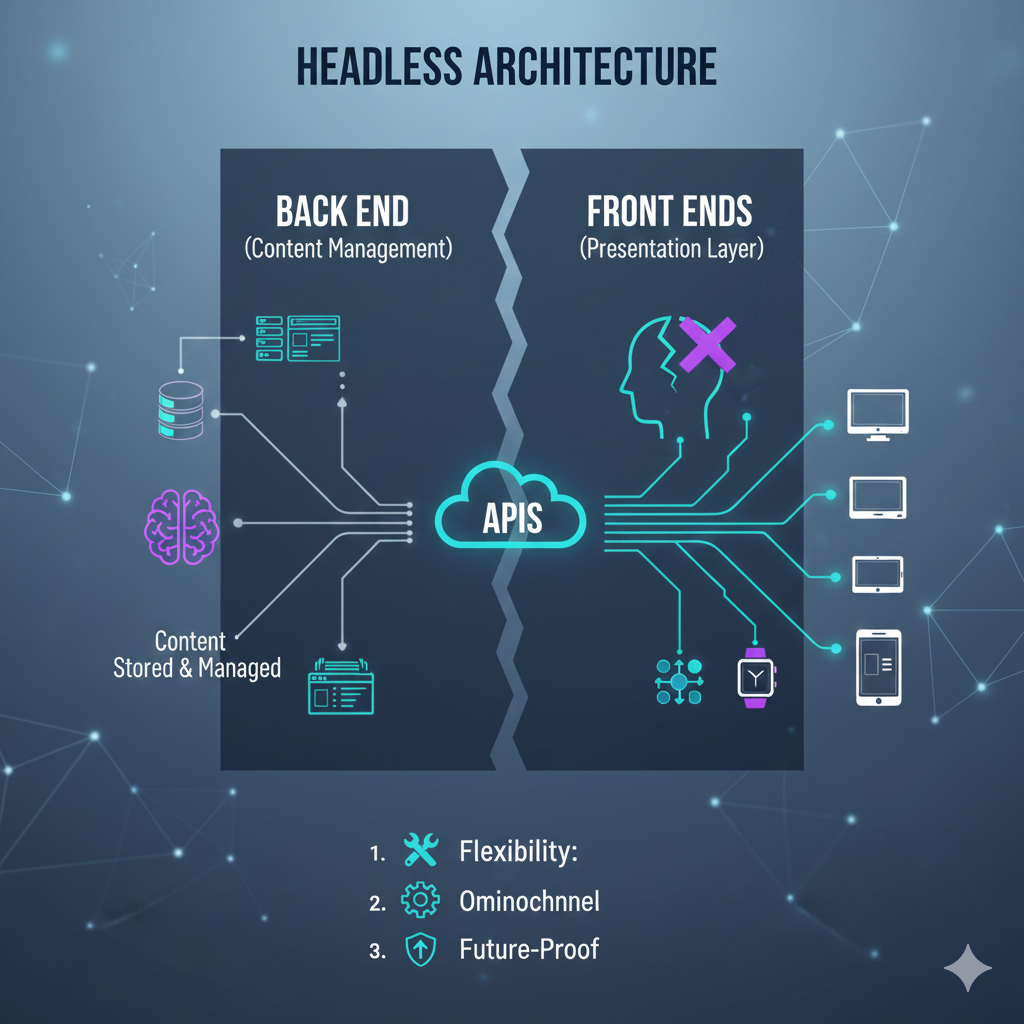
Headless architecture is a modern approach to content management and digital delivery that separates the “front end” (what users see) from the “back end” (where content is stored, managed, and processed). In simpler terms, it removes the “head” — the presentation layer — from traditional content systems.
Key Characteristics of Headless Architecture
Decoupled Front End and Back End: Content is managed in a back-end system and delivered via APIs to any front-end channel — websites, mobile apps, kiosks, or IoT devices.
API-First Approach: All content and functionality are exposed through APIs, making integration with other systems seamless.
Flexibility in Front-End Technology: Developers can use any programming language, framework, or platform to build the front end, independent of the back-end system.
Benefits for Businesses and Developers
Faster Time-to-Market: Front-end teams can work independently from back-end teams, speeding up development cycles.
Omnichannel Delivery: Businesses can deliver consistent content across multiple platforms without duplicating efforts.
Future-Proofing: New technologies and devices can be integrated without overhauling the entire system.
Examples of Headless Systems
Contentful: A popular headless CMS that allows content delivery to websites, mobile apps, and digital kiosks.
Shopify Plus (Headless Mode): E-commerce back-end can power multiple front-end storefronts with custom designs.
Strapi: Open-source headless CMS enabling developers to deliver content through APIs to any front-end application.
In essence, headless architecture is about flexibility and separation. It empowers teams to deliver content and experiences without being tied to a particular presentation layer.
What is Composable Architecture?
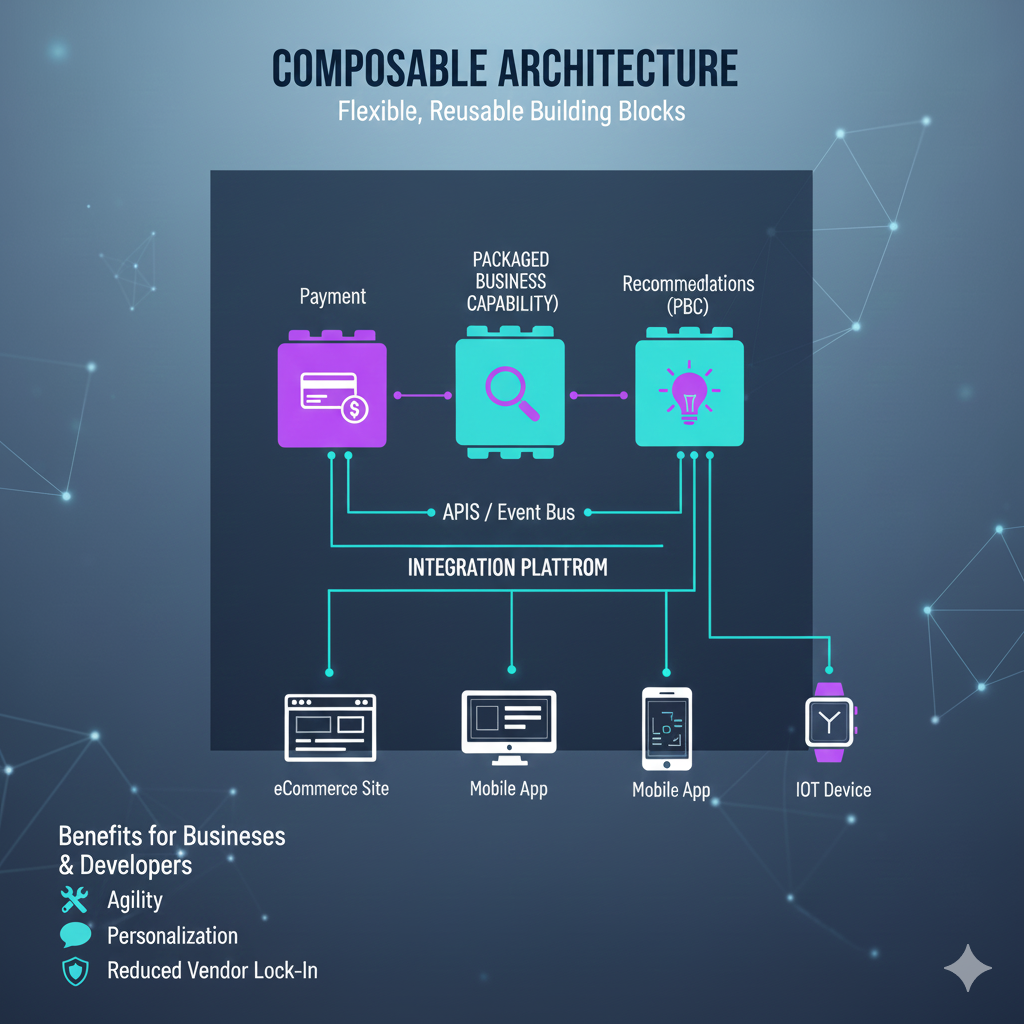
While headless focuses on decoupling the front end from the back end, composable architecture takes modularity a step further by breaking the entire digital ecosystem into discrete, interchangeable components. These components, sometimes called packaged business capabilities (PBCs), can be combined and recombined to build new digital experiences quickly.
Key Characteristics of Composable Architecture
Modularity: Each component (e.g., payment processing, search, product recommendations) functions independently but can integrate seamlessly with others.
Interoperability: Components communicate through APIs, event-driven systems, or integration platforms, allowing diverse technologies to work together.
Scalability: Components can be upgraded, replaced, or scaled individually without disrupting the rest of the system.
Benefits for Businesses and Developers
Agility: Teams can add or replace features without rebuilding the system from scratch.
Personalization: Businesses can create tailored experiences by combining different modules.
Reduced Vendor Lock-In: Organizations can mix and match best-of-breed solutions rather than relying on a single monolithic platform.
Examples of Composable Systems
CommerceTools: A composable commerce platform where businesses can integrate various microservices for checkout, inventory, and pricing.
Elastic Path: Offers modular e-commerce and experience components that can be orchestrated as needed.
SAP Commerce Cloud with Composable Add-Ons: Businesses can selectively deploy specific modules, like promotions or loyalty programs, without affecting the core system.
Composable architecture is essentially about flexible, reusable building blocks that allow organizations to assemble digital experiences faster and adapt to changing customer demands.
Headless vs. Composable: Key Differences
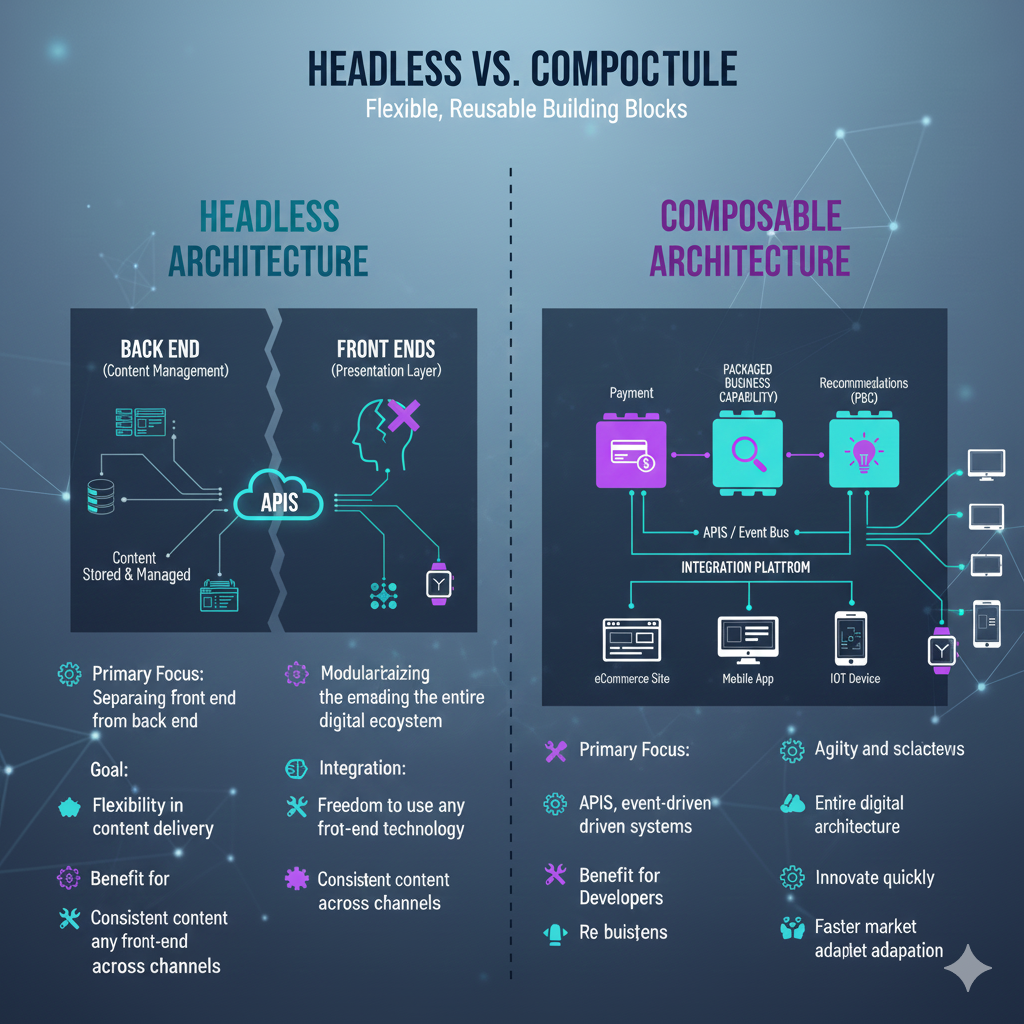
While headless and composable architectures are related, they serve different purposes. Here’s a side-by-side comparison:
| Feature | Headless | Composable |
|---|---|---|
| Primary Focus | Separating front end from back end | Modularizing the entire digital ecosystem |
| Goal | Flexibility in content delivery | Agility and scalability through interchangeable components |
| Integration | API-first to deliver content | APIs, event-driven systems, or integration platforms for multiple modules |
| Scope | Limited to content or commerce systems | Entire digital architecture, including e-commerce, CMS, CRM, analytics, and more |
| Use Case | Omnichannel content delivery | Rapid assembly of new experiences, experimentation, personalization |
| Complexity | Medium — mainly back-end decoupling | High — managing multiple modules, dependencies, and integrations |
| Benefit for Developers | Freedom to use any front-end technology | Ability to innovate quickly using modular components |
| Benefit for Business | Consistent content across channels | Faster market adaptation and reduced vendor lock-in |
Scenario Example:
If a retail company only wants to deliver content to a website, mobile app, and digital kiosk, headless CMS is sufficient.
If the same company wants a fully integrated system where loyalty programs, personalized recommendations, promotions, and analytics can be swapped or upgraded independently, composable architecture is the better choice.
Real-World Use Cases
Headless Architecture
E-commerce Retailers: A fashion retailer uses a headless CMS to manage content across its website, mobile app, and digital signage, ensuring consistency and real-time updates without redesigning the front end.
Media & Publishing: News organizations deliver articles, videos, and interactive content across web, mobile, and smart devices, all powered by a single headless CMS.
Composable Architecture
Global Retail Chains: A retailer integrates separate modules for e-commerce, customer loyalty, inventory management, and AI-driven recommendations, allowing each component to evolve independently.
Financial Services: Banks use composable architecture to integrate payment processing, fraud detection, and customer support modules, quickly adapting to regulatory changes or new offerings.
Conclusion
Understanding the distinction between headless and composable architectures is essential for executives and developers making strategic technology decisions.
Headless architecture focuses on decoupling content delivery from presentation, offering flexibility and consistency across channels.
Composable architecture builds on modularity to enable full system agility, allowing businesses to experiment, personalize, and scale rapidly.
Choosing the right approach depends on business needs. A headless system may suffice for content-driven applications, while a composable system is ideal for organizations requiring agility, modularity, and rapid innovation.
By clearly differentiating these terms, companies can make informed decisions, align technology with business goals, and deliver superior digital experiences — avoiding confusion and costly mistakes in today’s fast-paced digital landscape.

1 Comment
Pingback: Ask the Expert: Answering Reader Questions on Headless Migration Costs - futureecommerce.online