
E-commerce is undergoing a structural transformation. What began as digital storefronts—essentially online versions of physical shops—has evolved into complex, data-rich environments. By 2027, this evolution will reach a new phase: intent-driven service ecosystems.
In this model, the focus shifts from selling products to understanding and fulfilling customer intent in real time. The transaction becomes secondary. The experience, prediction, and orchestration of needs become primary.
This is not a surface-level trend—it represents a fundamental redesign of how commerce operates.
The Decline of the Traditional Storefront Model
The classic e-commerce model is built around discovery:
- Customers browse
- Compare products
- Add to cart
- Complete checkout
While effective, this model assumes that customers know what they want and are willing to spend time finding it.
In 2027, this assumption no longer holds.
Consumers now expect:
- Immediate relevance
- Minimal friction
- Personalized recommendations
- Seamless experiences across channels
The traditional storefront—static product listings and category pages—cannot meet these expectations alone. It is reactive, while modern commerce demands proactivity.
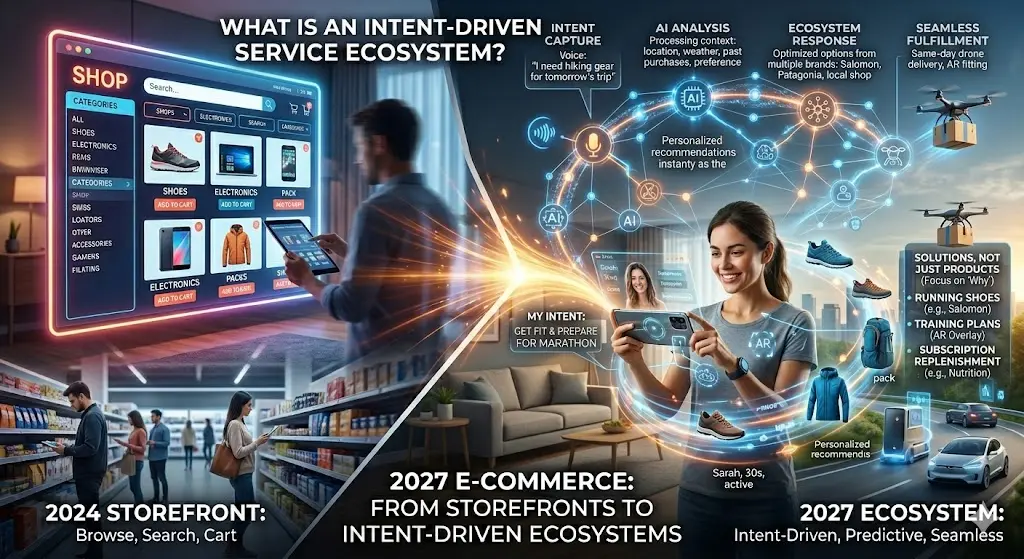
What Is an Intent-Driven Service Ecosystem?
An intent-driven ecosystem is designed to identify, predict, and act on customer needs—often before they are explicitly expressed.
Instead of waiting for a search query, the system:
- Interprets behavioral signals
- Analyzes historical data
- Integrates contextual factors (location, timing, preferences)
- Delivers solutions, not just products
For example, rather than showing a list of running shoes, an intent-driven system might:
- Recommend a complete fitness setup
- Suggest training plans
- Offer subscription-based replenishment for gear or nutrition
The focus shifts from what is being sold to why the customer needs it.
The Core Pillars of Intent-Driven Commerce
To build this model, organizations must integrate several advanced capabilities.
1. Real-Time Intent Detection
Intent is dynamic. It changes based on context, behavior, and external factors.
Modern systems use:
- Behavioral analytics
- AI-driven pattern recognition
- Cross-channel data integration
to continuously interpret what a customer is trying to achieve.
This goes beyond simple personalization. It is about predictive understanding.
2. Service Layer Integration
Products alone are no longer sufficient. Customers expect bundled solutions.
This requires integrating:
- Services (installation, support, subscriptions)
- Content (guides, tutorials, recommendations)
- Third-party offerings (partners, marketplaces)
The result is a service ecosystem where multiple elements work together to fulfill a single intent.
3. Composable Commerce Architecture
Rigid platforms cannot support dynamic ecosystems. Organizations are moving toward composable architectures that allow:
- Modular services
- API-driven integrations
- Rapid experimentation
This flexibility is essential for adapting to changing customer needs.
4. Continuous Experience Orchestration
In an intent-driven model, the customer journey is not linear. It is fluid and ongoing.
Orchestration involves:
- Delivering the right message at the right time
- Coordinating across channels (web, mobile, voice, in-store)
- Adjusting experiences in real time
The goal is to create a cohesive, adaptive journey rather than isolated interactions.

From Transactions to Relationships
One of the most important shifts in 2027 is the move from one-time transactions to ongoing relationships.
In traditional e-commerce:
- Success is measured by conversion rates
In intent-driven ecosystems:
- Success is measured by lifetime value and engagement
This requires:
- Subscription models
- Proactive support
- Continuous value delivery
Customers are no longer just buyers—they are participants in an ongoing service relationship.
The Role of AI and Automation
AI is the engine behind intent-driven commerce. It enables:
- Real-time decision-making
- Predictive recommendations
- Dynamic pricing and offers
However, the real value of AI lies not in automation alone, but in contextual intelligence—understanding the “why” behind customer actions.
Organizations that use AI merely to optimize existing processes will fall behind. Those that use it to redefine experiences will lead.
Data as the Foundation
Intent-driven ecosystems rely heavily on data—but not just volume. The key is data integration and quality.
Critical data sources include:
- Behavioral data (clicks, navigation patterns)
- Transactional data (purchase history)
- Contextual data (time, location, device)
- External data (market trends, environmental factors)
The challenge is not collecting data—it is connecting it in meaningful ways.
Ethical Considerations and Trust
As systems become more predictive, ethical concerns become more significant.
Customers may question:
- How their data is being used
- Whether recommendations are manipulative
- How much autonomy they retain
Trust becomes a competitive advantage.
Organizations must prioritize:
- Transparency in data usage
- Clear value exchange
- User control over personalization
Operational Implications for Businesses
Transitioning to an intent-driven ecosystem is not just a technology upgrade—it is an organizational transformation.
Cross-Functional Alignment
Marketing, IT, product, and operations must work together. Silos cannot support integrated experiences.
New Skill Sets
Teams need expertise in:
- Data science
- Experience design
- AI governance
- Ecosystem management
Agile Execution Models
Organizations must adopt iterative approaches, allowing them to:
- Test new services quickly
- Learn from user behavior
- Scale successful initiatives
Practical Steps to Begin the Transition
For organizations preparing for 2027, the shift can start with focused actions:
1. Map Customer Intent Journeys
Identify the underlying goals behind customer interactions.
2. Expand Beyond Products
Introduce services, content, and partnerships that enhance value.
3. Invest in Data Integration
Break down silos and create a unified view of the customer.
4. Adopt Modular Technologies
Move toward flexible systems that support rapid change.
5. Prioritize Trust and Transparency
Build systems that respect user preferences and privacy.
The Competitive Advantage of Intent-Driven Ecosystems
Organizations that successfully make this transition will gain:
- Higher customer loyalty
- Increased lifetime value
- Stronger differentiation in crowded markets
- Greater adaptability to future trends
Most importantly, they will move from reacting to customer actions to shaping customer experiences.
Final Thoughts
The future of e-commerce is not about better storefronts—it is about invisible, intelligent systems that anticipate and fulfill needs seamlessly.
By 2027, the most successful companies will not think of themselves as retailers. They will operate as service ecosystems, designed around customer intent rather than product catalogs.
This shift requires new technology, new thinking, and a deep commitment to understanding people—not just as buyers, but as individuals with evolving needs.
In this new era, the question is no longer “What are we selling?” but “What problem are we solving, and how can we solve it before it is even asked?”
