

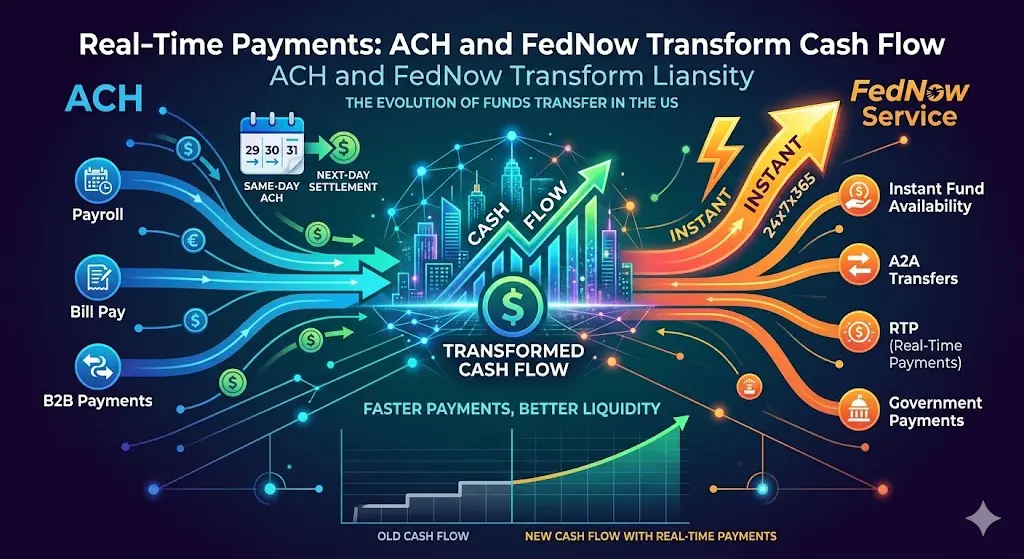
In modern finance, speed has long been an illusion.
A payment could be initiated in seconds, confirmed on-screen instantly, and even reflected as “pending” in a dashboard—yet the actual business confidence behind those funds often lagged by days, and in many workflows, by weeks. For treasury teams, lenders, payroll providers, and marketplaces, the visible transfer was never the full story. The real question was always:
When is the money truly safe to act on?
That distinction has defined operational finance for decades.
Now, the rise of FedNow, real-time payment infrastructure, and faster bank-to-bank orchestration is reshaping that assumption. What once required delayed release schedules, reserve buffers, settlement aging, and risk windows is evolving into something fundamentally different:
cash finality at the speed of software.
This is not simply a payments upgrade. It is a structural redesign of how businesses think about liquidity, trust, and financial execution.
The Old Settlement Mindset: Why Businesses Learned to Wait
Legacy ACH workflows trained companies to separate payment movement from payment confidence.
The transfer might begin today, but finance teams often built downstream actions around delayed certainty:
- waiting before shipping high-value goods
- delaying seller payouts
- holding loan proceeds
- postponing service activation
- reserving marketplace balances
- aging customer refunds
This delay culture was not caused by inefficiency alone. It was created by the gap between technical transmission and practical finality.
In many organizations, the “30-day wait” became less of a literal network timeline and more of an operational trust horizon. Businesses needed time to absorb return risks, fraud exposure, disputes, reversals, compliance checks, and internal reconciliation.
As a result, cash existed in a strange in-between state:
- digitally moved
- visually acknowledged
- operationally restricted
That uncertainty shaped finance architecture across industries.
FedNow Ends the Era of Settlement Ambiguity
FedNow changes the equation because it introduces a model built around instant clearing and immediate final settlement.
The significance is not just that funds move faster.
The real breakthrough is that the waiting layer disappears.
Once the transaction is accepted, the receiving institution has immediate usable funds. That eliminates the gray zone where businesses historically asked:
- Should we release the payout yet?
- Can we recognize this revenue?
- Is this safe enough for instant service?
- Do we need a reserve period?
With real-time settlement, those questions increasingly shift from post-payment caution to pre-payment intelligence.
This creates a new financial reality:
the transaction itself becomes the decision point.
That is a profound shift in systems design.
Why the “30-Day Wait” Was Really About Risk, Not Time
The most important insight in this transformation is that long settlement windows were rarely about the payment rail alone.
They were about institutional risk psychology.
Many companies created long internal hold periods because delayed certainty gave them room to manage:
- fraud investigation cycles
- merchant risk
- consumer disputes
- failed debits
- unauthorized activity
- operational errors
- compliance reviews
The time buffer acted as a safety valve.
FedNow and real-time bank rails reduce the need for these artificial waiting periods by making settlement finality immediate. But this does not eliminate risk.
Instead, it moves risk management earlier in the transaction lifecycle.
That means the real innovation is not just faster rails. It is better decisioning before the money moves.
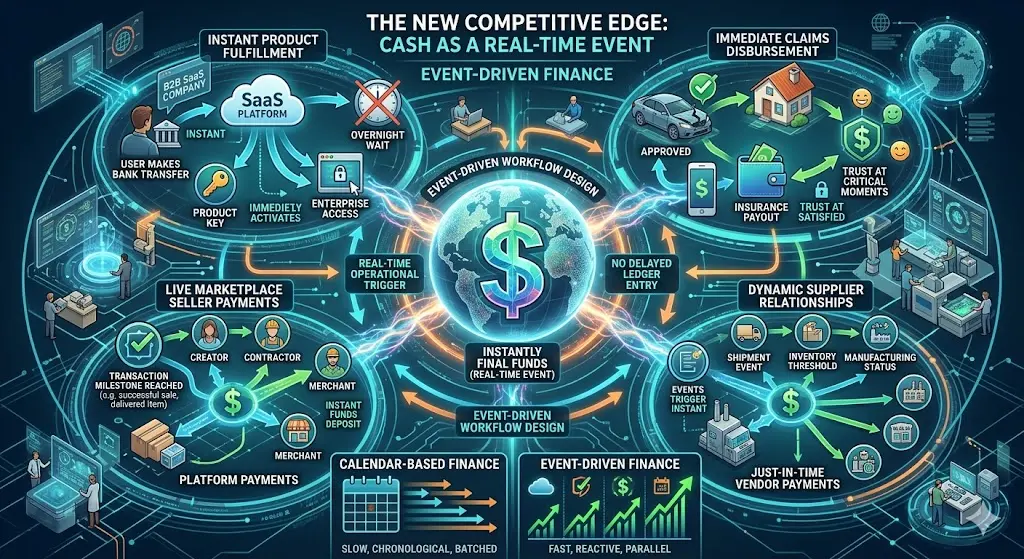
The New Competitive Edge: Cash as a Real-Time Event
When money becomes immediately final, cash stops behaving like a delayed ledger entry and starts behaving like a real-time operational trigger.
This changes how businesses design workflows.
Instant Product Fulfillment
A B2B SaaS company no longer needs to wait overnight after bank transfer confirmation before activating enterprise access.
Immediate Claims Disbursement
Insurance payouts can be released the moment a claim is approved, improving trust at emotionally critical moments.
Live Marketplace Seller Payments
Platforms can pay creators, contractors, or merchants instantly after a transaction milestone is reached.
Dynamic Supplier Relationships
Procurement teams can trigger just-in-time vendor payments tied to shipment events, inventory thresholds, or manufacturing status.
The result is a shift from calendar-based finance to event-driven finance.
Treasury Strategy Changes Completely
For CFOs and treasury leaders, the move toward real-time settlement introduces a powerful new operating model.
Historically, liquidity planning revolved around:
- batch release times
- end-of-day files
- next-business-day assumptions
- weekend blind spots
- holiday delays
- manual exception queues
With real-time rails, liquidity becomes continuous instead of periodic.
That means treasury can increasingly optimize:
- intraday cash positioning
- real-time working capital decisions
- short-duration borrowing exposure
- vendor discount timing
- cash concentration logic
- dynamic sweep strategies
This is where the business value compounds.
Faster settlement is not merely about convenience. It improves capital efficiency.
Product Innovation Becomes Easier
One of the most exciting outcomes of FedNow-era infrastructure is what it enables for fintech and platform product teams.
When funds are final immediately, product experiences can be redesigned around financial certainty as a feature.
This opens doors for:
- instant payroll disbursement
- real-time escrow release
- automated invoice settlement
- on-demand earned wage access
- immediate merchant onboarding
- instant refunds to bank accounts
- usage-based service unlocking
- real-time cross-platform revenue sharing
In other words, faster payments stop being a back-office capability and become a front-end experience differentiator.
Users no longer just value speed.
They value confidence without waiting.
ACH Still Matters—But Its Role Evolves
This transformation does not make ACH obsolete.
ACH remains highly effective for:
- payroll at scale
- subscriptions
- recurring invoices
- predictable vendor payments
- scheduled treasury movements
- low-cost bulk disbursements
Its strength is efficiency and reach.
What changes is the strategic division of labor between rails.
ACH becomes best for:
- planned
- recurring
- cost-sensitive
- non-urgent flows
FedNow becomes best for:
- instant certainty
- critical disbursements
- customer experience moments
- urgent supplier needs
- trust-sensitive payouts
The future is not one rail replacing another.
It is intelligent payment rail orchestration based on business intent.
The Bigger Industry Shift: Time Is Becoming a Trust Metric
The most advanced way to understand this evolution is through customer psychology.
In digital business, users increasingly interpret delay as risk.
If a payout takes days, customers question reliability.
If a refund is slow, trust erodes.
If a supplier payment misses a production window, relationships weaken.
Real-time settlement changes perception because speed signals confidence.
The faster the funds become final, the stronger the business appears operationally.
This is why FedNow is more than infrastructure.
It is becoming part of brand trust architecture.
Final Thoughts
The end of the 30-day settlement wait is really the end of a much older business habit:
designing around uncertainty.
Real-time ACH ecosystems, FedNow, and instant bank rails are pushing finance into a world where money movement, settlement confidence, and business action can happen in the same moment.
That collapses layers of friction that once felt unavoidable.
The winners in this new era will not simply move money faster.
They will redesign:
- treasury logic
- payout systems
- customer promises
- risk workflows
- product experiences
- liquidity strategy
around the idea that cash certainty is now immediate.
And when settlement no longer requires waiting, businesses gain something far more valuable than speed:
they gain the ability to operate in real time.
