

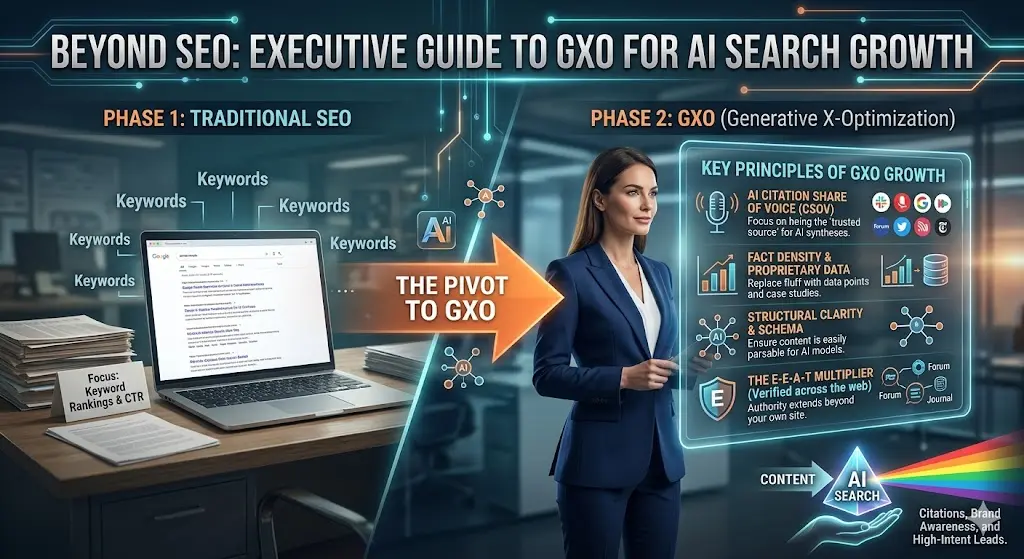
For more than two decades, search engine optimization (SEO) has been the cornerstone of digital visibility. Brands invested heavily in rankings, backlinks, keyword clusters, and technical performance to capture attention on traditional search engines. But the way people discover information is changing rapidly.
Today, decision-makers, consumers, and enterprise buyers increasingly rely on AI-powered assistants, conversational interfaces, and generative search experiences to answer questions, compare products, and make purchasing decisions. Instead of scrolling through ten blue links, users now expect direct, context-aware, personalized answers.
This shift has created a new strategic discipline: Generative Experience Optimization (GXO).
For executives, GXO is not simply “SEO with AI.” It is a broader business framework focused on ensuring that your brand, expertise, products, and trust signals are accurately represented inside AI-generated experiences.
In this guide, we’ll explore what GXO means, why it matters at the leadership level, and how organizations can build a sustainable competitive advantage beyond traditional search.
What Is GXO (Generative Experience Optimization)?
Generative Experience Optimization is the practice of optimizing your digital presence so AI systems can:
- Understand your brand accurately
- Retrieve reliable information about your business
- Reference your expertise in relevant responses
- Recommend your products or services in the right contexts
- Preserve your authority across conversational journeys
Unlike SEO, which focuses on ranking webpages, GXO focuses on influence within AI-generated answers, summaries, assistants, copilots, and discovery systems.
This includes platforms such as:
- AI search assistants
- Enterprise copilots
- Voice interfaces
- Smart recommendation engines
- AI-powered customer support systems
- Generative shopping and product discovery tools
The goal is not just visibility. The goal is inclusion, accuracy, trust, and preference inside AI-mediated decision flows.
Why GXO Matters to Executives
At the executive level, GXO impacts far more than traffic.
It directly affects:
1) Brand Narrative Control
AI systems summarize your company based on the digital signals they can access. If those signals are fragmented, outdated, or inconsistent, the generated narrative may misrepresent your value proposition.
GXO helps leadership teams shape how the market understands the business in AI-first environments.
2) Revenue Influence
Buyers increasingly use AI to shortlist vendors, compare solutions, and validate decisions. If your organization is absent from those recommendation layers, you may lose pipeline before prospects ever visit your website.
3) Trust and Risk Management
Executives must think beyond discoverability. Inaccurate AI summaries can create reputational, legal, and compliance risks.
A strong GXO strategy improves factual consistency, source authority, and controlled messaging.
4) Competitive Positioning
In many industries, the companies that become the “default answer” in AI interfaces will own disproportionate market share.
GXO is quickly becoming a board-level visibility and growth issue.
SEO vs. GXO: The Strategic Difference
While SEO and GXO overlap, they serve different user behaviors.
| SEO | GXO |
|---|---|
| Optimizes webpages for ranking | Optimizes knowledge for AI retrieval and synthesis |
| Focuses on clicks and SERP visibility | Focuses on mentions, citations, summaries, and recommendations |
| Keyword-driven | Intent, context, and semantic trust-driven |
| Traffic-centric | Decision-journey-centric |
| Page authority | Entity authority |
The executive takeaway: SEO drives discoverability, GXO drives decision influence.
The strongest brands will invest in both.
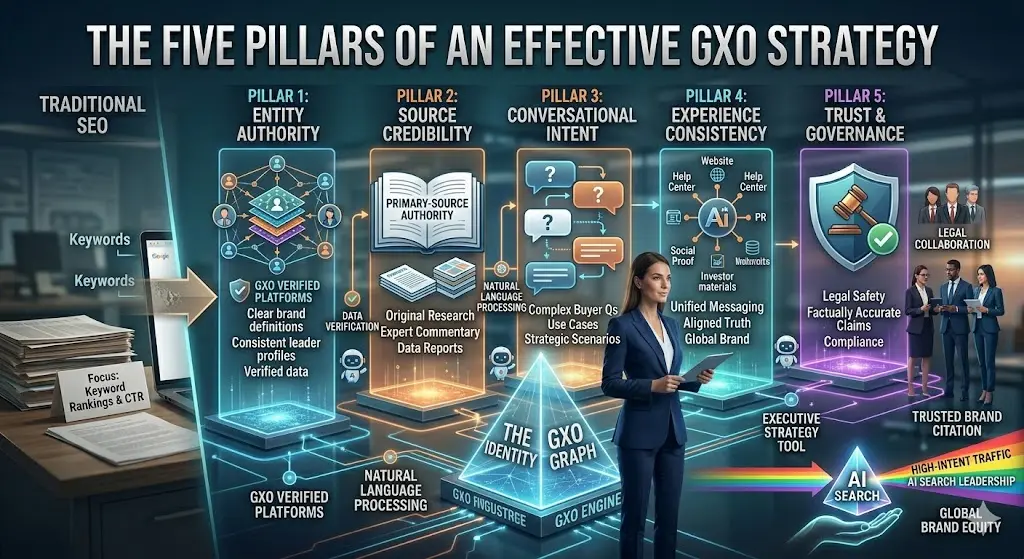
The Five Pillars of an Effective GXO Strategy
1. Entity Authority
AI systems work best when your brand is clearly recognized as an entity.
That means your business should maintain:
- Consistent company descriptions
- Structured brand data
- Unified product naming conventions
- Clear executive leadership profiles
- Verified business information across authoritative platforms
The more consistent your identity graph, the easier it is for AI systems to represent you correctly.
2. Source Credibility
Generative systems prioritize trustworthy and corroborated sources.
Executives should ensure their organizations publish:
- Original research
- Data-backed reports
- Expert commentary
- Whitepapers
- Case studies
- Industry benchmark studies
Primary-source authority is a major GXO advantage.
3. Conversational Intent Coverage
Traditional keyword coverage is no longer enough.
Your content ecosystem must address:
- Questions buyers ask
- Comparison scenarios
- Objection-handling conversations
- Strategic use cases
- Industry-specific workflows
- Executive-level decision criteria
The content must mirror how users naturally ask AI systems for help.
4. Experience Consistency
AI-generated answers often synthesize signals from multiple locations.
That means your:
- Website
- Help center
- Investor materials
- Product documentation
- PR mentions
- Leadership interviews
- Social proof
…must align around the same truth.
5. Trust, Governance, and Legal Safety
A legally safe GXO strategy prioritizes:
- Factually accurate claims
- Verifiable performance statements
- Clear attribution of statistics
- Transparent product positioning
- Responsible use of testimonials
- Up-to-date compliance messaging
This is where legal, marketing, and communications teams must collaborate.
How GXO Changes the Buyer Journey
The classic funnel is evolving.
Instead of:
Search → Website → Sales conversation → Decision
The modern journey increasingly looks like:
AI question → Generated shortlist → Validation → Human interaction → Decision
That means your brand may be judged before the first click.
Executives need to measure influence at the pre-click intelligence layer, where AI shapes perception early.
This is the true strategic value of GXO.
Key Metrics Executives Should Track
To operationalize GXO, leadership teams should monitor metrics beyond traffic.
Important KPIs include:
- Brand mention frequency in AI-generated responses
- Accuracy rate of AI summaries about your company
- Share of voice across AI assistants
- Inclusion in AI-generated vendor comparisons
- Sentiment consistency in AI responses
- Citation frequency from authoritative sources
- Conversion lift from AI-assisted discovery
These metrics help connect GXO directly to pipeline and brand equity.
Organizational Readiness: Who Owns GXO?
GXO is inherently cross-functional.
The most effective ownership model includes:
- Marketing: narrative architecture and content systems
- SEO/Content teams: semantic structure and discoverability
- PR/Communications: authority and external trust signals
- Legal/Compliance: claim validation and risk control
- Product teams: documentation clarity and use-case depth
- Sales enablement: buyer-question intelligence
- Executive leadership: strategic alignment and investment
Treating GXO as a siloed content initiative is a mistake.
It should be part of your broader digital growth and trust strategy.
Common Executive Mistakes to Avoid
Many organizations approach GXO too tactically.
Avoid these common errors:
Treating AI visibility like keyword stuffing
AI systems reward clarity and authority, not repetitive phrasing.
Ignoring brand consistency
Conflicting messaging across channels weakens retrieval confidence.
Publishing generic AI-written content at scale
Low-value content reduces authority and can damage trust.
Overlooking legal review
Unsupported claims can create compliance exposure when amplified by AI.
Measuring only traffic
Influence inside AI responses often happens before the visit.
The Future: From Search Optimization to Decision Optimization
The future of digital growth is moving from search visibility to decision visibility.
Executives who embrace GXO early will be better positioned to:
- Shape AI-mediated market perception
- Improve category leadership
- Increase recommendation likelihood
- Reduce misinformation risk
- Strengthen trust at scale
- Accelerate high-intent buyer journeys
The organizations that win in the next decade will not simply rank higher.
They will become the most trusted answer inside intelligent systems.
That is the strategic promise of GXO.
Final Thoughts
SEO is still important, but it is no longer sufficient on its own.
As AI transforms discovery, comparison, and decision-making, executives must evolve from optimizing pages to optimizing brand intelligence ecosystems.
Generative Experience Optimization is the next frontier of digital authority.
The question for leadership is no longer, “How do we rank?”
It is now:
“How do we become the preferred answer wherever AI helps customers decide?”
That is the mindset shift that moves organizations beyond SEO—and into sustainable, AI-era growth.
