
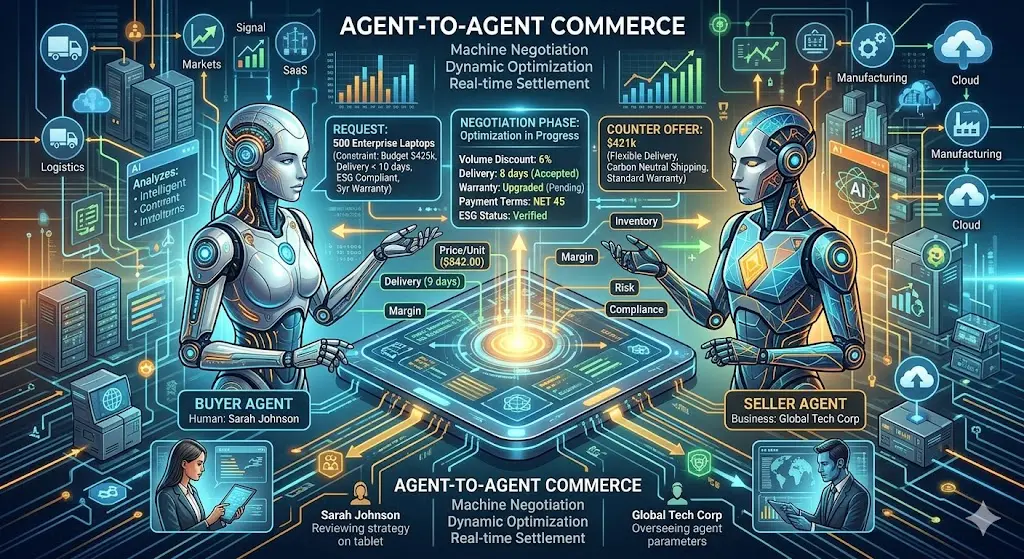
In the next phase of digital commerce, the most important conversations may no longer happen between humans clicking buttons—they may happen between autonomous agents acting on behalf of humans and businesses. This emerging model, often described as Agent-to-Agent (A2A) Commerce, represents a shift from traditional e-commerce workflows toward intelligent, real-time negotiation systems where a seller’s AI agent and a buyer’s AI agent communicate, evaluate trade-offs, and close deals with minimal friction.
Imagine a world where your procurement assistant doesn’t just search for products—it negotiates volume discounts, validates delivery windows, checks ESG compliance, compares warranty clauses, and finalizes terms with the seller’s revenue optimization agent in seconds. That is the promise of A2A commerce.
This evolution is bigger than chatbot shopping or recommendation engines. It changes how demand meets supply, how pricing becomes fluid, and how trust is operationalized between software entities.
What Is A2A Commerce?
A2A commerce is a transaction model in which software agents represent each side of a commercial exchange.
- The buyer agent represents the customer, enterprise procurement team, or end consumer.
- The seller agent represents the merchant, marketplace, supplier, or manufacturer.
Rather than simply retrieving catalog data, both agents actively reason, negotiate, and optimize outcomes based on predefined goals, live market conditions, policies, and contextual constraints.
This means the conversation can move far beyond:
“Here is the price. Would you like to buy?”
Instead, the interaction becomes:
- Can the seller reduce price if shipping is flexible?
- Can the buyer accept a substitute SKU with faster fulfillment?
- Is bundling economically superior?
- Does the contract require service-level guarantees?
- Can payment terms be extended in exchange for higher order volume?
The result is not a static checkout flow, but a dynamic machine-negotiated transaction layer.
Why This Matters Now
Three forces are accelerating A2A commerce:
1) Mature LLM and reasoning systems
Modern AI systems can interpret intent, constraints, and ambiguous commercial goals. They can translate business objectives into negotiation strategies.
2) API-native commerce infrastructure
Inventory, pricing, shipping, taxation, identity, and contract systems are increasingly accessible through APIs, giving agents direct execution capability.
3) Real-time market volatility
In sectors such as B2B wholesale, logistics, cloud services, travel, and digital advertising, pricing changes rapidly. Human-led negotiation simply cannot keep pace at scale.
A2A systems thrive in these environments because they can continuously renegotiate based on new signals.

How Seller and Buyer Agents Actually Negotiate
The most advanced implementations follow a multi-stage negotiation architecture.
1. Intent Discovery
The buyer agent starts by defining the true objective, not merely the requested item.
For example, instead of “buy 500 laptops,” the deeper objective may be:
- budget cap: $450,000
- delivery within 10 days
- minimum 3-year warranty
- approved vendor list only
- carbon-neutral shipping preferred
This matters because sophisticated seller agents optimize against business outcomes, not literal keywords.
2. Constraint Matching
The seller agent maps the request against:
- live inventory
- substitute availability
- margin thresholds
- regional warehouse capacity
- demand forecasts
- customer lifetime value
- promotion logic
At this stage, the seller agent may proactively surface a better commercial structure than the original request.
3. Autonomous Negotiation
This is where A2A commerce becomes transformative.
The buyer agent may say:
“Delivery can slip by 3 days if unit cost drops 8%.”
The seller agent may counter:
“A 5% reduction is possible if support services are bundled.”
Both sides continuously optimize around:
- price
- time
- risk
- financing
- service terms
- substitution tolerance
- loyalty incentives
This resembles institutional trading systems more than conventional shopping carts.
4. Execution and Settlement
Once terms converge, the agents can trigger:
- purchase orders
- smart contracts
- payment approvals
- logistics orchestration
- compliance documentation
- CRM updates
- post-sale workflow automation
The transaction becomes straight-through and machine-executable.
The Strategic Advantage for Sellers
For merchants and enterprises, seller-side agents create a powerful new commercial edge.
Revenue Optimization at Negotiation Time
Instead of fixed discount ladders, seller agents can calculate the best possible deal based on:
- margin elasticity
- inventory aging
- shipping lane congestion
- probability of churn
- competitor pricing signals
This allows micro-personalized negotiation at scale.
Better Conversion Without Human Sales Bottlenecks
High-consideration sales often stall because account managers cannot respond instantly. Seller agents eliminate latency and preserve momentum.
Higher Retention Through Intelligent Flexibility
A buyer ready to walk away over price may stay if the seller agent intelligently shifts terms elsewhere—longer support, faster onboarding, phased delivery, or financing adjustments.
The win is not always lower price; often it is better value architecture.
The Strategic Advantage for Buyers
Buyer agents protect the customer from bad decisions, overspending, and decision fatigue.
They can:
- benchmark prices across vendors
- detect hidden fees
- challenge unfavorable contract clauses
- optimize for TCO instead of sticker price
- enforce procurement policies automatically
- align purchases to budget cycles
In enterprise settings, this reduces procurement friction dramatically.
In consumer commerce, it may eventually mean your personal shopping agent negotiates directly with brands for:
- subscription renewals
- travel packages
- insurance plans
- electronics bundles
- home services
The future checkout button may simply become “let my agent handle it.”
The Trust Layer: The Real Challenge
The most important question in A2A commerce is not capability—it is trust.
For autonomous negotiations to work, both sides must trust:
- identity authenticity
- authorization scope
- negotiation boundaries
- auditability
- explainability
- policy compliance
- fraud prevention
This introduces the need for agent identity frameworks, verifiable credentials, signed negotiation logs, and transparent escalation rules.
Without this, A2A systems risk becoming black-box bargaining engines that create legal, reputational, or pricing disasters.
The winning platforms will be those that make agent decisions:
- observable
- reversible
- compliant
- human-reviewable
Where A2A Commerce Will Disrupt First
The earliest winners are likely to be industries where negotiation is already frequent and structured.
B2B Procurement
Bulk purchasing, SLAs, contract terms, and repeat negotiations make this a perfect fit.
Logistics and Freight
Shipment routing, capacity bidding, and deadline-sensitive pricing are ideal for agent-led negotiation.
Cloud and SaaS Procurement
Enterprise software licensing, seat counts, renewals, and support tiers can be autonomously optimized.
Travel and Dynamic Hospitality
Flights, hotels, upgrades, group bookings, and cancellation flexibility are highly negotiable.
Marketplace Wholesale
Large supplier ecosystems benefit from autonomous multi-party bargaining.
The Human Role Does Not Disappear
A2A commerce does not remove humans from commerce—it elevates human involvement to exception handling, policy design, and strategic oversight.
Humans still define:
- acceptable risk
- negotiation objectives
- brand positioning
- ethical constraints
- customer experience principles
- legal boundaries
The agents simply operate within those parameters at machine speed.
In other words, humans move from transaction operators to commerce architects.
Final Thoughts
A2A commerce is not just another AI trend. It represents the emergence of a machine-native economic layer where autonomous agents do what humans have always done in business: compare, negotiate, compromise, and close.
When your seller agent negotiates with their buyer agent, the transaction stops being a page flow and becomes a living decision system.
The businesses that adopt this early will unlock:
- faster deal cycles
- smarter pricing
- lower procurement costs
- better retention
- always-on sales intelligence
The real competitive question is no longer whether AI can help people shop.
It is whether your business is ready for a future where AI agents become the primary customers—and the primary sellers—of the digital economy.
That future is closer than most commerce leaders realize.
