

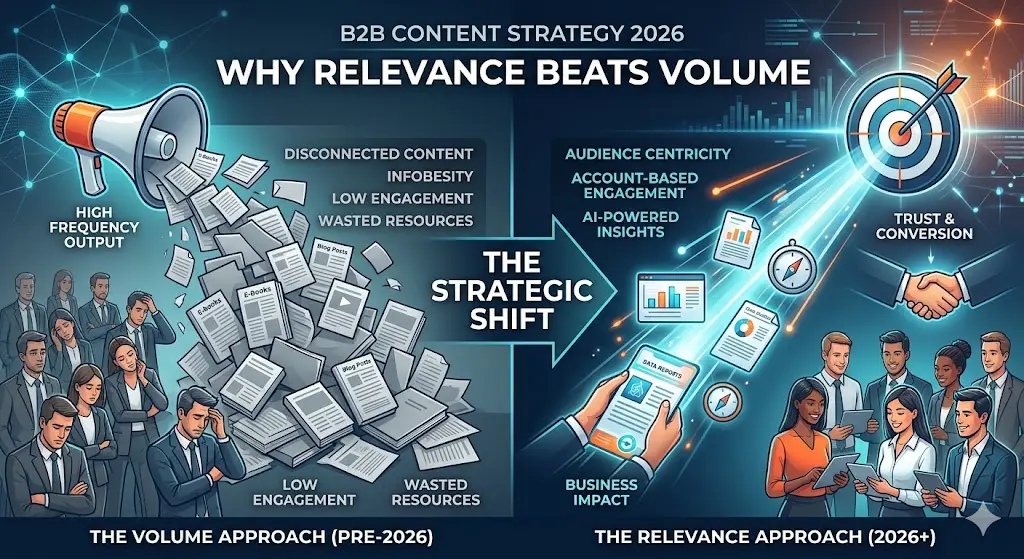
For years, B2B marketing has operated under a simple assumption: more content equals more visibility, more leads, and ultimately more revenue. That assumption is breaking down. As we move into 2026, the landscape has shifted dramatically. The problem is no longer content scarcity—it’s content saturation.
Decision-makers are overwhelmed. Feeds are crowded.AI technology can create thousands of articles within minutes.In this environment, scale alone is no longer a competitive advantage. In fact, it can become a liability.
The new differentiator is relevance—deep, human-centered, context-aware content that speaks directly to the needs of specific audiences.
The Collapse of the “More Is Better” Strategy
B2B organizations that still rely on volume-driven strategies are encountering diminishing returns. Publishing more blog posts, whitepapers, and social updates does not guarantee engagement. Why?
Because buyers have changed:
- They are more informed before engaging
- They expect personalization
- They value expertise over promotion
- They ignore generic messaging
At the same time, AI-generated content has flooded the market with surface-level information. This has created a paradox: content is everywhere, but insight is rare.
In this environment, producing more content without increasing its relevance only adds to the noise.

What Relevance Really Means in 2026
Relevance is often misunderstood as simple personalization—adding a company name or industry reference. In reality, it is much deeper.
True relevance is the intersection of:
- Context (where the buyer is in their journey)
- Intent (what problem they are trying to solve)
- Depth (how well the content addresses that problem)
- Timing (when the content is delivered)
A highly relevant piece of content does not just inform—it guides decision-making.
For example, a CFO evaluating cost optimization does not need a general article about efficiency. They need:
- Specific frameworks
- Real-world benchmarks
- Trade-off analysis
- Implementation risks
Relevance means delivering exactly that level of insight.
The Shift from Audience Size to Audience Precision
Traditional B2B strategies focused on expanding reach—more impressions, more clicks, more leads. In 2026, success depends on narrowing focus.
High-performing organizations are moving toward:
- Defined buying groups instead of broad personas
- Account-based strategies rather than mass campaigns
- Signal-driven engagement instead of static funnels
This approach prioritizes who you reach over how many you reach.
A smaller, highly targeted audience that trusts your content is far more valuable than a large, disengaged one.
Human-Centric Content in an AI-Driven World
AI has made content creation faster and cheaper—but also more uniform. This creates an opportunity for differentiation through human insight.
Human-centric content emphasizes:
- Experience-based knowledge
- Nuanced perspectives
- Honest trade-offs
- Real challenges, not idealized scenarios
In B2B, buyers are not just evaluating products—they are evaluating risk. They want to hear from people who understand their constraints, not just tools that generate polished answers.
Organizations that inject authentic expertise into their content stand out immediately.
From Content Production to Content Design
The most important shift is moving from “creating content” to designing content systems.
Instead of asking:
How much content should we publish?
Leading teams ask:
What decisions are our buyers trying to make, and how can we support them?
This leads to:
- Fewer pieces of content
- Higher quality per piece
- Stronger alignment with business outcomes
Content becomes a strategic asset, not a marketing output.
The Role of Data in Driving Relevance
Relevance at scale requires intelligence. Organizations must go beyond basic analytics and leverage deeper insights such as:
- Behavioral signals (what users engage with)
- Intent data (what topics they are actively researching)
- Sales feedback (what objections arise in conversations)
By integrating these signals, companies can continuously refine content to match real buyer needs.
The goal is not just to measure performance—but to inform creation.

Rethinking Metrics: From Volume to Impact
Traditional metrics—page views, impressions, and content output—are becoming less meaningful. They measure activity, not effectiveness.
In 2026, more relevant metrics include:
- Influence on pipeline progression
- Engagement depth (time, interaction, repeat visits)
- Conversion quality, not just quantity
- Sales team utilization of content
These metrics align content performance with business impact, not just visibility.
The Cost of Irrelevance
Producing irrelevant content has hidden costs:
- Wasted resources on low-impact assets
- Reduced trust from audiences
- Lower engagement across channels
- Increased pressure to produce even more content
Over time, this creates a cycle where teams work harder but achieve less.
Breaking this cycle requires a deliberate shift toward relevance.
Practical Strategies to Prioritize Relevance
Organizations looking to evolve their content strategy in 2026 should focus on the following:
1. Start with Buyer Decisions, Not Topics
Map out the key decisions your audience must make. Build content that supports those decisions directly.
2. Collaborate with Sales and Customer Teams
They have firsthand insight into real questions, objections, and challenges. Use this input to shape content.
3. Invest in Fewer, Higher-Quality Assets
Instead of producing ten average pieces, create two exceptional ones that provide real value.
4. Continuously Update Content
Relevance is not static. Refresh content based on new data, trends, and feedback.
5. Combine AI Efficiency with Human Insight
Use AI to accelerate research and production—but ensure human expertise shapes the final output.
The Strategic Advantage of Relevance
Organizations that prioritize relevance gain several advantages:
- Stronger trust with target audiences
- Higher conversion rates
- Better alignment between marketing and sales
- More efficient use of resources
Most importantly, they build lasting relationships, not just short-term attention.
Final Thoughts
The era of content scale is not over—but it is no longer enough. In a world where content can be produced instantly and endlessly, what truly matters is whether it resonates.
B2B success in 2026 will not be defined by how much content you create, but by how well you understand and serve your audience.
Relevance is not a tactic—it is a discipline. It requires focus, insight, and a commitment to putting people at the center of every message.
In the end, the organizations that win will not be the loudest—they will be the most meaningful.
