



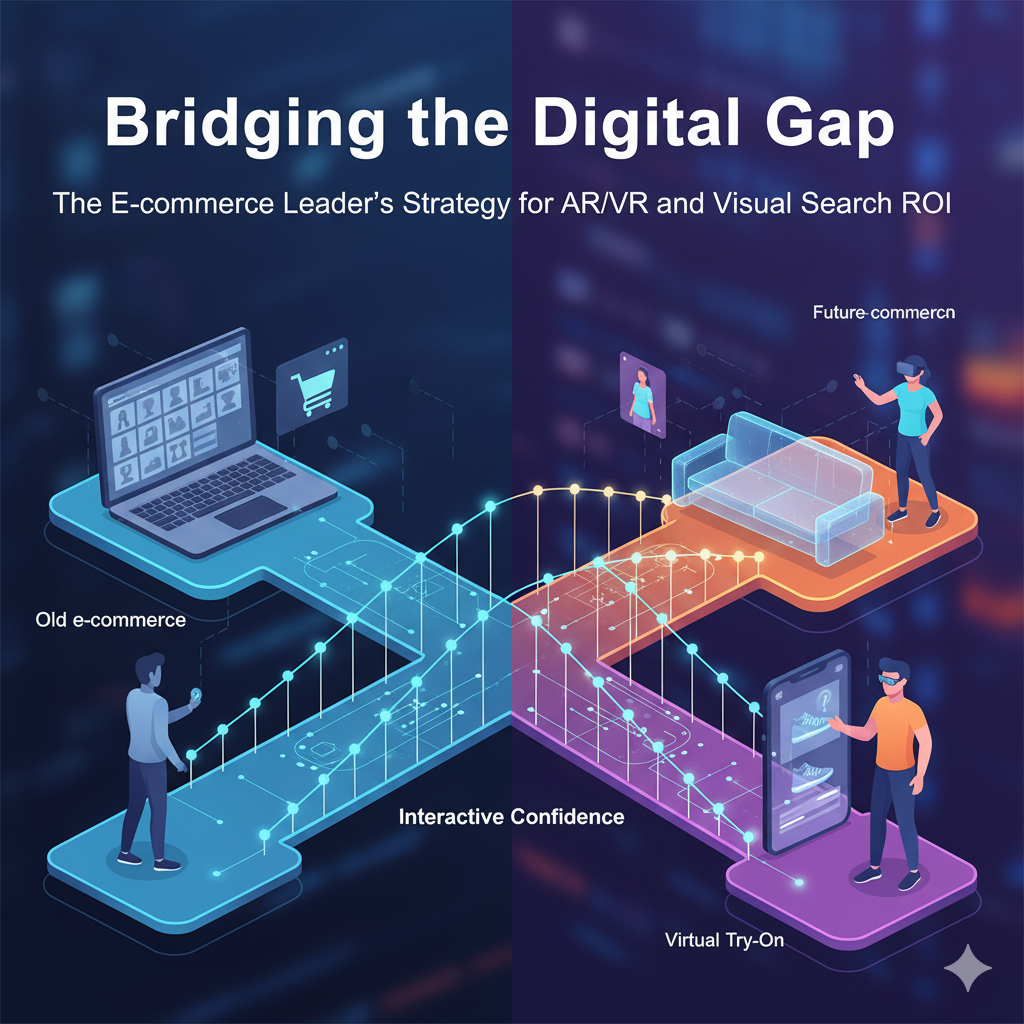
Why Customer Experience is Now the E-commerce Battlefield
The era of simply selling online is over. The real competition now lies in how customers experience your brand before they buy.
In an age when return rates reach as high as 40%, particularly in categories like fashion, furniture, and cosmetics, the underlying problem isn’t product quality — it’s purchase anxiety. Buyers hesitate when they can’t test a product beforehand.
Over my 10+ years of research and CX strategy design, one insight has consistently surfaced:
“Interactive Confidence is the new currency of conversion. Customers who engage with virtual try-on or visual tools are 98% more likely to feel confident in their purchase decision.”
This article explores how Augmented Reality (AR), Virtual Reality (VR), and Visual Search are no longer experimental — they’re measurable front-end profit drivers built on composable digital infrastructure (see Article 2 for backend alignment).
Let’s break down how immersive CX transforms ROI — from reducing returns to optimizing discovery and preparing your business for the AI-AR future.
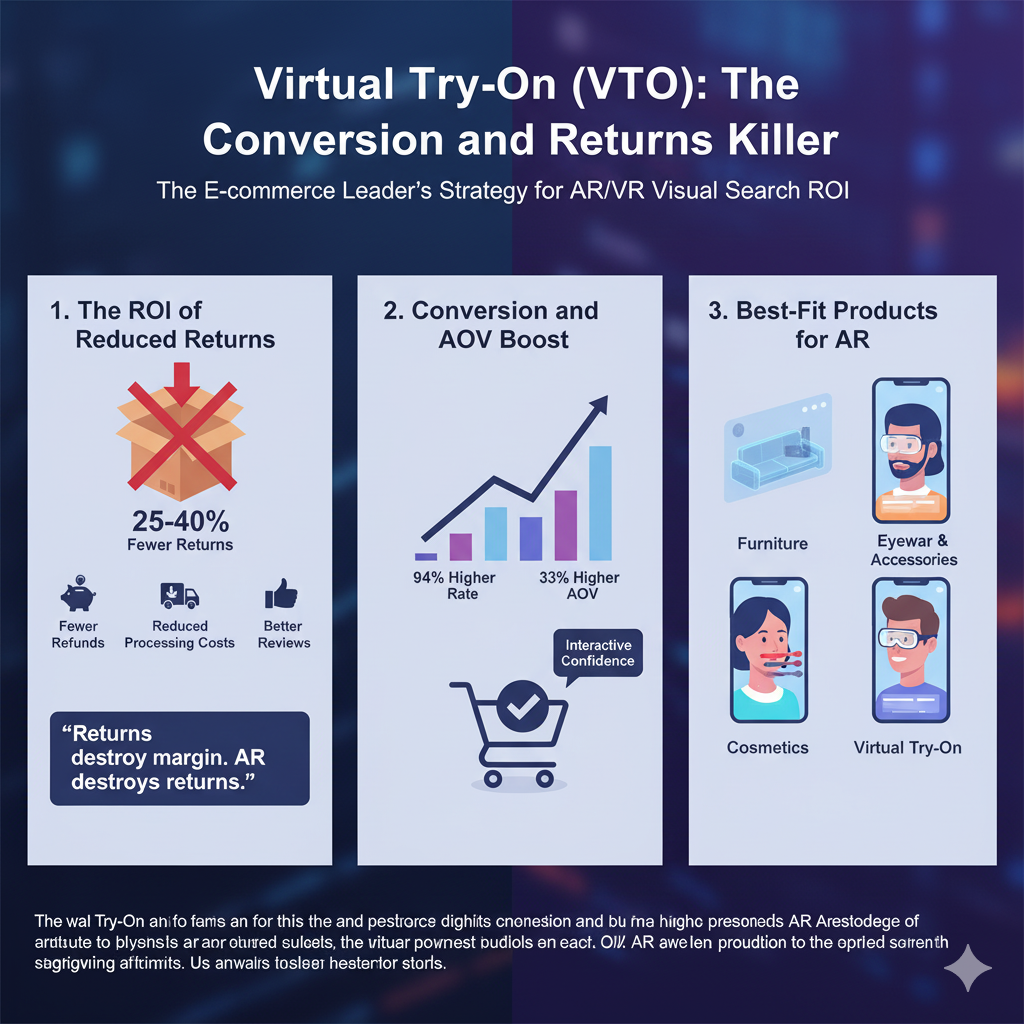
Virtual Try-On (VTO): The Conversion and Returns Killer
Every e-commerce leader knows that customer acquisition is expensive — but what’s even costlier is a returned product.
In 2024, global return logistics cost retailers over $800 billion, according to multiple sources (2.1, 2.3).
AR and VR-driven Virtual Try-On (VTO) technology attacks this issue head-on, creating real financial impact.
-
The ROI of Reduced Returns
Data consistently shows that VTO can reduce product returns by 25%–40% (Sources 1.2, 2.2).
When customers can virtually see how a sofa fits their living room, test lipstick shades on their own face, or view sneakers from every angle, uncertainty evaporates.
From a cost perspective, this shift is massive:
- Fewer restocks and reverse logistics reduce processing costs.
- Fewer refunds improve cash flow.
- Fewer disappointed customers mean better reviews and repeat business.
Across industries, the savings compound. In high-volume sectors like fashion, AR-based try-on can save billions annually. The value isn’t just in logistics — it’s in customer trust, which compounds lifetime value.
“Returns destroy margin. AR destroys returns.”
-
Conversion and AOV (Average Order Value) Boost
Beyond cost savings, AR directly increases sales.
Research from leading commerce platforms shows that AR product experiences drive a 94% higher conversion rate and 33% higher AOV compared to static imagery (Sources 2.3, 2.4).
Why? Because seeing is believing — but trying is deciding.
When customers can rotate, scale, and virtually interact with a product, they shift from browsing to buying. The data also reveals a psychological shift: VTO reduces “cart hesitation” and increases confidence in purchasing premium versions or upsells.
This aligns with the modern “confidence economy” — a space where emotional certainty equals commercial success.
-
The Best-Fit Products for AR
If you’re considering adopting AR, focus your pilot programs where the ROI is most immediate.
Here’s where global leaders began:
- Furniture – IKEA’s AR app allows users to place true-scale 3D models in their homes before purchase.
- Cosmetics – L’Oréal and Sephora use virtual mirrors that help customers test makeup shades virtually.
- Eyewear & Accessories – Warby Parker lets users try glasses using facial mapping technology.
These categories share one thing: visual variability. If a product’s appearance or fit matters, AR drives clarity — and clarity drives conversion.
The takeaway: Start with high-return, visually complex SKUs, then expand AR to your wider catalog.
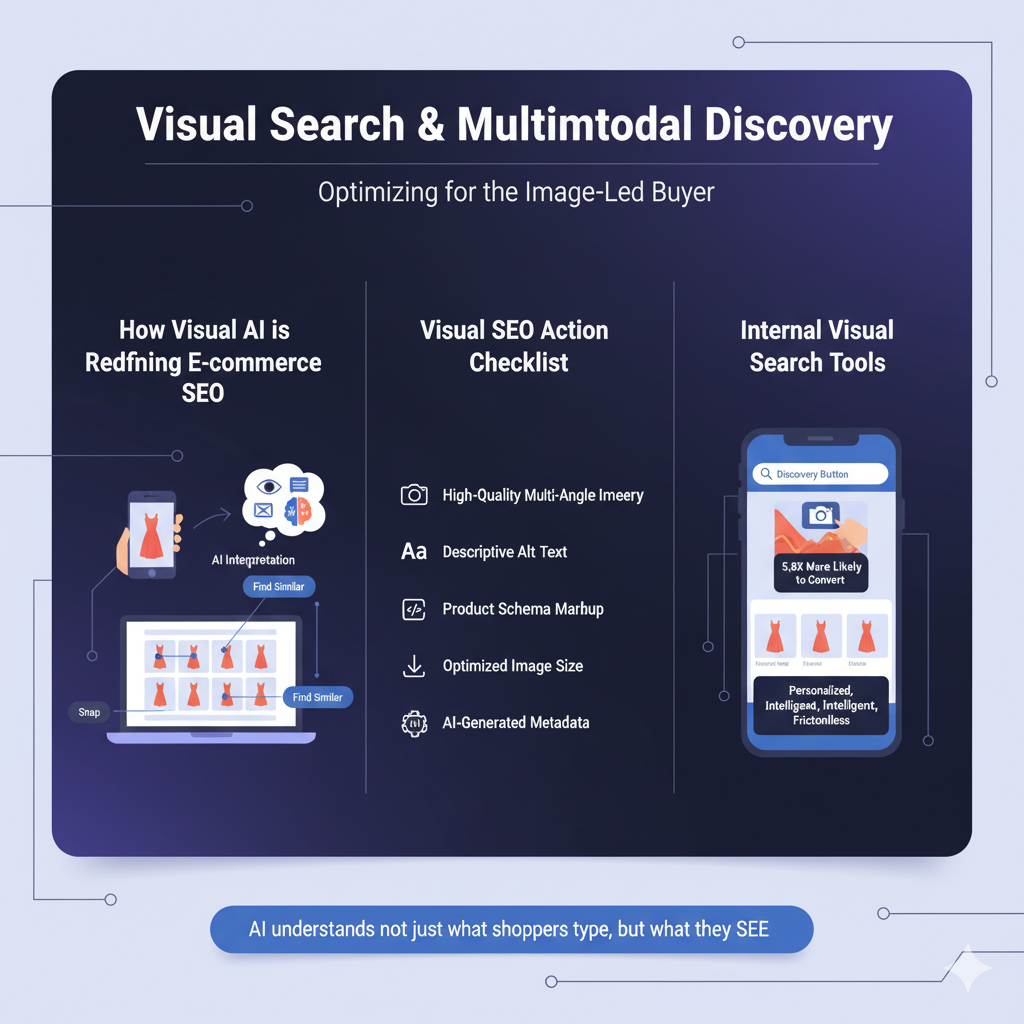
Visual Search & Multimodal Discovery: Optimizing for the Image-Led Buyer
For years, SEO revolved around keywords. But consumers are no longer typing; they’re snapping and searching.
Welcome to the era of Visual Search and Multimodal Discovery, where AI understands not just what shoppers type, but what they see.
-
How Visual AI is Redefining E-commerce SEO
Traditional SEO relies on text — but the modern buyer journey starts with images. A customer might upload a photo of a dress they saw on Instagram, and AI instantly returns similar styles.
This is Multimodal Search in action — combining image, text, and AI interpretation.
Leading platforms like Google Lens and Pinterest Lens have accelerated this shift, training shoppers to expect instant, image-driven discovery. Retailers who optimize for this are seeing exponential ROI: higher visibility, longer session durations, and improved conversion rates.
For e-commerce leaders, this means rethinking SEO — not abandoning it. You’re no longer just optimizing for search engines; you’re optimizing for visual understanding systems.
-
Visual SEO Action Checklist
If you want to future-proof your product catalog for visual discovery, implement this Visual SEO Optimization Framework:
- High-Quality Multi-Angle Imagery: Include at least five angles per product. Consider 3D rotation when possible.
- Descriptive Alt Text: Go beyond basic labels — describe color, texture, and style. (E.g., “matte black ceramic vase, Scandinavian minimalist design”).
- Product Schema Markup: Implement structured data that identifies attributes like size, color, material, and availability.
- Optimized Image Size: Compress without losing quality for faster load times.
- AI-Generated Metadata: Use AI to extract and tag key visual features automatically.
This checklist isn’t just technical — it’s commercial. Each step increases discoverability, improves AI matching accuracy, and strengthens your brand’s presence in visual-first search ecosystems.
-
Internal Visual Search Tools
While optimizing for Google and Pinterest is vital, forward-thinking e-commerce leaders are also investing in on-site visual search tools.
Imagine a customer uploading a picture of a product they love — and your platform instantly showing similar or matching items.
This “Discovery Button” model, powered by visual AI, isn’t just a gimmick. Data shows users who use such tools are 5.8X more likely to convert (Source 3.2).
From fashion to home décor, these tools transform passive browsers into active buyers. The experience feels personalized, intelligent, and frictionless — the hallmarks of a modern e-commerce brand.
The Future: Integrating AR/VR with AI Agents
If AR and Visual Search are today’s tools, AI-integrated AR is tomorrow’s revolution. The next phase of immersive CX lies in fusion technologies that connect digital intelligence with spatial experiences.
The Rise of AR Glasses
The global AR/VR market is accelerating. AR headset shipments grew by over 60% year-over-year (Source 1.4), driven by both enterprise and consumer adoption.
In retail, these devices are evolving from novelty to necessity.
Brands are experimenting with AR-assisted in-store shopping, virtual sales associates, and immersive product demos that merge physical and digital experiences.
Enterprises are also using AR headsets for employee training, inventory visualization, and real-time support, bridging the gap between the digital warehouse and physical storefront.
For e-commerce leaders, this means preparing for a phygital retail future — one where digital experiences enhance every physical interaction.
AI-AR Fusion: Context-Aware Experiences
AR by itself is powerful, but when combined with AI, it becomes intelligent and adaptive.
Picture this: A customer uses AR to place a virtual lamp in their living room. The AI analyzes the room’s lighting and automatically adjusts the product rendering — showing how it will actually look at night or under warm light.
That’s not just visualization. That’s contextual commerce.
AI-powered AR can:
- Adjust colors, textures, and lighting in real time.
- Offer size recommendations based on body shape or room dimensions.
- Personalize product suggestions based on the shopper’s style preferences.
These capabilities elevate AR from an “interactive feature” to a core revenue-generating engine that blends emotional engagement with intelligent automation.
The Competitive Edge is in the Experience
The takeaway for every e-commerce executive is clear:
Immersive CX isn’t a differentiator anymore — it’s the new baseline.
In a world where customer expectations evolve faster than marketing cycles, AR, VR, and Visual AI are business enablers, not experiments. They cut returns, increase conversions, and future-proof your brand against the next digital shift.
The brands leading this charge are not just adopting new tech — they’re redesigning how customers feel before they buy.
Next Step
The best experience is useless without conversation. Once you’ve built immersive experiences, you must connect them with intelligent dialogue.
👉 Next: [Learn how AI is revolutionizing direct customer dialogue in “Conversational Commerce: Turning Dialogue into Revenue.”]
Immersive CX FAQs
- How much does AR implementation cost?
Depending on your scale and complexity, AR integration can range from $5,000 to $50,000+ for setup and testing. Enterprise-level AR programs with 3D modeling, analytics, and integration can go beyond six figures — but the ROI often justifies the investment. - What is WebAR?
WebAR is Augmented Reality that works directly in a web browser, no app required. Users can view and interact with AR experiences instantly through links or QR codes — reducing friction and boosting engagement rates by up to 80%. - What industries benefit most from AR/VR in retail?
Fashion, furniture, cosmetics, automotive, and luxury goods see the strongest results due to their reliance on visual fit, style, and personalization. - How long does AR integration take?
For small pilot projects, 4–6 weeks is common. For enterprise-grade AR ecosystems, expect 3–6 months, including 3D modeling and middleware integration.
Final Thought
The e-commerce battleground has shifted — from clicks to confidence.
By investing in AR/VR and visual discovery, brands are not just showcasing products — they’re building trust, deepening engagement, and engineering ROI at every interaction.
The digital gap isn’t between brands and technology — it’s between those who experiment and those who transform.
Be the latter.


