




In today’s fast-moving business environment, speed and accuracy are no longer optional—they are essential. Organizations process hundreds or even thousands of purchase orders (POs) every month, while their Enterprise Resource Planning (ERP) systems manage everything from inventory and finance to procurement and supply chain operations. Yet despite advances in digital transformation, many companies still rely on manual processes to review, validate, and resolve issues inside their ERP platforms.
This is where AI agents step in—not just as simple chatbots, but as intelligent digital coworkers capable of automating complex workflows. Moving beyond rule-based automation, AI agents are transforming how businesses handle PO processing and ERP triage. In this blog post, we’ll explore what that means, how it works, and why it matters.
Understanding the Challenge: PO Processing and ERP Triage
What Is PO Processing?
Purchase order processing involves creating, reviewing, approving, sending, receiving, and reconciling purchase orders. It sounds straightforward, but in practice it can involve:
-
Validating vendor information
-
Checking contract compliance
-
Matching invoices with receipts
-
Identifying pricing discrepancies
-
Routing approvals to the correct stakeholders
Even small errors—like mismatched quantities or incorrect vendor codes—can cause delays, payment disputes, or inventory problems.
What Is ERP Triage?
ERP triage refers to the process of identifying, prioritizing, and resolving issues within an ERP system. These issues might include:
-
Stuck workflows
-
Data mismatches
-
Approval bottlenecks
-
Failed integrations
-
System-generated error alerts
Traditionally, ERP triage requires human intervention. IT teams or operations staff manually review system alerts, investigate root causes, and determine corrective actions. This can be time-consuming and expensive.
Moving Beyond Basic Automation
For years, businesses relied on Robotic Process Automation (RPA) to handle repetitive tasks. While RPA can mimic human clicks and keystrokes, it typically operates based on predefined rules. If something unexpected occurs—like a new vendor format or an unusual invoice structure—the bot may fail.
AI agents, however, go further.
Unlike simple bots, AI agents can:
-
Learn from historical patterns
-
Make context-aware decisions
-
Communicate across systems
-
Adapt to new scenarios over time
They don’t just execute tasks—they analyze, decide, and improve.
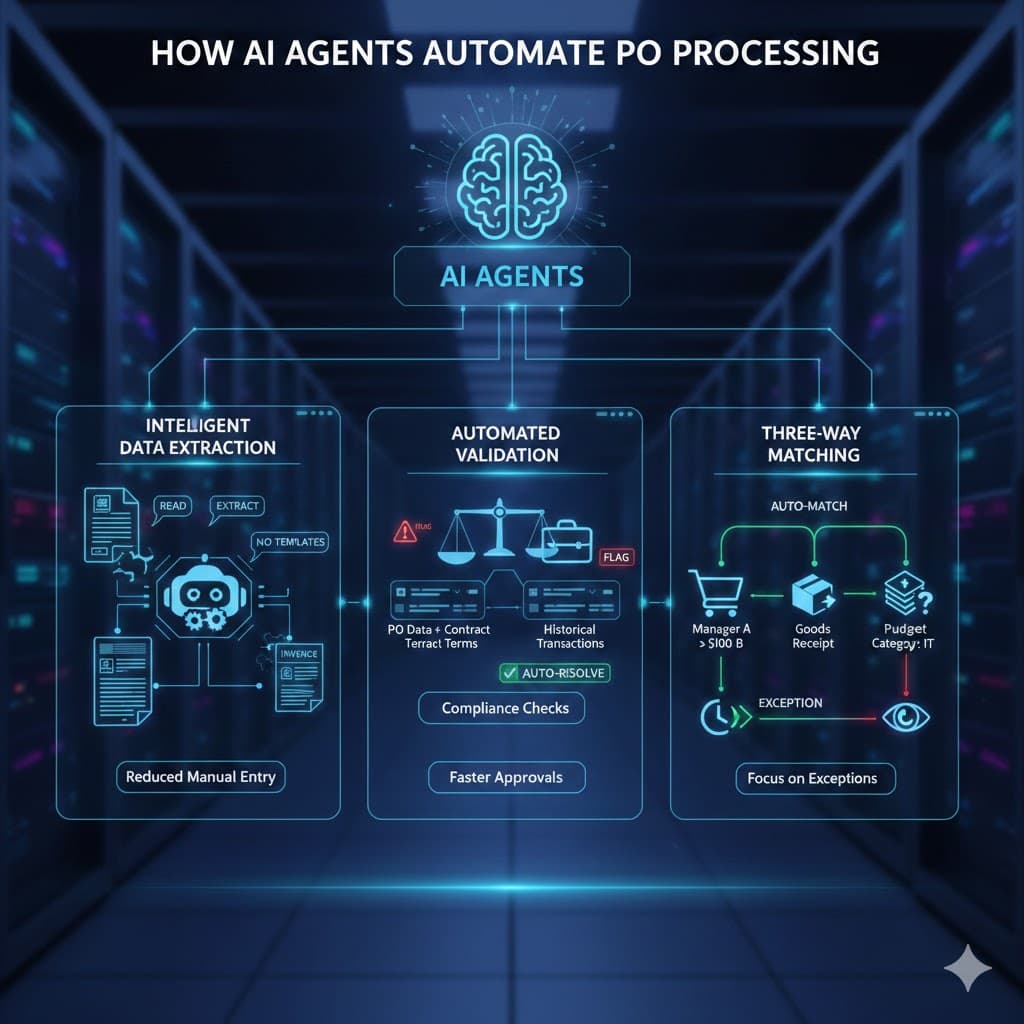
How AI Agents Automate PO Processing
1. Intelligent Data Extraction
AI agents can read purchase orders, invoices, and contracts using advanced document recognition. Instead of relying on fixed templates, they can extract relevant data even if formats vary.
This reduces the need for manual data entry and lowers the risk of human error.
2. Automated Validation and Compliance Checks
AI agents can cross-reference PO data with contract terms, pricing agreements, and historical transactions. If something doesn’t match—like an unexpected price increase—the system flags it automatically.
In many cases, the agent can resolve minor discrepancies without human involvement.
3. Smart Approval Routing
Rather than sending approvals through static workflows, AI agents can determine the appropriate approver based on context. For example, if a purchase exceeds a certain threshold or falls outside a budget category, the system routes it to the right manager automatically.
This speeds up approvals and reduces bottlenecks.
4. Three-Way Matching at Scale
One of the most time-consuming tasks in finance departments is three-way matching: comparing the purchase order, goods receipt, and invoice.
AI agents can perform this matching automatically and highlight only the exceptions that require human review. Instead of reviewing every transaction, teams focus only on the few that truly need attention.
How AI Agents Transform ERP Triage
1. Real-Time Error Detection
ERP systems generate countless alerts. AI agents can monitor these alerts continuously, identify patterns, and classify issues by severity.
Rather than overwhelming IT teams with raw notifications, AI agents prioritize the most critical issues.
2. Root Cause Analysis
Instead of simply reporting that a workflow failed, AI agents can analyze logs and historical data to identify likely root causes. For example, they may detect that a vendor ID mismatch is repeatedly causing payment delays.
By pinpointing recurring issues, businesses can fix systemic problems rather than applying temporary patches.
3. Automated Issue Resolution
In many cases, AI agents can resolve minor ERP issues automatically. If a missing field or formatting error is detected, the agent can correct it based on predefined governance rules.
This reduces downtime and frees up technical staff for strategic work.
4. Continuous Learning and Improvement
Over time, AI agents learn from resolved cases. If a specific error type is frequently escalated to a particular team, the agent adapts its triage logic to route similar cases more efficiently in the future.
This creates a self-improving system rather than a static one.
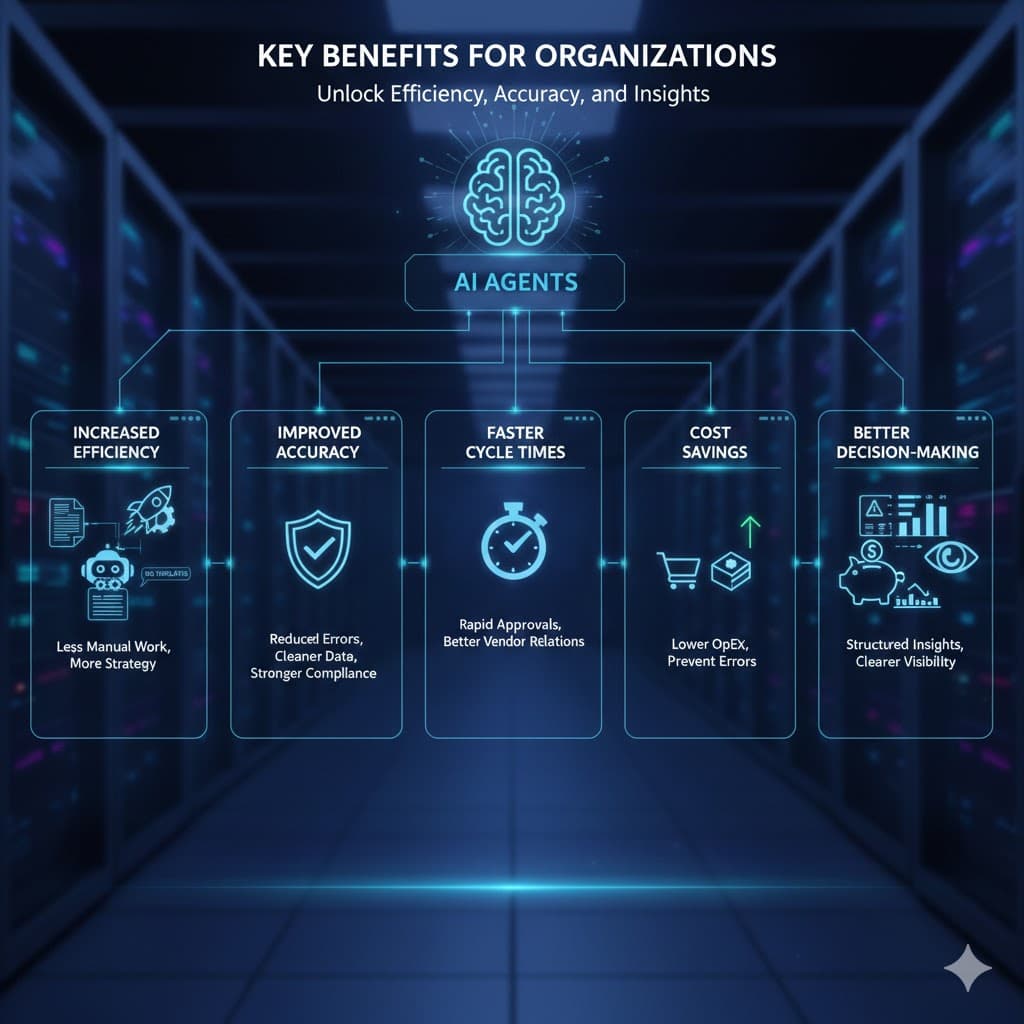
Key Benefits for Organizations
Increased Efficiency
Automating PO processing and ERP triage significantly reduces manual workload. Employees spend less time on repetitive tasks and more time on strategic initiatives.
Improved Accuracy
AI agents minimize human error in data entry and validation. This leads to fewer payment disputes, cleaner financial records, and stronger compliance.
Faster Cycle Times
Purchase approvals, invoice matching, and error resolution happen faster. This improves vendor relationships and enhances operational agility.
Cost Savings
By reducing manual intervention and preventing costly errors, organizations lower operational expenses.
Better Decision-Making
AI agents provide structured insights from unstructured data. Leadership teams gain clearer visibility into procurement trends, vendor performance, and system health.
Governance, Compliance, and Legal Considerations
While AI agents offer powerful capabilities, organizations must implement them responsibly.
-
Data Privacy: AI systems must comply with applicable data protection regulations and internal security policies.
-
Auditability: Decisions made by AI agents should be transparent and traceable.
-
Human Oversight: Critical financial decisions should still include human review where required.
-
Vendor Risk Management: Companies should carefully evaluate AI technology providers for security, reliability, and regulatory compliance.
Responsible implementation ensures that automation enhances operations without introducing new risks.
The Human-AI Partnership
It’s important to emphasize that AI agents are not designed to replace people—they are designed to augment them. By handling repetitive validation, monitoring, and routing tasks, AI frees finance and IT teams to focus on strategic analysis, vendor relationships, and system improvements.
In many organizations, employees report higher job satisfaction when tedious tasks are automated. Instead of constantly troubleshooting routine ERP errors, teams can work on innovation and optimization.
The Future of Intelligent Operations
As AI technology continues to evolve, we can expect even deeper integration with ERP systems. Future AI agents may:
-
Predict procurement risks before they occur
-
Automatically negotiate routine vendor terms
-
Provide real-time financial forecasting
-
Coordinate cross-department workflows autonomously
The shift from reactive troubleshooting to proactive optimization marks a major transformation in enterprise operations.
Final Thoughts
Beyond simple bots and rule-based automation, AI agents represent a new era of intelligent process management. By automating purchase order processing and ERP triage, they reduce errors, accelerate workflows, and empower teams to focus on higher-value work.
For organizations seeking efficiency, accuracy, and scalability, adopting AI-driven automation is no longer a futuristic concept—it is a practical, strategic move. When implemented responsibly and ethically, AI agents can become trusted digital collaborators, helping businesses operate smarter, faster, and more effectively in an increasingly complex world.


