



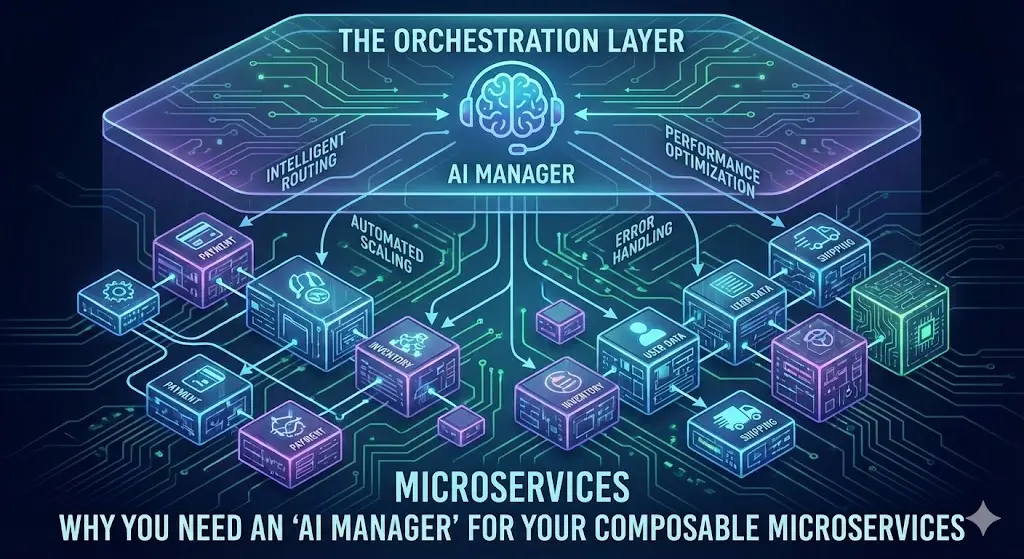
In the era of cloud-native applications, composable microservices have emerged as the de facto architecture for building scalable, flexible, and resilient systems. Organizations are moving away from monolithic applications toward a modular approach where each microservice performs a specific function, and multiple services can be combined to deliver complex workflows.
However, as the number of microservices grows, so does the complexity of orchestrating them effectively. Traditional orchestration approaches struggle to keep up with dynamic scaling, dependency management, and intelligent decision-making. Enter the concept of an AI-driven orchestration layer—or what many refer to as an “AI Manager”—a sophisticated layer that not only coordinates microservices but also optimizes, predicts, and automates operational decisions in real time.
This post dives into the advanced concepts behind orchestration, the role of an AI Manager, and why it’s becoming essential for modern composable microservices architectures.
The Challenge of Composable Microservices
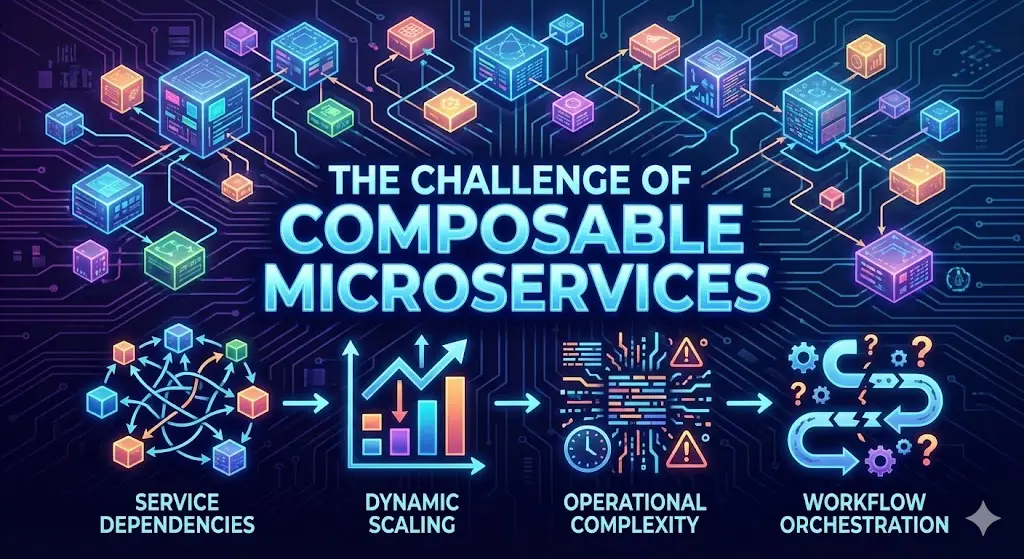
Composable microservices are designed to be independent, modular, and reusable. Each microservice encapsulates a specific business capability and communicates with others through APIs or event-driven mechanisms. While this offers immense flexibility, it also introduces significant challenges:
-
Service Dependencies: Microservices rarely operate in isolation. One service may rely on data or functionality from several others, creating complex dependency graphs. Managing these dependencies manually becomes impractical at scale.
-
Dynamic Scaling: Some services experience variable workloads, requiring dynamic scaling of instances. Determining which services to scale, and when, is challenging without automated intelligence.
-
Operational Complexity: Microservices generate distributed logs, telemetry, and metrics, which need constant monitoring. Traditional monitoring systems can detect anomalies but often lack the context to predict failures or optimize performance proactively.
-
Workflow Orchestration: Executing business workflows across multiple services often requires synchronous or asynchronous coordination, transaction management, and error recovery mechanisms. Implementing this manually increases engineering overhead and risks introducing bottlenecks.
These challenges highlight the need for an orchestration layer that goes beyond simple service coordination.

What Is an AI-Driven Orchestration Layer?
An AI-driven orchestration layer is a software layer that acts as the central manager for a network of composable microservices. Unlike traditional orchestration tools, which primarily rely on predefined rules and static workflows, an AI Manager leverages machine learning, predictive analytics, and real-time telemetry to make intelligent decisions.
Key capabilities include:
-
Dynamic Service Discovery and Routing: Automatically identifying available services, selecting the optimal instances, and routing requests based on load, latency, and context.
-
Predictive Scaling: Using historical and real-time data to predict traffic spikes and proactively scale services up or down.
-
Fault Prediction and Self-Healing: Detecting anomalies before they escalate into failures and triggering automated recovery actions.
-
Intelligent Workflow Optimization: Sequencing service calls dynamically to minimize latency, balance loads, and ensure high availability.
-
Resource Optimization: Allocating computing resources efficiently based on predicted demand, performance goals, and cost constraints.
In essence, the AI Manager is not just a scheduler—it’s an autonomous decision-making layer that continuously optimizes the microservices ecosystem.
Why Traditional Orchestration Falls Short
Traditional orchestration tools such as Kubernetes, Docker Swarm, or Apache Mesos focus on container management, deployment, and scaling. While effective for many use cases, they fall short in complex composable microservice environments:
-
Static Policies: Rules for routing, scaling, and resource allocation are often predefined and rigid, making it difficult to adapt to unpredictable workloads.
-
Limited Predictive Capabilities: Standard orchestration reacts to current states (e.g., CPU load) rather than anticipating future states, leaving systems vulnerable to sudden spikes.
-
Workflow Myopia: Traditional orchestrators lack deep understanding of business-level workflows. They can deploy and scale containers but cannot optimize multi-service transactions or cross-service dependencies intelligently.
-
Manual Interventions: Complex failures or dependency conflicts often require human intervention, which slows down response times and increases operational risk.
The AI Manager addresses these limitations by combining orchestration, predictive analytics, and optimization into a unified, autonomous layer.
Core Components of an AI Manager
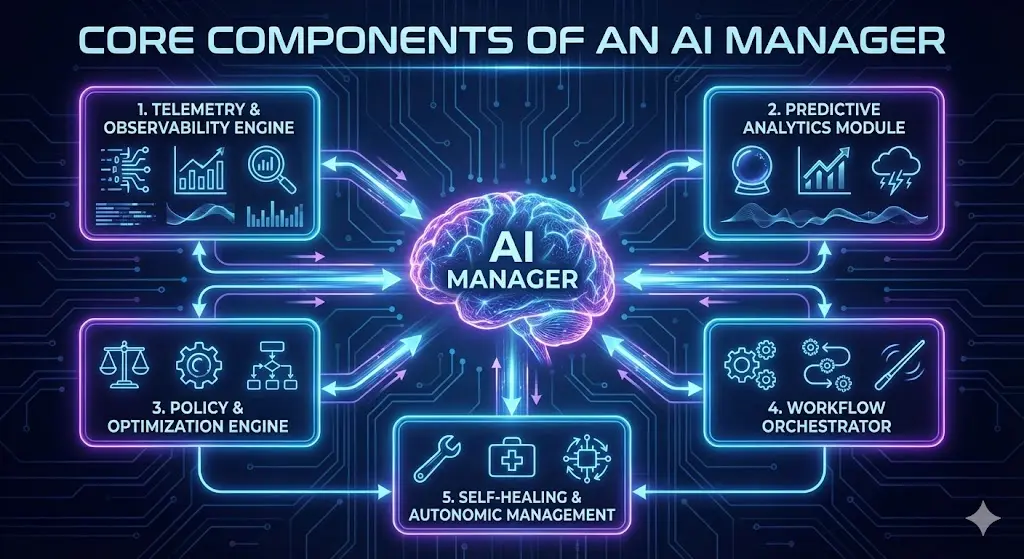
A robust AI-driven orchestration layer consists of several critical components:
1. Telemetry and Observability Engine
This component collects real-time metrics, logs, and traces from all microservices. Unlike traditional monitoring, the AI Manager continuously analyzes patterns, correlations, and anomalies, providing a granular understanding of system behavior.
2. Predictive Analytics Module
Using historical and live data, the AI Manager predicts:
-
Traffic surges or drops
-
Latency bottlenecks
-
Resource exhaustion
-
Potential failures
These predictions enable proactive scaling and self-healing, reducing downtime and improving user experience.
3. Policy and Optimization Engine
Rather than relying solely on hardcoded rules, this engine balances multiple objectives such as performance, cost, reliability, and compliance. It makes decisions like:
-
Which instance of a service should handle a request
-
When to migrate workloads to less busy nodes
-
How to restructure workflows dynamically for efficiency
4. Workflow Orchestrator
This module handles multi-service transactions and ensures that service calls are executed in the most efficient sequence. It can reroute workflows dynamically if a service fails or underperforms, maintaining continuity without human intervention.
5. Self-Healing and Autonomic Management
The AI Manager can detect errors, predict failures, and trigger automated corrective actions, such as restarting containers, reallocating resources, or spinning up redundant instances.
Benefits of Using an AI Manager
Implementing an AI-driven orchestration layer provides tangible benefits:
-
Operational Efficiency
By automating decision-making, teams can reduce manual intervention, lower operational costs, and free engineers to focus on high-value development tasks. -
Resilience and Reliability
Predictive scaling, fault detection, and self-healing mechanisms improve system uptime and reduce the risk of cascading failures in complex microservice ecosystems. -
Improved Performance
Intelligent routing and workflow optimization reduce latency, balance loads, and ensure optimal response times across services. -
Cost Optimization
Dynamic resource allocation based on predicted demand ensures efficient use of cloud resources, preventing over-provisioning and reducing infrastructure costs. -
Enhanced Business Agility
With AI handling orchestration, organizations can deploy new services faster, experiment with new workflows, and adapt quickly to changing market demands.
Use Cases for AI-Driven Orchestration
The AI Manager is particularly valuable in scenarios where microservices are highly dynamic, interdependent, and mission-critical:
-
E-commerce Platforms: Predicting shopping spikes, managing inventory microservices, and ensuring fast checkout workflows.
-
Financial Services: Real-time fraud detection, transaction orchestration, and compliance monitoring.
-
Telecommunications: Managing high-volume network services, dynamically scaling media servers, and minimizing latency.
-
Healthcare Systems: Coordinating diagnostic, patient record, and scheduling microservices to ensure reliable service delivery.
These use cases demonstrate that AI-driven orchestration is not just a convenience—it’s increasingly a strategic necessity.
Implementing an AI Manager: Best Practices
-
Start with Observability
Ensure all microservices emit standardized telemetry and logs. Without comprehensive observability, predictive and autonomous management will be inaccurate. -
Leverage Machine Learning
Train predictive models on historical workloads, failure patterns, and traffic trends. Continuously refine models using live data. -
Define Optimization Goals
Clearly identify business objectives such as latency, throughput, cost, or availability. The AI Manager’s decisions should align with these goals. -
Test Failures in Sandbox Environments
Simulate service failures and traffic spikes to validate the AI Manager’s autonomous responses before deployment in production. -
Integrate Gradually
Start with critical workflows or high-traffic services and expand the AI Manager’s scope gradually, allowing teams to monitor performance and adjust policies.
Future of AI in Microservice Orchestration
The next generation of orchestration layers will combine AI, reinforcement learning, and advanced decision engines to achieve full autonomic management of distributed systems. Some emerging trends include:
-
Cross-cloud orchestration: AI managers handling microservices deployed across multiple cloud providers.
-
Self-optimizing pipelines: Systems that continuously restructure themselves based on demand patterns and performance metrics.
-
Context-aware orchestration: Decision-making that incorporates business context, user experience, and compliance requirements, not just technical metrics.
As microservices architectures continue to scale in complexity, AI-driven orchestration will become essential for maintaining agility, reliability, and cost-effectiveness.
Conclusion
Composable microservices offer unmatched flexibility, but they also introduce orchestration complexity that traditional tools struggle to manage. An AI Manager, or AI-driven orchestration layer, transforms how organizations operate microservices ecosystems by providing predictive intelligence, autonomous decision-making, and continuous optimization.
From improved reliability and performance to operational efficiency and cost savings, the benefits are clear. For any organization building large-scale, composable microservices architectures, investing in an AI-driven orchestration layer is no longer optional—it’s essential for scalability, resilience, and future-ready operations.
In 2026, as applications become increasingly dynamic and distributed, the AI Manager will act as the invisible conductor, ensuring that every microservice performs in harmony, resources are allocated intelligently, and the system adapts proactively to changing demands.


