

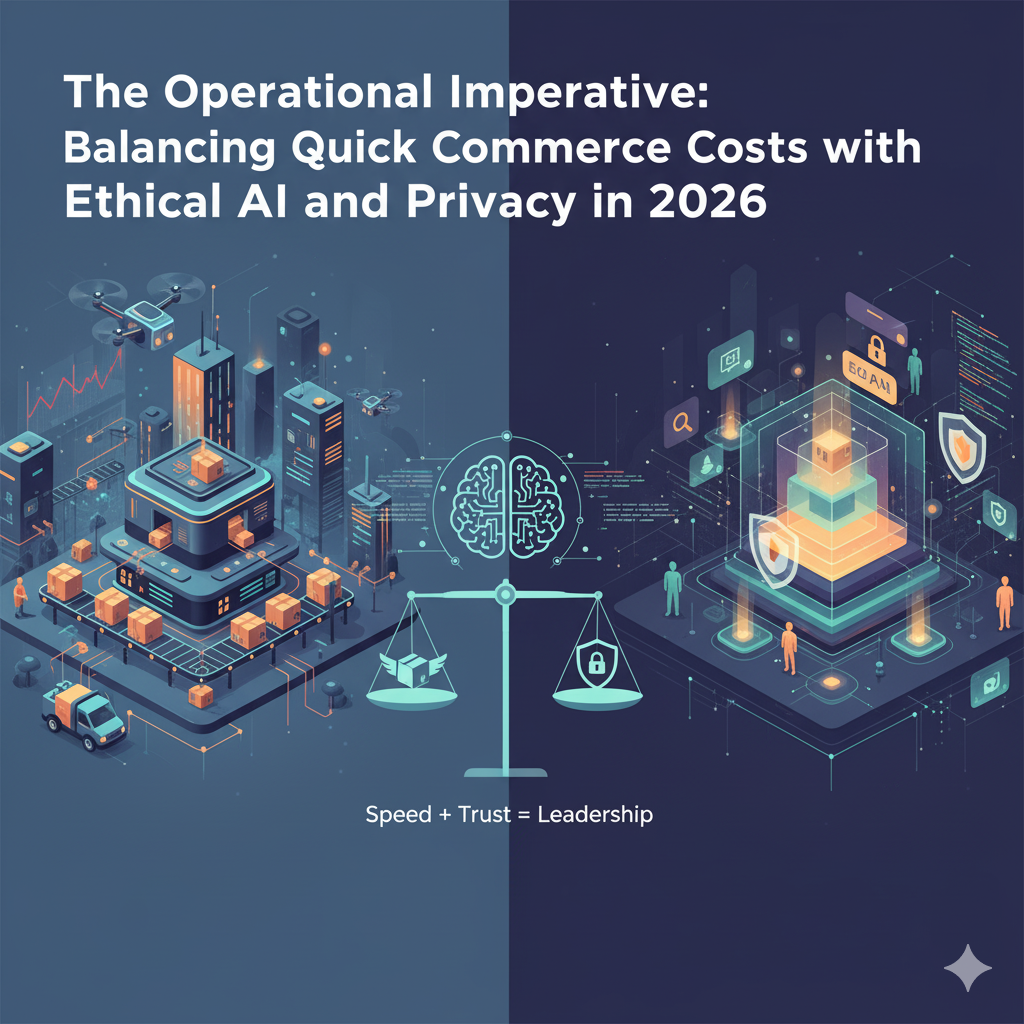
In 2026, the e-commerce landscape is defined by a paradox: customers demand near-instant deliveries while simultaneously expecting complete transparency in how their data is used. My decade in e-commerce R&D demonstrates that mastering this dual imperative—speed and trust—is what separates industry leaders from laggards. Quick commerce (Q-Commerce) is no longer just a differentiator in marketing; it has become an operational necessity. At the same time, ethical AI, data privacy, and compliance are increasingly crucial for customer retention and brand credibility.
Fast delivery must always be accompanied by a fast, trustworthy customer experience. While Article 3 in this series explored customer-facing innovation, this piece focuses on operations and logistics—the backbone of the future e-commerce strategy.
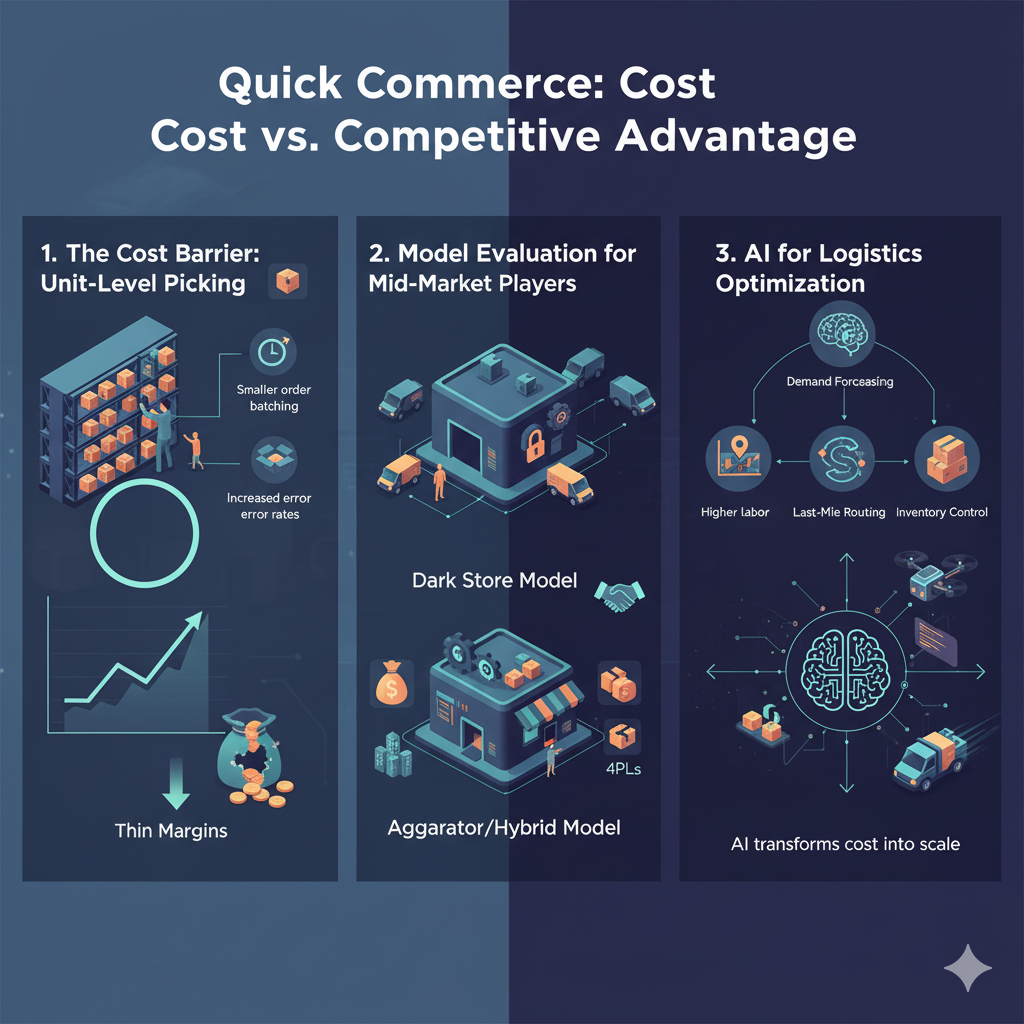
Quick Commerce (Q-Commerce): Assessing the Cost vs. Competitive Advantage
Quick commerce promises unparalleled speed in product delivery, often in under 15 minutes. This promise attracts new customers and can significantly increase loyalty. However, achieving this speed is expensive, particularly for mid-market players who lack the scale of giants like Amazon or Alibaba.
While the market rewards rapid fulfillment, it is essential to understand that operational costs rise exponentially with speed. The following factors explain why:
1. The Cost Barrier: Unit-Level Picking & Thin Margins
Unit-level picking, the process of retrieving individual items from inventory for direct shipment, is a cornerstone of Q-Commerce. Unlike traditional warehouse operations, where items are picked in bulk (cases or pallets), unit-level picking requires:
Higher labor input per order
Smaller order batching, increasing handling time
Increased error rates requiring quality control interventions
These factors translate into thin margins, as the cost of fulfilling an order can often exceed the profit from it, particularly when orders are small. For mid-market e-commerce businesses, operating a Q-Commerce model without strategic cost controls is financially unsustainable.
Expert insight: Q-Commerce margins are notably slim without consistent high-volume orders. While large enterprises can absorb the costs through scale, mid-market companies must evaluate operational strategies carefully to avoid margin erosion.
2. Model Evaluation for Mid-Market Players
Mid-market businesses often face a critical choice: which Q-Commerce model balances cost, speed, and risk? Two primary models dominate:
Dark Store Model: Essentially a dedicated fulfillment center optimized for fast delivery. Advantages include complete inventory control and faster last-mile fulfillment. However, the model incurs high fixed costs, requiring significant upfront investment in real estate, technology, and labor.
Aggregator/Hybrid Model: This model leverages existing stores or third-party platforms to fulfill orders. Costs are lower, but control over inventory and customer experience is reduced. Partnering with 4PLs (fourth-party logistics providers) can mitigate risk, enabling regional or urban focus without massive capital outlay.
Actionable insight: Mid-market businesses should often adopt a hybrid model, balancing operational control and cost efficiency while scaling Q-Commerce capabilities regionally.
3. AI for Logistics Optimization
AI is the critical lever to make Q-Commerce profitable. By deploying advanced algorithms, businesses can optimize operations across multiple dimensions:
Demand Forecasting: AI predicts local product demand, ensuring micro-fulfillment centers maintain optimal stock levels.
Last-Mile Routing: Real-time routing reduces delivery time, fuel consumption, and labor costs.
Inventory Control: AI-driven inventory systems determine restocking priorities and manage supply chains dynamically.
In short, AI transforms Q-Commerce from a high-cost experiment into a scalable operational model. Without it, companies risk either losing money or compromising delivery speed.
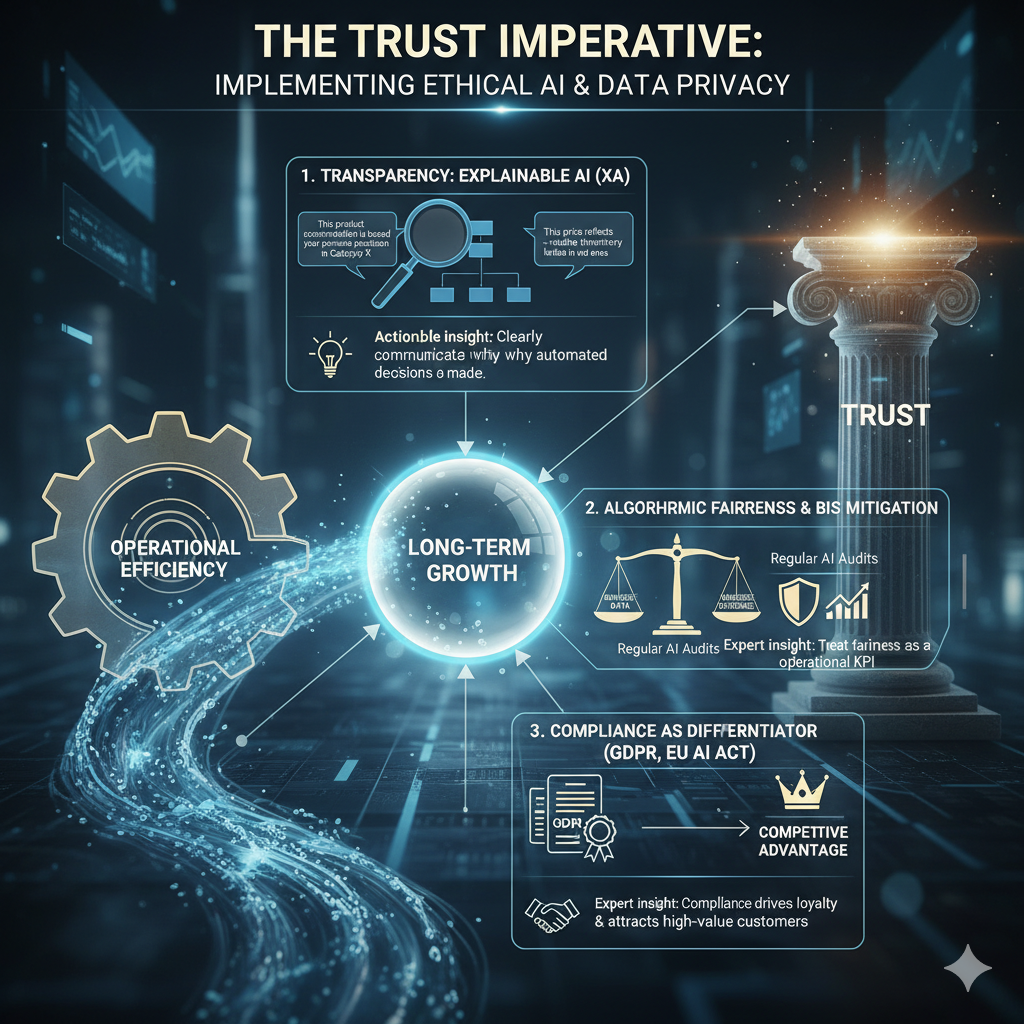
The Trust Imperative: Implementing Ethical AI and Data Privacy
Operational efficiency is only half the equation. Trust is the other critical pillar. Regulatory pressure and customer expectations make ethical AI and data privacy central to sustaining long-term growth.
1. Transparency: Explainable AI (XAI)
Explainable AI (XAI) ensures that automated decisions—such as dynamic pricing, product recommendations, or fulfillment prioritization—are understandable to both customers and regulators. Examples include:
“This product recommendation is based on your previous purchase in Category X.”
“This price reflects real-time inventory levels in your area.”
Actionable insight: Clearly communicate why automated decisions are made. Transparency reduces friction, increases trust, and positions your company as accountable in an era of increased scrutiny.
2. Algorithmic Fairness and Bias Mitigation
AI systems are only as unbiased as the data they are trained on. Without proper checks, recommendation engines, search algorithms, and pricing models may inadvertently reinforce bias, favoring certain products or demographics.
Expert insight: Regular AI audits, diverse training datasets, and bias mitigation strategies are essential. Companies must treat fairness as an operational KPI, not a regulatory checkbox.
3. GDPR, EU AI Act, and Compliance as a Differentiator
Regulations like GDPR and the EU AI Act are often viewed as operational burdens. However, companies that embrace these standards position compliance as a trust builder. Customers are increasingly choosing brands based on data privacy and ethical AI practices.
Expert insight: Compliance is a competitive advantage. When integrated into operational workflows, ethical data practices drive loyalty and attract high-value customers.
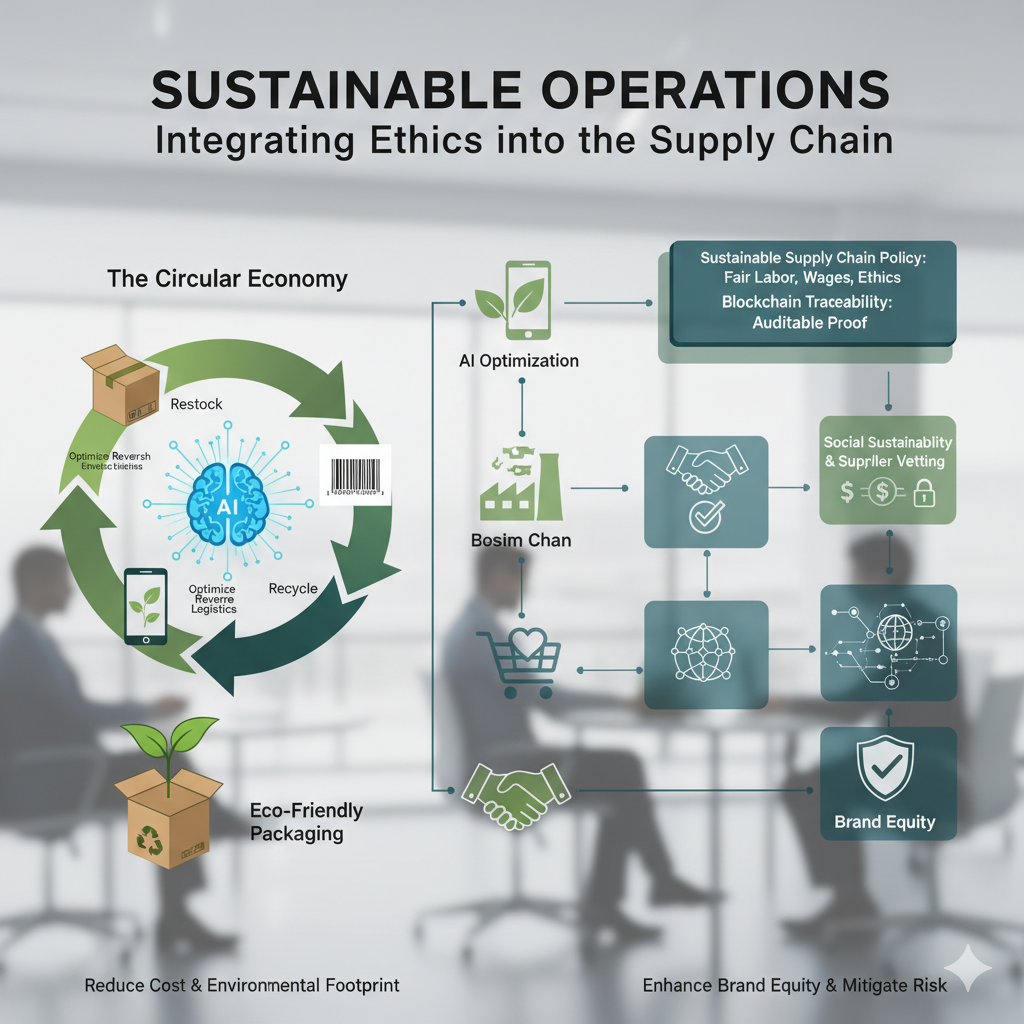
Sustainable Operations: Integrating Ethics into the Supply Chain
Ethics should extend beyond AI and data privacy to environmental and social operational practices.
1. The Circular Economy: Returns & Packaging
Returns are an inherent cost in Q-Commerce. AI can optimize reverse logistics by determining whether returned items should be:
Restocked for resale
Refurbished
Recycled
In addition, eco-friendly packaging and minimized materials reduce waste and align operations with sustainability goals. Actionable insight: Leverage AI and operational data to reduce both cost and environmental footprint.
2. Social Sustainability & Supplier Vetting
A responsible supply chain extends to fair labor, wage compliance, and supplier accountability. Operational leaders should:
Develop a Sustainable Supply Chain Policy covering labor standards, fair wages, and ethical practices.
Use Blockchain-enabled traceability to provide transparent, auditable proof of supplier compliance.
Expert insight: Consumers reward brands that integrate social responsibility into operations. Ethical supply chain practices not only mitigate risk but also enhance brand equity.
Conclusion: Operations Are the Engine of Authority
In 2026, operations define brand identity. Speed alone is not sufficient—companies must balance:
Rapid Q-Commerce fulfillment
Ethical AI implementation
Data privacy compliance
Sustainable supply chain practices
Businesses that integrate these four pillars position themselves as operational authorities in e-commerce. Logistics and data practices are a tangible reflection of brand values, impacting customer perception and loyalty.
Next Step: You now have the four pillars of the Future E-commerce strategy. The final guide in this series focuses on launching a content strategy that drives high-value B2B traffic and converts operational excellence into measurable growth.
FAQ: Future Operations
Q1: How can I afford Q-Commerce?
A: Focus regionally, implement micro-fulfillment centers, and partner with 4PLs to reduce capital expenditure while maintaining speed.
Q2: What is the biggest operational risk in 2026?
A: AI-driven fraud and cybersecurity threats are the top risks. Continuous monitoring and ethical AI frameworks are critical mitigations.
Q3: How can I integrate sustainability without increasing costs?
A: Use AI-driven reverse logistics, eco-friendly packaging, and vet suppliers for ethical operations. This reduces waste and long-term operational costs.
Q4: Is compliance worth the investment?
A: Absolutely. GDPR and AI Act compliance build trust, retain high-value customers, and can differentiate your brand.
