

In today’s software landscape, microservices architecture has become the backbone of scalable, resilient, and flexible applications. The promise of microservices lies in composability—the ability to assemble loosely coupled, independently deployable services into a coherent system. However, as applications grow in complexity, managing interactions, security, and performance across hundreds of microservices can become overwhelming. This is where API gateways come into play. Acting as the entry point for client requests, an API gateway provides routing, security, observability, and orchestration for microservices, enabling teams to focus on business logic rather than infrastructure plumbing.
Choosing the right API gateway is crucial for a composable microservices ecosystem. A misaligned gateway can introduce bottlenecks, security gaps, or operational overhead, while the right choice accelerates development and enhances performance. In this article, we’ll explore the top five API gateways for managing composable microservices, with technical depth and insights for architects, developers, and DevOps teams.
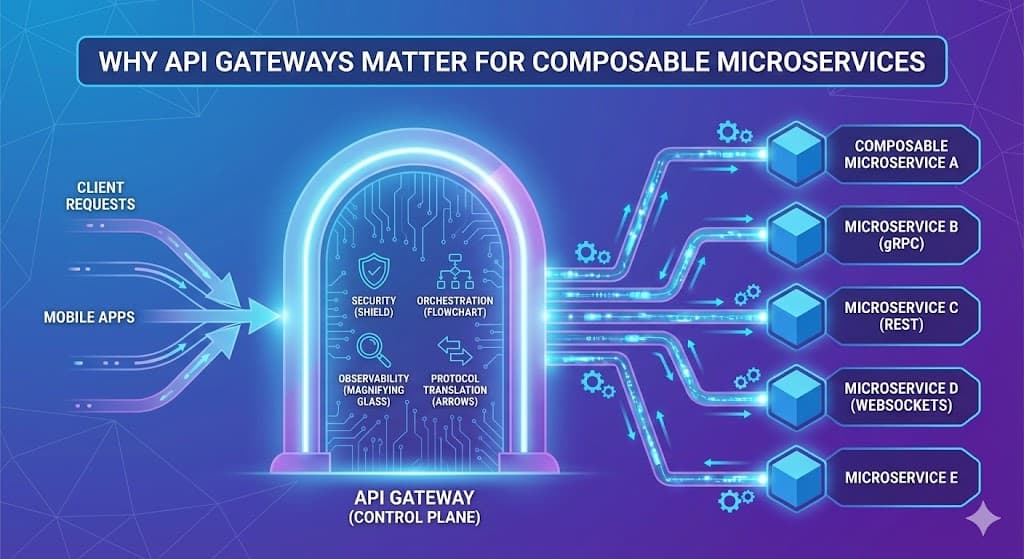
Why API Gateways Matter for Composable Microservices
Before diving into specific solutions, it’s essential to understand why API gateways are indispensable in microservices:
Centralized Entry Point
API gateways act as a single point of entry for all client requests, enabling developers to standardize routing, authentication, and monitoring across services.Service Orchestration
Complex microservice workflows often require aggregating responses from multiple services. Gateways can handle request composition and response transformation efficiently.Security Enforcement
Gateways manage authentication, authorization, throttling, and rate-limiting policies, reducing the exposure of internal microservices.Observability
API gateways can integrate with logging, metrics, and tracing systems, providing insights into latency, error rates, and traffic patterns.Protocol Translation
Modern microservices may communicate over HTTP/REST, gRPC, or WebSockets. Gateways can translate protocols, enabling heterogeneous services to interoperate seamlessly.
In essence, API gateways are not just traffic routers—they are the control plane for composable microservices.
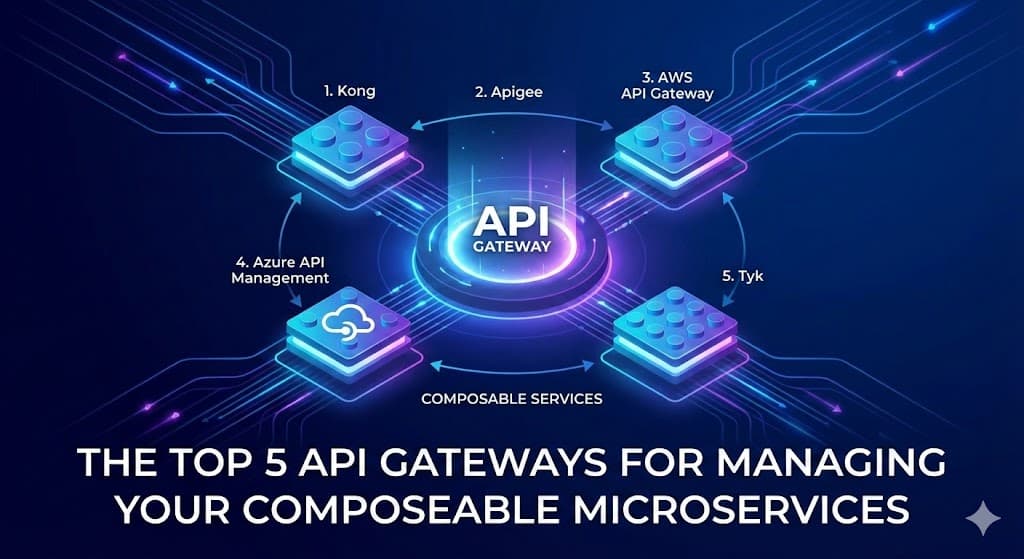
Top 5 API Gateways for Composable Microservices
Here’s a detailed look at the leading API gateways, highlighting their strengths, technical features, and ideal use cases.
1. Kong Gateway
Overview:
Kong is an open-source, cloud-native API gateway built on Nginx and designed for high performance and scalability. It has gained popularity for its plugin architecture, which allows developers to extend functionality without modifying core code.
Key Features:
Plugin Ecosystem: Kong supports over 60 plugins, including authentication, rate limiting, logging, and analytics. Custom plugins can be written in Lua.
Service Mesh Integration: Works with Istio and Kuma to provide mesh-based routing for microservices.
Protocol Support: HTTP, HTTPS, TCP, gRPC, and WebSockets.
Enterprise Features: Role-based access control, multi-datacenter deployments, and analytics dashboards.
Technical Strengths:
Low-latency request processing due to its Nginx foundation.
Scalable horizontally across clusters.
Supports declarative configuration with YAML or database-backed dynamic configuration.
Ideal Use Cases:
Organizations running hybrid or multi-cloud microservices.
Teams that want a highly extensible and customizable gateway.
Use cases requiring both REST and gRPC routing.
2. NGINX API Gateway
Overview:
NGINX, traditionally known as a high-performance web server, also functions as a robust API gateway. Its lightweight architecture, combined with a rich ecosystem of modules, makes it suitable for high-throughput environments.
Key Features:
Load Balancing: Advanced layer 7 load balancing with health checks.
Security: JWT authentication, OAuth 2.0 support, and TLS termination.
Traffic Management: Rate limiting, request/response transformations, caching.
Observability: Native integration with monitoring tools like Prometheus, Grafana, and ELK stack.
Technical Strengths:
Extremely fast request processing with minimal overhead.
Fine-grained control over routing logic through configuration files.
Supports containerized environments with NGINX Plus features.
Ideal Use Cases:
High-performance microservices requiring low latency.
Organizations already leveraging NGINX as a reverse proxy.
Teams needing advanced traffic shaping and caching capabilities.
3. AWS API Gateway
Overview:
AWS API Gateway is a fully managed service that enables developers to create, publish, and secure APIs at scale. It is tightly integrated with the AWS ecosystem, making it a natural choice for cloud-native microservices.
Key Features:
Serverless Integration: Works seamlessly with AWS Lambda for function-based microservices.
Security: Native support for IAM, Cognito, and API keys.
Protocol Support: HTTP/HTTPS, WebSockets, and REST APIs.
Technical Strengths:
Fully managed, removing operational overhead.
Auto-scaling with built-in high availability.
Supports API versioning and stage deployments for CI/CD workflows.
Ideal Use Cases:
Teams building serverless or AWS-centric microservices.
Organizations requiring automatic scaling without infrastructure management.
Use cases needing deep integration with other AWS services like DynamoDB, S3, and Lambda.
4. Apigee by Google Cloud
Overview:
Apigee is an enterprise-grade API management platform that combines gateway capabilities with analytics, monetization, and developer portal features. It’s designed for organizations with complex integration and governance requirements.
Key Features:
Policy Engine: Fine-grained control for security, traffic, mediation, and transformation policies.
API Analytics: Comprehensive dashboards and insights for monitoring performance, adoption, and SLA compliance.
Hybrid Deployment: On-premises or cloud deployment options.
Developer Portal: Enables API documentation, testing, and onboarding for external developers.
Technical Strengths:
Strong support for API versioning and lifecycle management.
Built-in analytics to detect performance bottlenecks.
Advanced security features like OAuth, SAML, and JWT validation.
Ideal Use Cases:
Enterprises needing strict API governance and monitoring.
Organizations exposing APIs to external partners or developers.
Use cases requiring hybrid deployment and multi-region support.
5. Traefik
Overview:
Traefik is a modern, cloud-native API gateway and reverse proxy designed for dynamic environments like Kubernetes. It focuses on simplicity, automation, and integration with container orchestration systems.
Key Features:
Dynamic Routing: Automatically discovers services in Docker, Kubernetes, Consul, and other environments.
Protocol Support: HTTP, HTTPS, TCP, and gRPC.
Security: Letsencrypt integration for automatic TLS certificates.
Observability: Native metrics, access logs, and tracing support.
Technical Strengths:
Perfect for microservices deployed in containers or orchestration platforms.
Minimal configuration required thanks to service discovery.
Supports middleware chaining for authentication, rate limiting, and more.
Ideal Use Cases:
Kubernetes-native microservices environments.
Startups or teams seeking a lightweight, easy-to-configure API gateway.
Applications that require automatic service discovery and routing.

How to Choose the Right API Gateway
Selecting the right API gateway for composable microservices requires a careful evaluation of your organization’s requirements:
Performance Requirements: For low-latency, high-throughput services, NGINX or Kong may be preferable.
Cloud Integration: AWS API Gateway works best for serverless architectures, while Apigee excels in hybrid environments.
Security & Governance: Enterprises with strict compliance needs may lean toward Apigee or Kong Enterprise.
Ecosystem Fit: Traefik is ideal for containerized microservices, whereas NGINX fits organizations already using its reverse proxy.
Extensibility: Consider whether you need custom plugins, protocol translation, or traffic shaping features.
Conclusion
API gateways are no longer optional—they are a critical layer in managing composable microservices. They centralize routing, enforce security, provide observability, and enable service orchestration. Choosing the right API gateway can determine how efficiently your architecture scales, how secure your microservices are, and how easily developers can innovate.
Whether you’re looking for the extensibility of Kong, the speed of NGINX, the cloud-native automation of AWS API Gateway, the enterprise governance of Apigee, or the dynamic container-aware routing of Traefik, the right API gateway empowers your microservices to operate at peak efficiency.
For technical teams navigating this decision, the key is to align gateway capabilities with your operational, architectural, and security requirements while keeping scalability and developer experience at the forefront.
Managing composable microservices doesn’t have to be chaotic. With the right API gateway, you gain control, insight, and confidence—turning a complex ecosystem of services into a cohesive, manageable, and high-performing architecture.
