

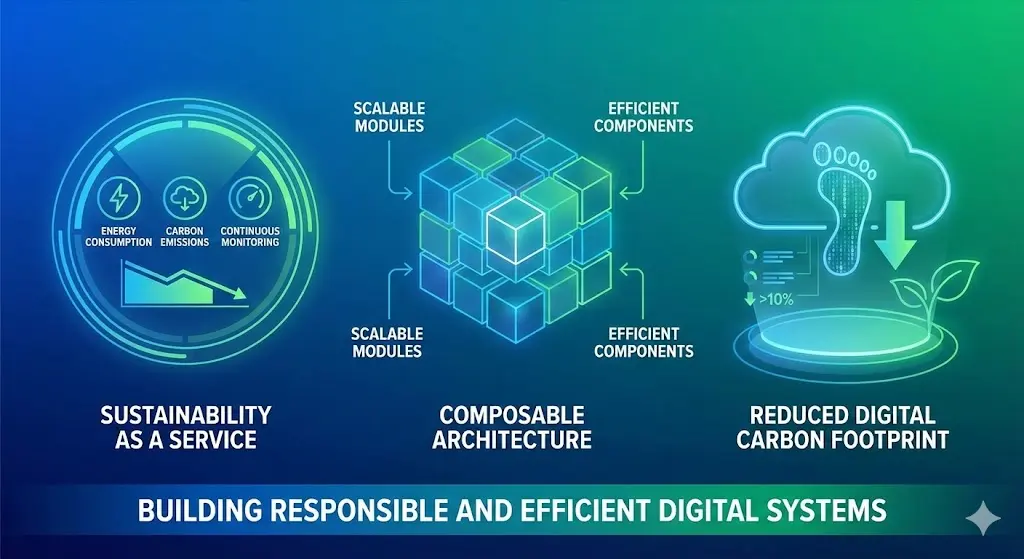
Introduction to Sustainability as a Service
Sustainability as a Service is becoming an important topic for companies that depend on digital platforms. As more business operations move online the use of software cloud services and data centers keeps increasing. This growth leads to higher energy consumption and higher carbon emissions. Many organizations now want to reduce this impact while still supporting innovation and business growth.
Sustainability as a Service offers a structured way to manage environmental impact as an ongoing activity. When this approach is combined with composable architecture it becomes easier to lower the digital carbon footprint of modern systems. This blog explains how these two concepts work together and why they matter for long term digital sustainability.

What Sustainability as a Service Means
Sustainability as a Service focuses on providing tools processes and insights that help organizations measure and reduce their environmental impact continuously. Instead of treating sustainability as a separate project it becomes part of everyday operations and technology decisions.
In digital environments this includes tracking energy use optimizing workloads reducing unnecessary computing and improving system efficiency. Sustainability as a Service helps teams understand how software design choices affect energy use and emissions. It also supports ongoing improvement rather than one time changes.
This approach is especially useful for large digital platforms where small efficiency gains can result in significant reductions in energy use over time.
Understanding the Digital Carbon Footprint
The digital carbon footprint refers to the carbon emissions created by running digital services. This includes servers storage data processing and network traffic. It also includes inefficiencies such as poorly optimized code unused features and over provisioned infrastructure.
As digital services grow the carbon footprint grows as well. Without careful design systems often consume more resources than necessary. This makes it harder for organizations to meet sustainability goals even if they invest in renewable energy or carbon offset programs.
Reducing the digital carbon footprint requires both better measurement and better system design. This is where composable architecture plays an important role.
What Is Composable Architecture
Composable architecture is a way of building software systems from independent components. Each component handles a specific function and communicates with other components through clear interfaces. These components can be developed deployed updated and scaled separately.
Instead of relying on one large system composable architecture allows teams to assemble systems from smaller parts. If one part needs improvement it can be changed without affecting the rest of the system. This makes systems more flexible and easier to manage.
While composable architecture is often discussed in terms of speed and flexibility it also provides clear environmental benefits.
How Traditional Systems Create Digital Waste
Traditional software systems often grow into large complex structures over time. They include many features that are rarely used but still consume resources. These systems are usually scaled as a whole which means unused capacity is always running.
When one part of a large system needs more performance the entire system may be scaled up. This leads to wasted computing power and higher energy use. Over time this waste adds significantly to carbon emissions.
Another issue is slow improvement. Large systems are difficult to change so inefficient components often remain in place for years. Even when better solutions exist replacing old parts can be risky and expensive.
Reducing Energy Use with Targeted Scaling
Composable architecture reduces energy use by allowing targeted scaling. Each component can scale independently based on actual demand. Only the parts of the system that need more resources receive them.
For example a search service may experience heavy traffic while a user profile service remains stable. With composable architecture only the search component scales up. This avoids wasting energy on parts of the system that do not need additional capacity.
This targeted approach leads to better use of cloud resources and lower overall energy consumption. It also supports more accurate planning and forecasting.
Supporting Continuous Optimization
Sustainability as a Service relies on continuous improvement. Data about energy use and emissions must lead to real changes in how systems are built and run. Composable architecture supports this by making systems easier to update.
When a component is identified as inefficient it can be optimized or replaced without affecting other components. Teams can test improvements measure results and deploy changes quickly. This allows organizations to respond to sustainability insights in a practical way.
In contrast tightly connected systems often require long release cycles. This slows down optimization and makes sustainability efforts less effective.
Avoiding Unused Features and Over Engineering
Composable architecture encourages teams to build only what is needed. Components are added when there is a clear requirement. This reduces the number of unused features that consume resources without delivering value.
Unused features increase memory use processing demand and system complexity. They also make systems harder to maintain and optimize. By keeping systems simple organizations reduce both technical and environmental overhead.
Composable systems also make it easier to remove features that are no longer needed. When a component is no longer used it can be shut down completely which directly reduces energy use.

Enabling Better Technology and Vendor Choices
Sustainability as a Service often includes choosing technology providers based on their environmental performance. Composable architecture makes this easier by reducing dependence on a single vendor or platform.
Each component can use the most suitable service or provider. This allows organizations to select energy efficient options or providers that use cleaner energy sources. Over time components can be moved to better platforms without rebuilding the entire system.
This flexibility helps organizations stay aligned with sustainability goals as technology and standards continue to evolve.
Making Sustainability Measurable and Actionable
Composable architecture improves measurement by allowing energy use to be tracked at the component level. This makes it easier to identify which parts of a system contribute most to the digital carbon footprint.
Sustainability as a Service platforms can use this data to provide clear recommendations. Teams can see the impact of specific changes rather than relying on general estimates. This makes sustainability efforts more practical and results focused.
Clear measurement also helps developers understand how their work affects environmental outcomes. This encourages more efficient design choices and supports a culture of responsibility.
Conclusion
Sustainability as a Service and composable architecture work well together to reduce digital carbon footprints. By designing systems as independent components organizations can scale efficiently reduce waste and improve performance over time. This leads to lower energy use and fewer emissions without slowing down innovation.
As digital services continue to grow the environmental impact of software will become more important. Combining composable architecture with ongoing sustainability services provides a strong foundation for building responsible and efficient digital systems.
