

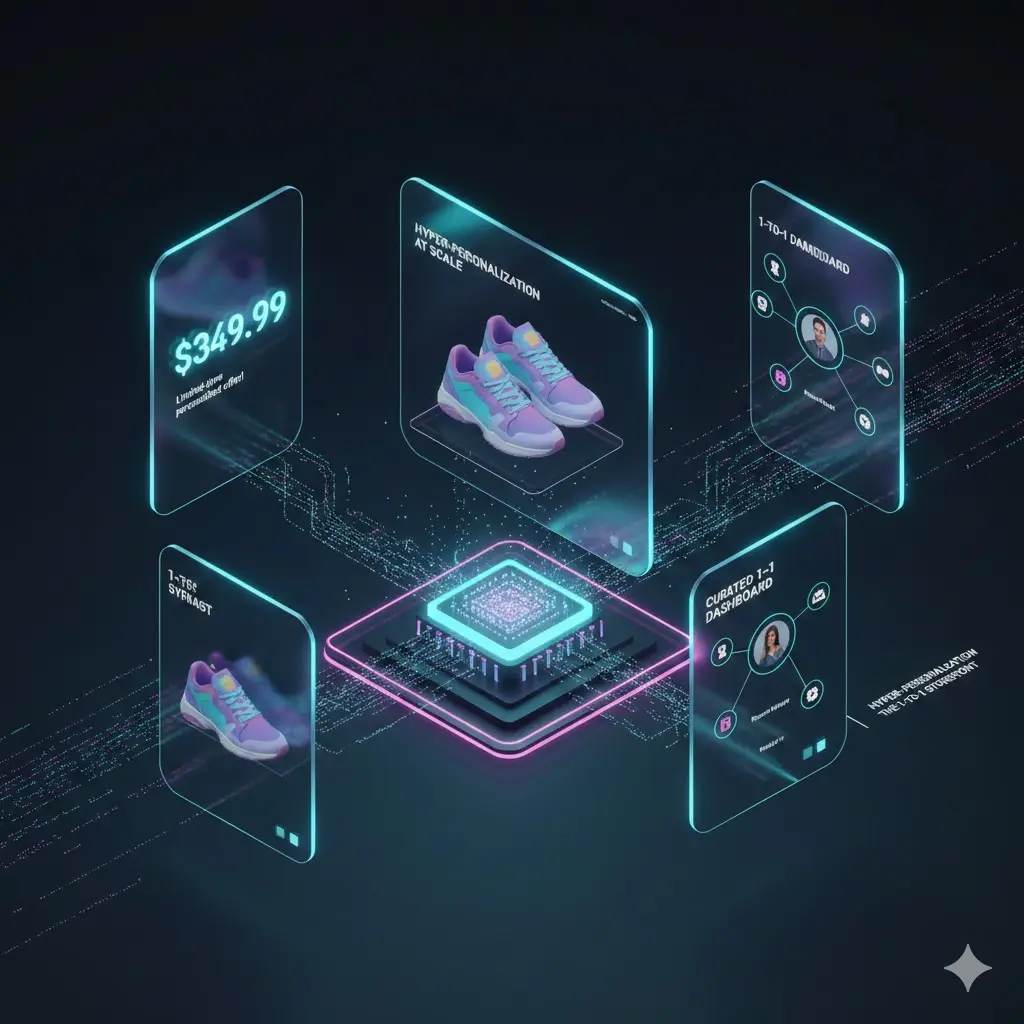
Today, hyper-personalization at scale represents a fundamental shift in how digital storefronts operate. It moves beyond static segments and surface-level recommendations to create dynamic, real-time, 1-to-1 experiences—where every user encounters a storefront uniquely shaped around their intent, behavior, context, and preferences.
This is the roadmap toward the 1-to-1 storefront: an adaptive digital environment that feels less like a catalog and more like a personal shopping assistant, evolving continuously with each interaction.
FROM SEGMENTS TO INDIVIDUALS: WHY BASIC PERSONALIZATION IS NO LONGER ENOUGH
Traditional personalization relies on segmentation. Users are grouped by age, location, purchase history, or broad behavioral traits. While segmentation improves relevance compared to generic experiences, it still treats individuals as averages.
The modern consumer does not behave like an average.
Intent changes by minute, not month
Preferences shift across devices and contexts
Decision-making is influenced by timing, mood, urgency, and environment
A user browsing casually on mobile during a commute is not the same user returning later on a desktop ready to purchase—even if they are the same person.
Hyper-personalization addresses this gap by reacting to real-time signals and continuously adjusting the experience at the individual level.
DEFINING HYPER-PERSONALIZATION AT SCALE
Hyper-personalization at scale is the ability to deliver individualized experiences to millions of users simultaneously, without manual rules or static templates.
It combines:
Real-time data ingestion
Advanced machine learning and AI
Context-aware decisioning
Modular, composable storefront architecture
The goal is not to personalize one element—but to orchestrate the entire storefront experience dynamically for each user.
This includes:
Homepage layout
Navigation structure
Content sequencing
Product discovery paths
Pricing signals and promotions
Messaging tone and urgency
In a true 1-to-1 storefront, no two users see the same store at the same moment.
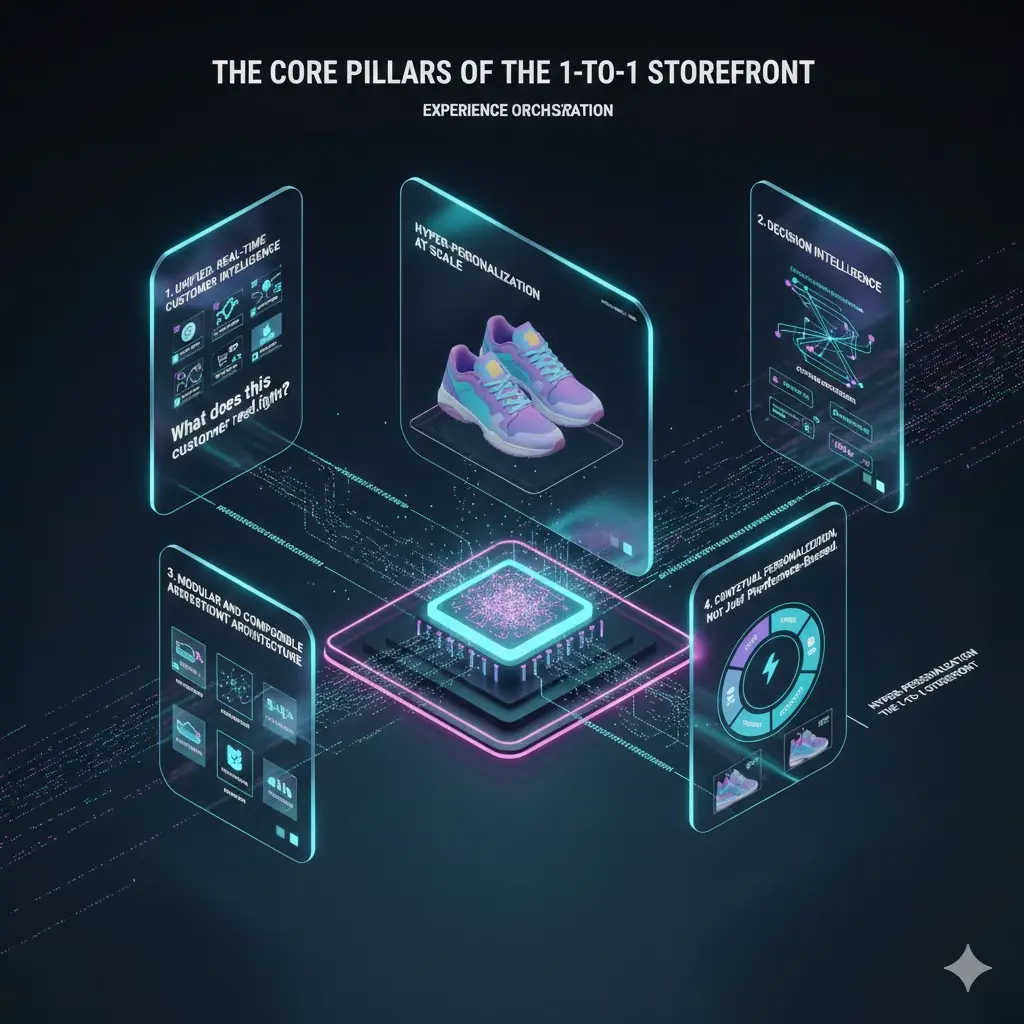
THE CORE PILLARS OF THE 1-TO-1 STOREFRONT
1. Unified, Real-Time Customer Intelligence
Hyper-personalization starts with data—but not just more data. It requires unified, actionable data.
This includes:
Behavioral signals (clicks, scroll depth, dwell time)
Transactional history
Contextual data (device, location, time, weather, referrer)
Interaction cadence and frequency
Micro-intents inferred from behavior patterns
The key shift is moving from historical snapshots to continuous behavioral streams. Decisions are made in milliseconds, not hours.
A 1-to-1 storefront doesn’t ask, “Who is this customer?”
It asks, “What does this customer need right now?”
2. Decision Intelligence Over Rules Engines
Most personalization systems rely on rules:
“If user is X, show Y.”
Hyper-personalization replaces rigid rules with decision intelligence—AI systems that evaluate probabilities, trade-offs, and outcomes in real time.
Instead of predefining experiences, the system:
Predicts likely user intent
Evaluates multiple experience paths
Selects the optimal storefront configuration
Learns from the outcome instantly
This allows personalization to scale without becoming brittle or impossible to manage.
3. Modular and Composable Storefront Architecture
A 1-to-1 storefront cannot exist on a monolithic frontend.
Hyper-personalization requires modular components:
Dynamic hero banners
Adaptive product grids
Contextual navigation blocks
Flexible content modules
Each component must be independently swappable, reorderable, or replaceable based on real-time decisions.
Composable commerce architectures enable this by decoupling:
Content
Commerce logic
Presentation layers
Personalization engines
This architectural flexibility is what allows personalization to happen everywhere, all at once.
4. Contextual Personalization, Not Just Preference-Based
Most personalization focuses on what users like. Hyper-personalization focuses equally on when and why.
Contextual signals include:
Time of day
Device type
Session duration
Entry point (search, social, email)
Behavioral momentum
For example:
A returning customer late at night may see faster checkout paths
A first-time visitor from social may see trust-building content
A high-intent user may see reduced friction and urgency cues
Context transforms personalization from relevance into resonance.
MOVING FROM RECOMMENDATIONS TO EXPERIENCE ORCHESTRATION
Product recommendations are only one layer of personalization—and often the least impactful on their own.
Hyper-personalization orchestrates the entire experience flow:
What the user sees first
What they see next
What is hidden or deprioritized
How many choices are presented
When to prompt, pause, or simplify
This orchestration reduces cognitive load and aligns the storefront with the user’s decision state.
The result is not more content—but better sequencing.

PRIVACY, TRUST, AND ETHICAL PERSONALIZATION
Hyper-personalization must be built responsibly.
As personalization becomes more precise, transparency becomes critical. Users should feel helped—not watched.
Key principles:
Use first-party data responsibly
Avoid personalization that feels invasive
Provide clear value in exchange for data
Design for trust, not manipulation
The most successful 1-to-1 storefronts are those where personalization feels natural and supportive, not algorithmic or aggressive.
MEASURING SUCCESS IN A HYPER-PERSONALIZED WORLD
Traditional KPIs like click-through rates and average order value still matter—but they are no longer sufficient on their own.
Advanced metrics include:
Time-to-value (how quickly users find what they need)
Decision confidence indicators
Experience consistency across sessions
Adaptation speed of personalization models
Long-term engagement lift, not short-term conversion spikes
The real win is not just higher sales—it’s reduced friction and increased loyalty.
THE FUTURE: FROM STOREFRONTS TO PERSONAL SHOPPING ENVIRONMENTS
The 1-to-1 storefront is not the end state—it’s the foundation.
As hyper-personalization matures, storefronts will evolve into:
Predictive environments
Conversational and agent-driven interfaces
Cross-channel continuity hubs
Experience layers that persist across devices and sessions
Commerce will feel less transactional and more assistive—designed around human behavior rather than product catalogs.
CONCLUSION
Hyper-personalization at scale is no longer a competitive advantage—it’s becoming a baseline expectation. The roadmap to the 1-to-1 storefront requires more than better recommendations. It demands a rethinking of data, architecture, decision-making, and experience design.
Brands that succeed will not be those who personalize more—but those who personalize smarter, adapting continuously to individual intent while maintaining trust and clarity.
The future of digital commerce belongs to storefronts that don’t just sell—but understand.
