


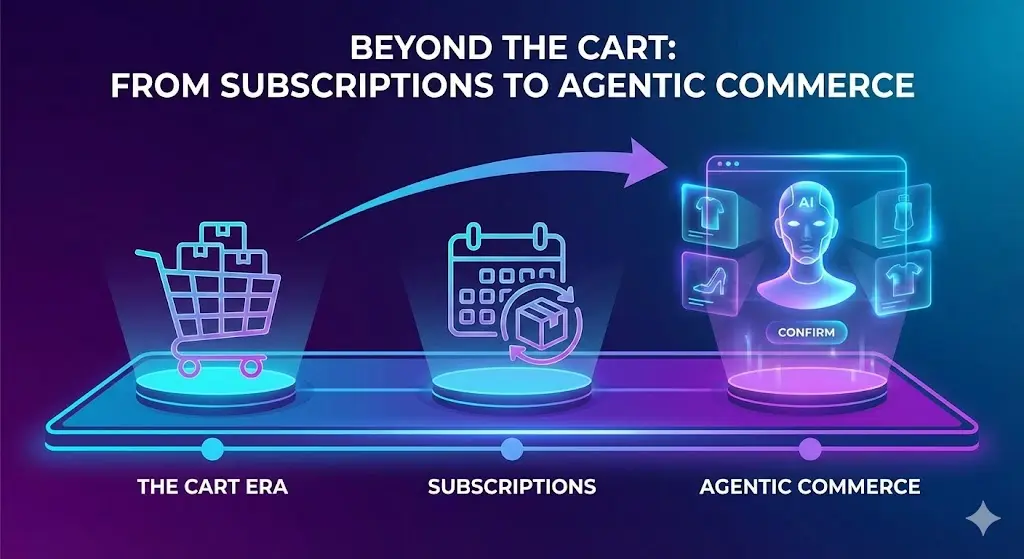
The retail landscape is evolving at a pace few could have anticipated just a decade ago. Traditional shopping, defined by one-off purchases and reactive consumer behavior, is being replaced by subscription models that anticipate and fulfill needs proactively. This evolution has laid the foundation for a more advanced and nuanced concept: agentic commerce. In this model, commerce is not only predictive but autonomous, leveraging advanced technology to act on behalf of the consumer. Understanding this shift requires a deep dive into the mechanics of both the subscription economy and agentic commerce, as well as the intersection between the two.
The Subscription Economy: A Recap
Subscription-based business models have transformed how consumers access products and services. Rather than purchasing goods outright, customers pay recurring fees to receive consistent, often curated offerings. This model has been highly successful across industries, from digital services like streaming platforms to physical goods like meal kits and grooming products.
The appeal of subscriptions lies in convenience, predictability, and personalized experiences. Consumers no longer need to make repetitive purchasing decisions; the service does it for them. Businesses benefit from recurring revenue streams, better demand forecasting, and stronger customer retention.
However, traditional subscription models still rely heavily on consumer input. Even when algorithms suggest products or services, the final decision often rests with the consumer. This is where agentic commerce begins to change the paradigm.
Defining Agentic Commerce
Agentic commerce refers to transactions where artificial intelligence, smart systems, and automated agents act on behalf of consumers to make purchasing decisions. These systems are designed to understand preferences, anticipate needs, and execute transactions autonomously. Unlike simple recommendation engines, agentic commerce platforms can manage budgets, schedule purchases, and even negotiate deals without requiring constant user input.
At its core, agentic commerce shifts the consumer role from decision-maker to overseer. Consumers set parameters such as budget, preferences, or sustainability goals, while the system manages the rest. This creates a highly personalized, frictionless experience, where convenience is combined with efficiency and relevance.
The Intersection of Subscription and Agentic Commerce
While subscriptions introduced a level of predictability and continuity in consumer behavior, agentic commerce takes it a step further by introducing autonomy. Consider the traditional subscription model of a skincare company. A consumer selects products, delivery frequency, and payment options. With agentic commerce, the system could analyze the consumer’s usage patterns, environmental factors, or even changes in skin condition to automatically adjust the order—adding, removing, or swapping products as needed.
This evolution is significant for both consumers and businesses. For consumers, it reduces the cognitive load of managing subscriptions and ensures that products remain aligned with changing needs. For businesses, it increases loyalty, reduces churn, and provides richer data insights, allowing for highly dynamic inventory and supply chain management.

Technological Foundations
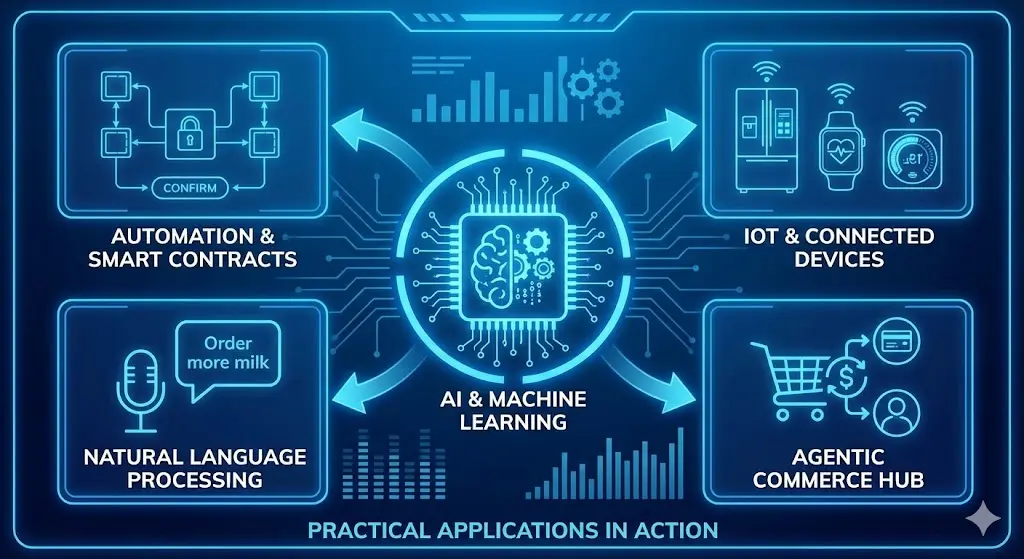
Agentic commerce relies on several key technological innovations:
-
Artificial Intelligence and Machine Learning: These systems analyze historical behavior, identify patterns, and predict future needs. They also continuously refine their recommendations based on outcomes, making the commerce experience increasingly accurate over time.
-
Automation and Smart Contracts: Many agentic commerce transactions are executed automatically via secure protocols. Smart contracts in blockchain technology, for example, can facilitate autonomous purchasing while ensuring compliance with predefined conditions.
-
IoT and Connected Devices: Integration with smart devices allows agentic systems to gather real-time data. Refrigerators that track food consumption or wearable devices monitoring health metrics are examples of data inputs that can inform autonomous purchasing decisions.
-
Natural Language Processing: AI-powered communication tools enable consumers to interact with agentic systems through natural dialogue, further simplifying the oversight process.
Practical Applications
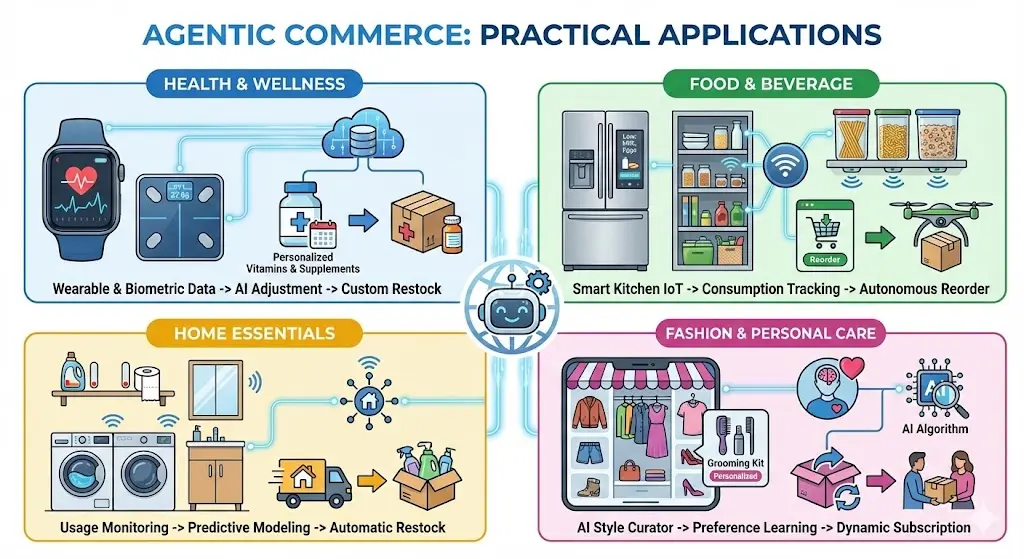
Several industries are already exploring the convergence of subscriptions and agentic commerce:
-
Health and Wellness: Personalized vitamin and supplement subscriptions can be automatically adjusted based on biometric data collected from wearable devices.
-
Food and Beverage: Smart kitchens equipped with IoT devices can autonomously reorder ingredients and meals based on consumption patterns and dietary goals.
-
Home Essentials: Household items like detergents, toiletries, and cleaning supplies can be restocked automatically, avoiding both overstock and shortages.
-
Fashion and Personal Care: AI-driven platforms can curate clothing or grooming products based on style trends, past purchases, and user preferences, creating dynamic subscription experiences.
Benefits and Opportunities
The combination of subscription and agentic commerce offers several strategic advantages:
-
Personalization at Scale: The system adapts in real time to the consumer’s evolving needs, creating hyper-relevant experiences.
-
Reduced Cognitive Load: By automating decisions, consumers can focus on higher-level priorities instead of routine purchasing tasks.
-
Improved Retention and Loyalty: Dynamic subscriptions that respond to consumer behavior naturally increase engagement and decrease churn.
-
Data-Driven Insights: Businesses gain access to richer behavioral data, enabling better forecasting, inventory planning, and product innovation.
Challenges and Considerations
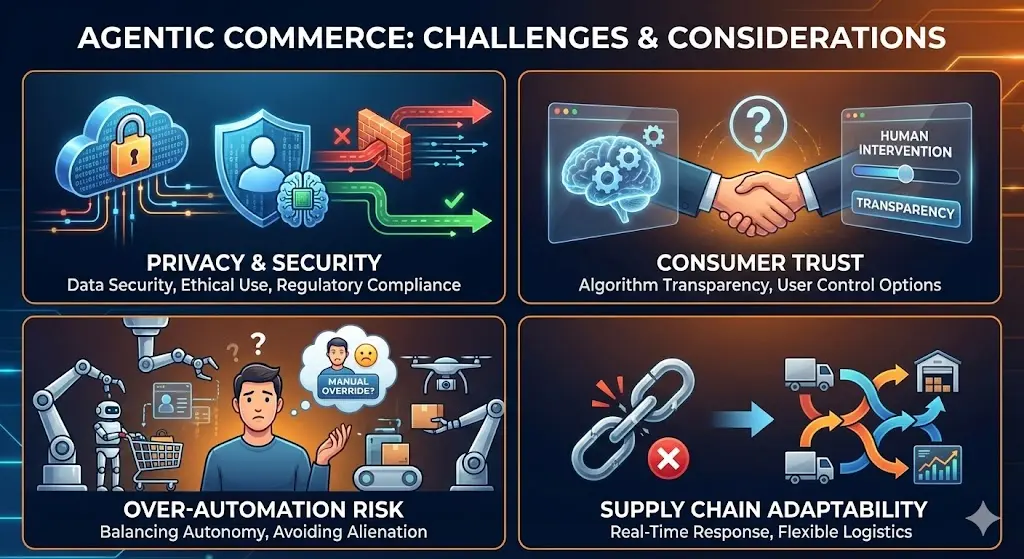
Despite its potential, agentic commerce introduces complexities that need careful attention:
-
Privacy and Security: Autonomous systems rely heavily on personal data. Ensuring secure storage, ethical use, and regulatory compliance is critical.
-
Consumer Trust: Users must trust that the system will make decisions aligned with their preferences. Transparency in algorithms and options for human intervention are essential.
-
Over-Automation Risk: Some consumers may feel alienated if too many decisions are removed from their control. Balancing autonomy with human oversight is key.
-
Supply Chain Adaptability: Dynamic, autonomous subscriptions require flexible supply chains capable of responding to real-time demand fluctuations.
The Future Outlook
The future of commerce will likely see a continuum between human-driven subscriptions and fully autonomous agentic commerce. Early adoption will focus on hybrid models, where consumers set boundaries and AI manages execution within those limits. Over time, as systems become more sophisticated and consumer trust grows, agentic commerce could dominate the retail experience.
We may also see industry-specific ecosystems emerge. Healthcare, home automation, and personal care are natural starting points, but eventually, agentic commerce could extend into complex financial, travel, and lifestyle domains. The underlying principle remains consistent: commerce will be proactive, anticipatory, and increasingly independent.
Conclusion
The convergence of the subscription economy and agentic commerce represents a paradigm shift in retail. Subscriptions brought predictability, while agentic commerce brings autonomy. Together, they redefine the consumer experience, making it more seamless, personalized, and adaptive. Businesses that understand this intersection and invest in AI-driven, autonomous systems will be better positioned to meet evolving expectations and build deeper, more resilient relationships with their customers.
As the lines between consumer intention and automated action blur, the future of commerce will be less about carts and checkouts and more about intelligent systems acting as true agents of consumer choice.


