



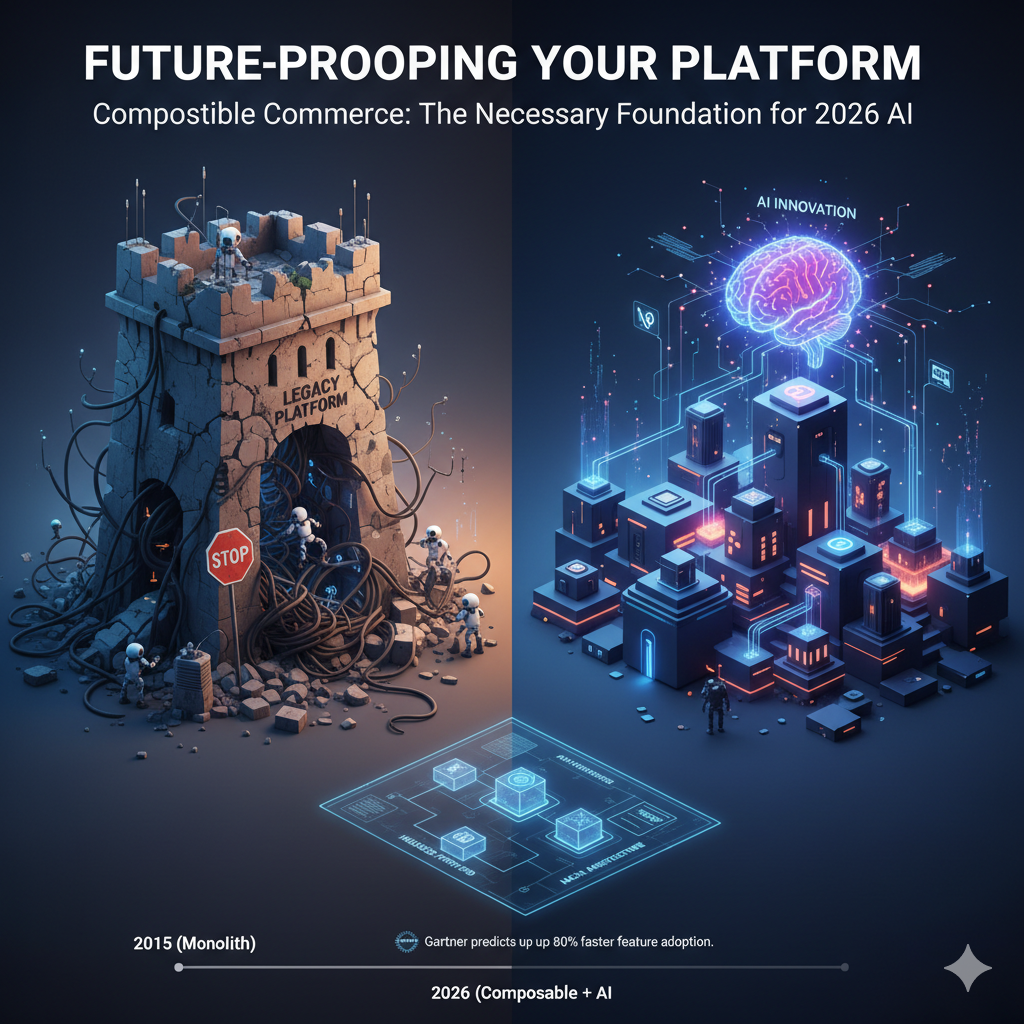
The Bottleneck: Why Your Current Platform is Stopping AI Innovation
Gartner predicts that organizations adopting Composable Commerce will achieve up to 80% faster feature adoption than competitors stuck in monolithic platforms. Yet, despite this, many enterprise e-commerce teams are still running systems architected for 2015—when AI was a “nice to have,” not a survival requirement.
In Article 1, we explored the rise of Agentic AI—autonomous systems capable of learning and executing tasks that redefine personalization, operations, and customer experience. But here’s the hard truth: if your architecture is monolithic, your AI strategy is already handicapped.
Legacy platforms were never built for real-time data orchestration, modular scalability, or API-based experimentation. The result? Innovation bottlenecks, skyrocketing maintenance costs, and a widening competitive gap between digital leaders and everyone else.
Composable Commerce is not just another architectural buzzword—it’s the strategic foundation for AI-driven growth heading into 2026. Let’s unpack why.
The Core Problem: Why Monolithic Architecture Fails Modern E-commerce
-
Vendor Lock-in and Technical Debt
Monolithic platforms lock enterprises into a rigid ecosystem. You can’t innovate without the vendor’s permission, can’t scale without major upgrades, and can’t evolve without rewriting large sections of code.
This “upgrade treadmill” traps development teams in an endless cycle of patching, testing, and refactoring. A small change—like integrating a new AI-based search service—can require a full system overhaul. That’s months of delay and millions in technical debt, just to remain competitive.
The opportunity cost is staggering. While your team is fighting through upgrade dependencies, more agile competitors are shipping new features, testing new AI models, and personalizing every touchpoint in real time.
-
Siloed Data & Sluggish Speed
Monolithic systems are inherently siloed. Customer data sits in one system (CRM), product information in another (PIM), transactions in a third (ERP). Connecting them requires brittle, one-off integrations.
For AI, this is fatal. Machine learning thrives on unified, clean, real-time data. If your architecture can’t deliver that, your AI tools can’t deliver accurate insights—or worse, they’ll produce biased, outdated recommendations.
Add in slow page loads and inflexible workflows, and you’re not just losing speed; you’re losing conversion and credibility. In the era of predictive commerce, slow data equals slow decisions.

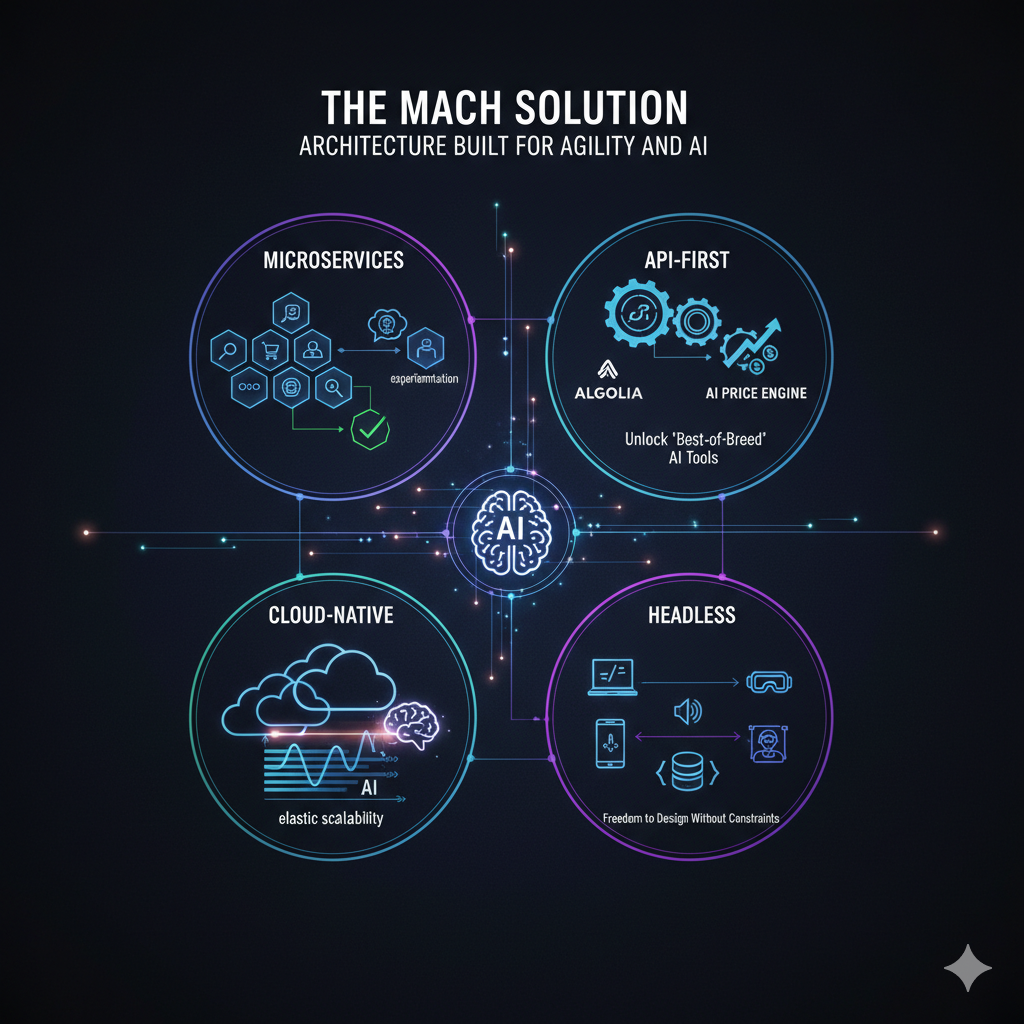
The MACH Solution: Architecture Built for Agility and AI
To break free from these constraints, global enterprises are embracing MACH architecture—a framework built on Microservices, API-first, Cloud-native, and Headless principles. MACH isn’t a single product; it’s an ecosystem that makes AI innovation scalable, modular, and risk-resilient.
-
Microservices: The Building Blocks for Experimentation
In a composable setup, each service—catalog, checkout, pricing, search—operates as an independent, deployable unit. That means you can experiment without fear.
For example, let’s say you’re piloting an AI-driven personalization engine. In a monolithic system, a failure could crash your entire storefront. In a microservices-based system, it only affects that one service. Your customers keep shopping while your developers iterate.
Microservices de-risk innovation and accelerate experimentation cycles. CTOs gain confidence to test AI-driven ideas rapidly, knowing any issue can be isolated, rolled back, or replaced without disrupting the business.
-
API-First: Unlocking “Best-of-Breed” AI Tools
AI evolves faster than any software category in commerce. An API-first architecture lets you plug in best-in-class tools—not just what your platform vendor provides.
You can use Algolia for intelligent search, Contentful for composable content management, and a specialized AI pricing engine that adjusts prices dynamically based on demand signals. Each integrates seamlessly through APIs rather than code rewrites.
This modular flexibility gives your business a future-proof edge: as new AI vendors emerge, you can adopt them immediately—without replatforming. That’s innovation velocity by design.
-
Cloud-Native: Elastic Scalability Meets Predictive AI
Cloud-native commerce eliminates physical infrastructure limits. AI workloads—especially for recommendation engines or predictive analytics—can scale elastically with demand. You’re no longer provisioning servers for peak traffic; your platform scales intelligently with your customers.
It’s not just about cost efficiency; it’s about real-time adaptability. When AI models detect a spike in interest for a product line, your infrastructure can respond instantly—allocating more compute, pre-fetching content, or updating promotions on the fly.
-
Headless: The Freedom to Design Without Constraints
Headless commerce decouples the front-end (customer experience layer) from the back-end (commerce logic). This enables teams to deliver ultra-fast, custom experiences across web, mobile, voice, and even AR or metaverse interfaces.
When your architecture is headless, you can connect AI-driven components—like conversational agents, visual search, or generative product descriptions—directly into your front-end without waiting on the back-end roadmap. That’s true agility.
The Phased Approach: A Cost-Efficient Migration Roadmap
Executives often fear that moving to composable commerce means a massive, expensive “rip and replace.” The reality? Successful transformations happen incrementally, using a phased roadmap that delivers ROI at every stage.
Phase 1: Headless Front-end Pilot
Start small. Decouple your front-end from the monolithic back-end using a headless framework like Next.js or Remix. This pilot instantly improves performance (often reducing load times by 50%+) and provides a visible, measurable win for stakeholders.
This phase proves value quickly—showing that composable isn’t about disruption; it’s about evolution. It also lays the foundation for integrating future AI-driven UX enhancements like voice navigation, dynamic personalization, and predictive merchandising.
Phase 2: Swapping High-Pain Microservices
Next, identify which components are creating the most friction—slow checkout, outdated search, or inefficient PIM systems. Replace these with best-of-breed composable alternatives one at a time.
For example:
- Replace your legacy PIM with a composable PIM like Akeneo or Plytix.
- Upgrade search with AI-based tools like Algolia or Constructor.io.
- Introduce a microservice-based checkout for faster, frictionless transactions.
Each replacement reduces technical debt and increases modularity, bringing your architecture closer to full composability without overwhelming teams or budgets.
Expert Warning: Control Scope and Protect Budgets
As you evolve, maintain a contingency budget for unexpected integration complexities. AI-driven systems can introduce new dependencies—especially around data quality and synchronization. Avoid scope creep by clearly defining success metrics for each migration phase.
This disciplined, agile approach ensures executives see continuous business value while mitigating risk—a vital balance for enterprise-scale transformations.
The Business Case: Investing in Composable for Competitive Edge
Composable commerce isn’t just a technology decision; it’s a business performance strategy.
- Lower Total Cost of Ownership (TCO): By replacing only what you need, when you need it, you avoid the massive replatforming costs typical of monolith upgrades.
- Faster Time-to-Market: Independent microservices enable faster rollouts, updates, and experiments.
- Increased Innovation Capacity: Teams can test, fail, and learn faster—with minimal risk to the core platform.
- AI Readiness: Unified data and modular architecture create the perfect environment for machine learning, personalization, and predictive analytics.
Organizations adopting composable commerce report significant operational agility and higher conversion rates due to real-time data integration and personalized experiences.
As AI becomes the backbone of e-commerce differentiation, composable architecture becomes the necessary foundation for adaptability, not just scalability.
You’ve built the infrastructure—Composable Commerce—now it’s time to explore what it enables for your customers.

Next up: Immersive CX – How AI and Composable Architecture Redefine Digital Experience (Article 3).
Composable Commerce FAQs
Q1: What’s the difference between Headless and Composable Commerce?
Headless is a front-end decoupling strategy—it separates the user interface from the back-end. Composable Commerce goes further, enabling each component (cart, CMS, payments, etc.) to be independently replaced or upgraded through APIs. Think of headless as the first step toward full composability.
Q2: Is Composable Commerce only for large enterprises?
Not anymore. Mid-market brands like Primark and Nordic Nest have successfully transitioned to composable ecosystems, leveraging MACH principles to innovate faster without the overhead of enterprise complexity. Modern platforms and integration frameworks have democratized access to composability, making it viable for businesses of all sizes.
Q3: How long does a composable transition take?
A full migration can take 12–24 months depending on scope, but many organizations see ROI within the first 3–6 months by starting small—typically with a headless pilot or targeted microservice replacement.
Q4: Will composable commerce make our tech stack harder to manage?
Initially, it introduces more moving parts—but with proper orchestration tools and governance, it actually simplifies maintenance. You gain the freedom to update or swap components without system-wide downtime.
Final Thoughts
The era of AI-driven commerce is accelerating faster than most legacy systems can evolve. In 2026 and beyond, the winners won’t be the brands with the biggest budgets—but those with the most adaptable architectures.
Composable Commerce provides the foundation for that adaptability. It transforms your e-commerce stack from a rigid monolith into a living ecosystem—ready for whatever AI, data, and customer expectations come next.
The question isn’t if you’ll adopt composable commerce.
It’s how soon you can start before AI leaves your platform behind.


