

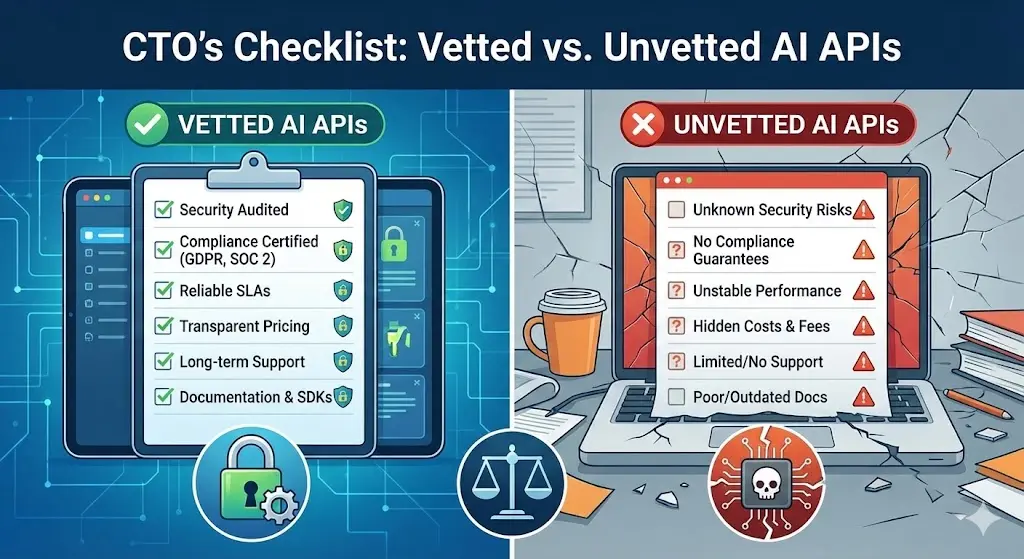
Artificial intelligence (AI) has become a cornerstone of modern software development. From automating routine tasks to generating insights from massive datasets, AI APIs are enabling companies to innovate faster than ever before. For Chief Technology Officers (CTOs) and technology leaders, choosing the right AI API is a critical decision. A wrong choice can result in security vulnerabilities, compliance risks, or wasted development effort.
In this article, we explore the differences between vetted and unvetted AI APIs and provide a practical checklist for CTOs to evaluate and select the right AI solutions for their organization.
Understanding Vetted vs. Unvetted AI APIs
Before diving into the evaluation process, it is essential to define what “vetted” and “unvetted” AI APIs mean in practical terms.
Vetted AI APIs are services that have undergone thorough security, compliance, and quality reviews. They are usually provided by established vendors or platforms, come with clear documentation, and often include service-level agreements (SLAs). These APIs are considered reliable and safe for enterprise use.
Unvetted AI APIs, on the other hand, are typically newer, less established services, or APIs released without comprehensive security and compliance reviews. They may offer cutting-edge features but carry higher risks. Unvetted APIs might lack proper documentation, scalability guarantees, or robust privacy safeguards.
The choice between vetted and unvetted APIs depends on a company’s risk tolerance, project timeline, and regulatory requirements. However, for most enterprises, a structured evaluation process is necessary to make an informed decision.
Key Considerations for CTOs
When evaluating AI APIs, CTOs should consider several factors. These considerations help differentiate reliable APIs from those that could introduce risks to the organization.
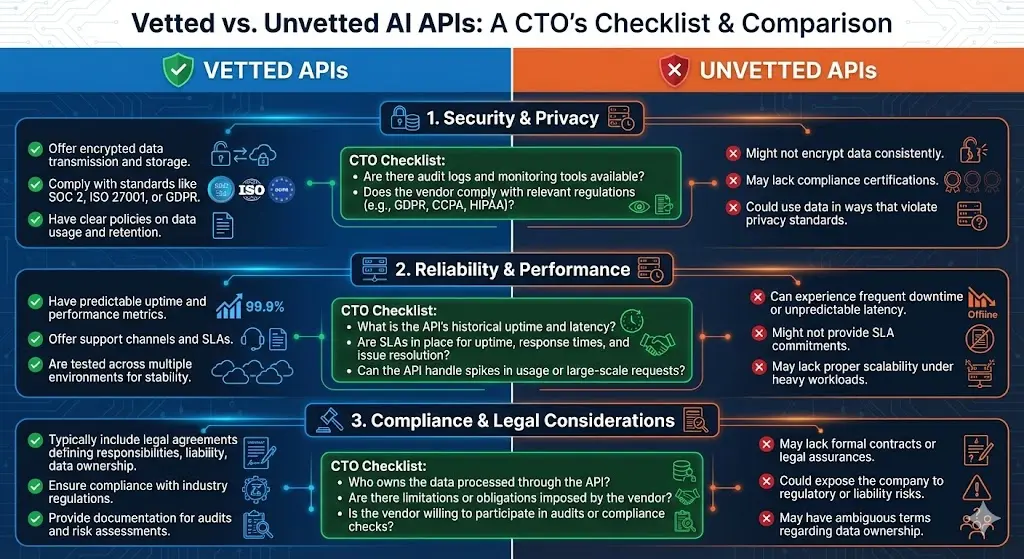
1. Security and Privacy
Vetted APIs:
-
Offer encrypted data transmission and storage.
-
Comply with standards like SOC 2, ISO 27001, or GDPR.
-
Have clear policies on data usage and retention.
Unvetted APIs:
-
Might not encrypt data consistently.
-
May lack compliance certifications.
-
Could use data in ways that violate privacy standards.
Checklist for CTOs:
-
Are there audit logs and monitoring tools available?
-
Does the vendor comply with relevant regulations (e.g., GDPR, CCPA, HIPAA)?
2. Reliability and Performance
Vetted APIs:
-
Have predictable uptime and performance metrics.
-
Offer support channels and SLAs.
-
Are tested across multiple environments for stability.
Unvetted APIs:
-
Can experience frequent downtime or unpredictable latency.
-
Might not provide SLA commitments.
-
May lack proper scalability under heavy workloads.
Checklist for CTOs:
-
What is the API’s historical uptime and latency?
-
Are SLAs in place for uptime, response times, and issue resolution?
-
Can the API handle spikes in usage or large-scale requests?
3. Compliance and Legal Considerations
Vetted APIs:
-
Typically include legal agreements that define responsibilities, liability, and data ownership.
-
Ensure compliance with industry regulations.
-
Provide documentation for audits and risk assessments.
Unvetted APIs:
-
May lack formal contracts or legal assurances.
-
Could expose the company to regulatory or liability risks.
-
May have ambiguous terms regarding data ownership.
Checklist for CTOs:
-
Who owns the data processed through the API?
-
Are there limitations or obligations imposed by the vendor?
-
Is the vendor willing to participate in audits or compliance checks?
4. Accuracy and Quality of AI Models
Vetted APIs:
-
Are backed by well-tested AI models.
-
Often include performance benchmarks and case studies.
-
Provide clear documentation about limitations and expected outcomes.
Unvetted APIs:
-
May use experimental models with limited testing.
-
Might produce inconsistent or biased results.
-
Often have sparse documentation.
Checklist for CTOs:
-
Are there publicly available performance metrics?
-
Has the model been tested on datasets similar to yours?
-
Are there mechanisms to monitor and correct errors or biases?
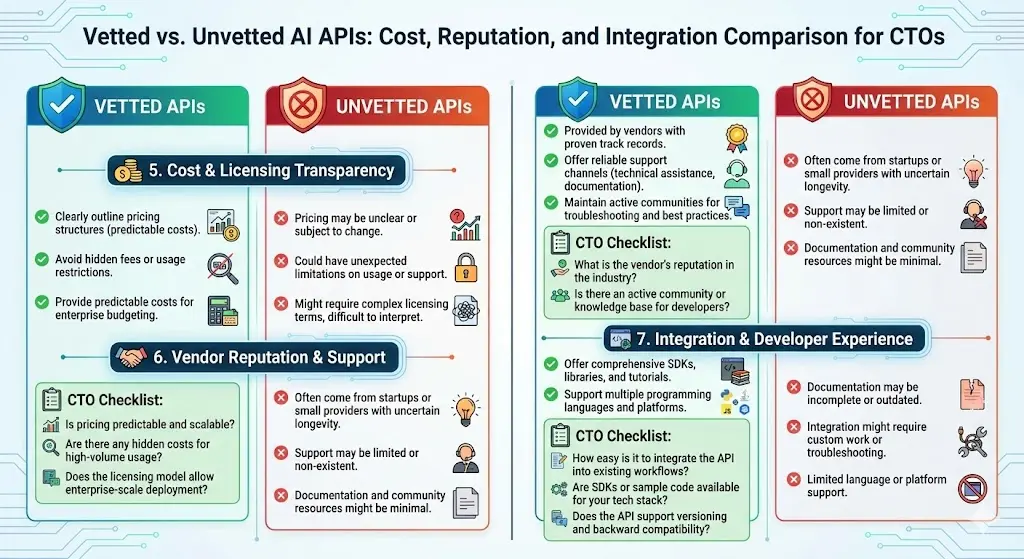
5. Cost and Licensing Transparency
Vetted APIs:
-
Clearly outline pricing structures.
-
Avoid hidden fees or usage restrictions.
-
Provide predictable costs for enterprise budgeting.
Unvetted APIs:
-
Pricing may be unclear or subject to change.
-
Could have unexpected limitations on usage or support.
-
Might require complex licensing terms that are difficult to interpret.
Checklist for CTOs:
-
Is pricing predictable and scalable?
-
Are there any hidden costs for high-volume usage?
-
Does the licensing model allow enterprise-scale deployment?
6. Vendor Reputation and Support
Vetted APIs:
-
Provided by vendors with proven track records.
-
Offer reliable support channels, including technical assistance and documentation.
-
Maintain active communities for troubleshooting and best practices.
Unvetted APIs:
-
Often come from startups or small providers with uncertain longevity.
-
Support may be limited or non-existent.
-
Documentation and community resources might be minimal.
Checklist for CTOs:
-
What is the vendor’s reputation in the industry?
-
Are support channels responsive and effective?
-
Is there an active community or knowledge base for developers?
7. Integration and Developer Experience
Vetted APIs:
-
Offer comprehensive SDKs, libraries, and tutorials.
-
Provide clear examples of integration with existing systems.
-
Support multiple programming languages and platforms.
Unvetted APIs:
-
Documentation may be incomplete or outdated.
-
Integration might require custom work or troubleshooting.
-
Limited language or platform support.
Checklist for CTOs:
-
How easy is it to integrate the API into existing workflows?
-
Are SDKs or sample code available for your tech stack?
-
Does the API support versioning and backward compatibility?
Making the Decision: Vetted vs. Unvetted
For CTOs, the choice between vetted and unvetted AI APIs is rarely black and white. Here are some guiding principles:
-
For enterprise-critical projects: Vetted APIs are almost always the safer choice. Security, compliance, and reliability outweigh the novelty of experimental features.
-
For rapid prototyping or research: Unvetted APIs may offer cutting-edge capabilities, but risk management strategies should be in place. Consider isolated testing environments and clear rollback plans.
-
Hybrid approach: Some companies use a combination, employing vetted APIs for core operations while experimenting with unvetted APIs in sandboxed environments.
Practical Steps for CTOs
To simplify the evaluation process, CTOs can follow these steps:
-
Define project requirements: Identify the key functional, security, and compliance needs.
-
Shortlist APIs: Separate vetted and unvetted options based on preliminary research.
-
Perform risk assessment: Evaluate security, legal, and operational risks for each option.
-
Test APIs: Run pilot projects or sandbox tests to evaluate performance, accuracy, and usability.
-
Assess vendor stability: Check reputation, financial stability, and support availability.
-
Document findings: Maintain a comparison matrix for all evaluated APIs.
-
Make a decision: Choose the API(s) that balance innovation, risk, and cost effectively.
Conclusion
AI APIs are powerful tools that can accelerate innovation, but they come with varying levels of risk and reliability. For CTOs, understanding the difference between vetted and unvetted APIs is essential for making informed decisions. By focusing on security, compliance, reliability, and vendor reputation, technology leaders can implement AI solutions that are both innovative and safe.
A structured evaluation process—combined with careful testing and risk assessment—ensures that AI adoption enhances your organization’s capabilities without introducing unnecessary risk.
Ultimately, the right API choice can drive both technical and business success, while the wrong one can lead to security breaches, compliance violations, and wasted resources. For CTOs, a thorough checklist is not just a convenience—it’s a necessity.
