



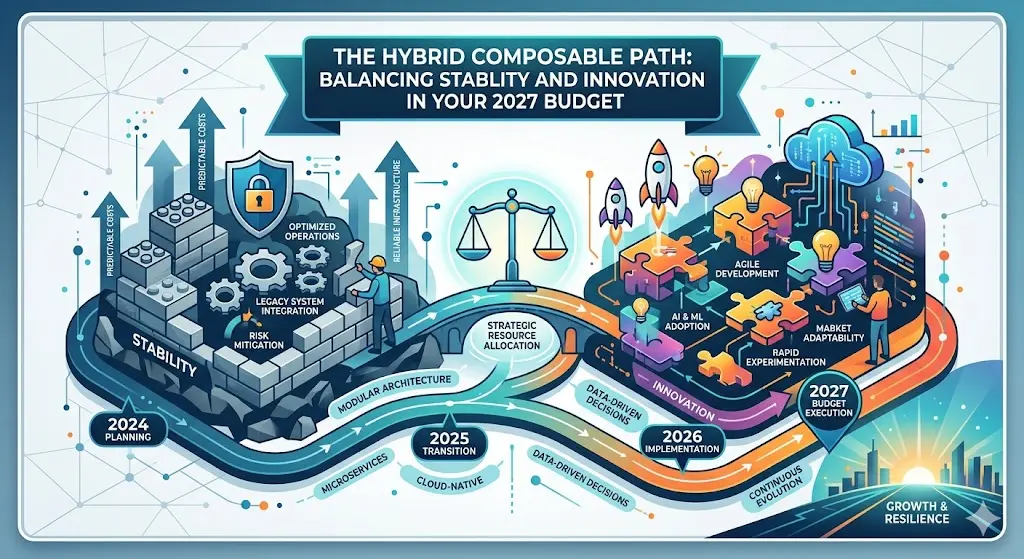
Planning a 2027 budget is no longer about choosing between caution and ambition—it’s about engineering both into the same system. Organizations today operate in an environment where disruption is constant, yet reliability remains non-negotiable. The Hybrid Composable Path offers a way forward: a budgeting philosophy designed to protect core operations while actively enabling innovation.
This is not a trend-driven concept—it’s a structural evolution in how financial strategy supports modern business.
Rethinking Budgeting as a System, Not a Spreadsheet
Traditional budgets are static by design. They assume predictability, enforce rigid allocations, and prioritize control. That model worked when change was slower and systems were more centralized.
In contrast, modern organizations function more like ecosystems. They rely on interconnected platforms, third-party services, and rapidly evolving technologies. Budgeting, therefore, must mirror this reality.
The hybrid composable approach treats budgeting as a living system:
- Stable where consistency is critical
- Flexible where adaptation creates value
Instead of locking decisions upfront, it enables continuous adjustment without losing strategic direction.

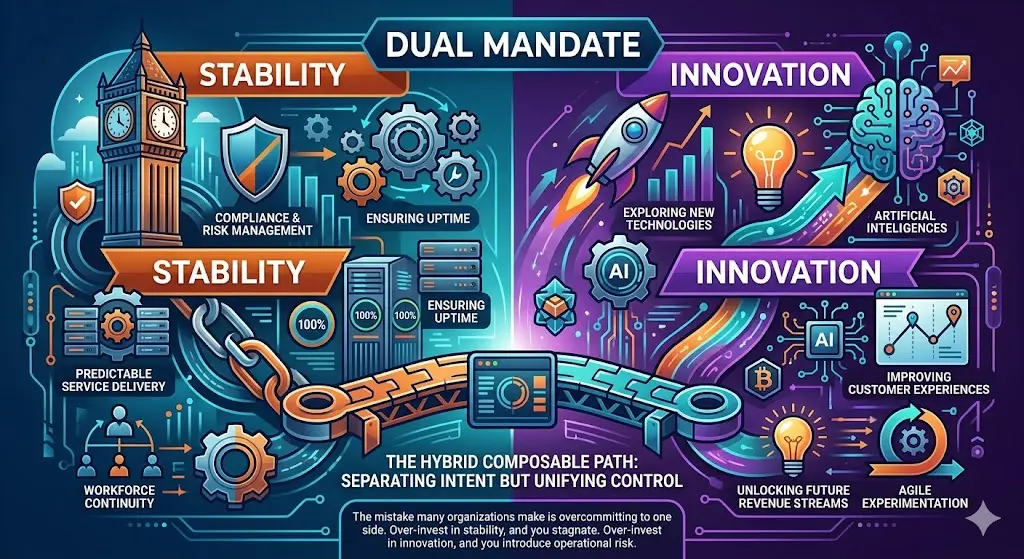
The Dual Mandate: Stability vs. Innovation
Every organization faces two competing financial priorities:
1. Stability
Ensuring uptime, compliance, workforce continuity, and predictable service delivery.
2. Innovation
Exploring new technologies, improving customer experiences, and unlocking future revenue streams.
The mistake many organizations make is overcommitting to one side. Over-invest in stability, and you stagnate. Over-invest in innovation, and you introduce operational risk.
The hybrid composable path resolves this tension by separating intent but unifying control.
Designing a Hybrid Budget Architecture
A well-structured hybrid budget is intentional. It doesn’t just “leave room” for innovation—it builds it into the framework.
1. Core Stability Zone
This portion of the budget is engineered for predictability. It includes:
- Critical infrastructure
- Security and compliance
- Essential personnel and operations
The goal here is not cost-cutting but risk elimination. This layer should be insulated from frequent changes to ensure business continuity.
2. Adaptive Growth Zone
Sitting between stability and innovation, this layer focuses on optimization:
- Process automation
- System integration
- Performance improvements
This is where organizations gain efficiency that can later fund innovation. It acts as a bridge, ensuring that improvements in the present enable investments in the future.
3. Experimental Innovation Zone
This is where true composability comes into play. Funds in this zone are:
- Fluid rather than fixed
- Allocated in shorter cycles
- Tied to measurable outcomes
Instead of committing large sums upfront, organizations distribute smaller investments across multiple initiatives. This creates a portfolio effect, increasing the likelihood of meaningful breakthroughs.
Moving Beyond Annual Budget Cycles
One of the biggest limitations of traditional budgeting is its reliance on annual planning. In a rapidly changing environment, a 12-month cycle is simply too slow.
The hybrid composable model replaces this with continuous financial calibration:
- Quarterly strategy reviews
- Monthly allocation adjustments
- Real-time performance tracking
This doesn’t eliminate long-term planning—it enhances it by making it responsive.
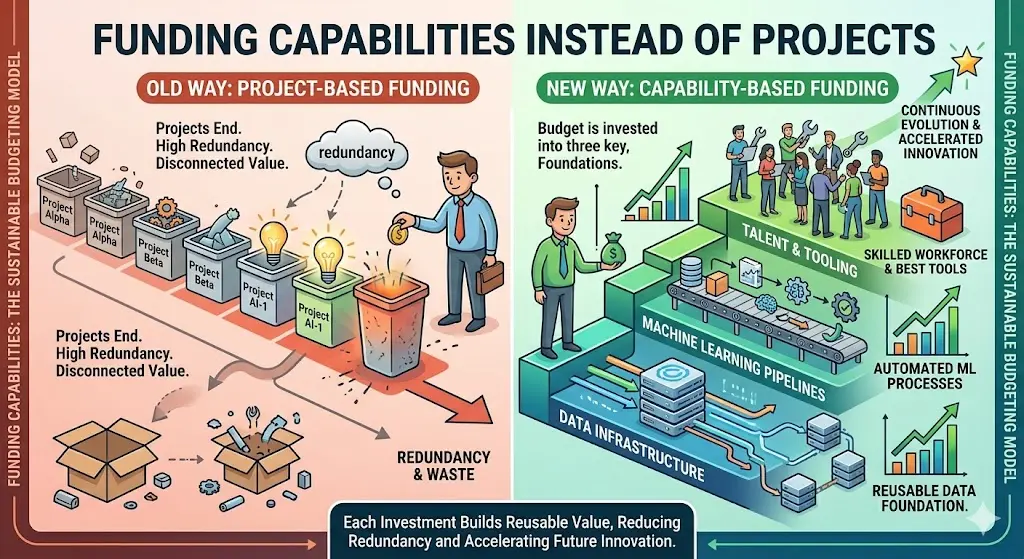
Funding Capabilities Instead of Projects
A key shift in advanced budgeting is moving away from project-based funding.
Projects end. Capabilities evolve.
For example, instead of funding a single AI initiative, organizations should invest in:
- Data infrastructure
- Machine learning pipelines
- Talent and tooling
This ensures that each investment builds reusable value, reducing redundancy and accelerating future innovation.
Intelligent Governance: Control Without Friction
Innovation often fails not بسبب lack of ideas, but بسبب excessive control. At the same time, removing oversight entirely creates inefficiency and waste.
The hybrid composable path introduces precision governance:
- Predefined spending thresholds
- Clear success metrics
- Autonomous decision zones for teams
Leaders shift from approving every expense to defining rules of engagement. This allows teams to move quickly while staying aligned with organizational priorities.
Data as the Budgeting Engine
In 2027, intuition alone is not enough. Budget decisions must be informed by integrated data streams.
High-performing organizations connect:
- Financial data
- Operational metrics
- Customer behavior insights
This enables dynamic decisions such as:
- Scaling high-performing initiatives instantly
- Redirecting funds from underperforming areas
- Predicting future cost pressures before they occur
Budgeting becomes less reactive and more predictive.
Managing Risk Without Slowing Down
Innovation introduces uncertainty—but avoiding it entirely is a bigger risk.
The hybrid composable approach manages this through structured experimentation:
- Small initial investments
- Clear performance checkpoints
- Fast exit strategies
This allows organizations to explore aggressively while limiting downside exposure. Failure is no longer costly—it becomes informational.
The Cultural Layer: Where Most Strategies Fail
Even the most well-designed budget will fail without the right mindset.
A hybrid composable approach requires:
- Finance teams to act as strategic advisors, not just controllers
- Leaders to reward learning, not just success
- Teams to collaborate across functions rather than operate in silos
Culture determines whether flexibility becomes innovation—or chaos.
Practical Implementation Strategy
To adopt this model effectively for 2027, organizations should focus on gradual transformation:
Start with visibility
Understand where money is currently locked versus where it can be made flexible.
Create a protected innovation pool
Even a small percentage of the budget can drive significant change if managed dynamically.
Introduce shorter decision cycles
Shift from annual approvals to iterative funding checkpoints.
Measure outcomes, not activity
Focus on impact—revenue growth, efficiency gains, customer engagement.
Scale what works
Successful experiments should quickly transition into the core or growth layers.
Why This Approach Matters Now
The pace of change is not slowing down. Organizations that rely on rigid financial models will struggle to keep up, while those that abandon structure entirely will lose control.
The hybrid composable path offers a middle ground with intent:
- Stability is preserved where it matters
- Innovation is enabled where it counts
- Resources are continuously aligned with reality
Closing Perspective
The future of budgeting is not about tighter control or greater freedom—it’s about designed adaptability.
Organizations that embrace the hybrid composable path will not just manage uncertainty—they will leverage it. By structuring budgets to evolve alongside strategy, they position themselves to remain stable in the present while actively building the future.
In 2027, the most successful budgets won’t be the most accurate—they will be the most adaptive.


