




In today’s fast-paced digital economy, businesses are increasingly relying on agentic commerce platforms—autonomous systems that manage transactions, inventory, and customer interactions with minimal human intervention. These platforms promise speed, efficiency, and scalability, but they also introduce a new set of cyber risks. Chief among these is AI-driven fraud, a sophisticated threat that leverages artificial intelligence and machine learning to exploit vulnerabilities in automated commerce stacks.
As commerce becomes more autonomous, traditional fraud prevention strategies are no longer sufficient. Businesses need a proactive approach that addresses the unique challenges posed by AI-enabled attacks while maintaining seamless user experiences. This blog post explores the landscape of agentic commerce, the evolving threat of AI-driven fraud, and practical strategies to secure your systems.
Understanding Agentic Commerce
Agentic commerce refers to systems and applications designed to autonomously manage commercial processes. These platforms can handle everything from automated pricing adjustments and stock replenishment to personalized recommendations and payment processing. By leveraging AI and machine learning, agentic commerce allows companies to operate 24/7, reduce human error, and scale rapidly.
Key components of an agentic commerce stack include:
-
Automated inventory management: AI predicts demand and adjusts stock levels in real-time.
-
Dynamic pricing engines: Algorithms adjust pricing based on market conditions, competitor activity, and customer behavior.
-
Personalized customer experiences: Machine learning models create individualized offers, promotions, and product recommendations.
-
Autonomous transaction handling: Payments, refunds, and order confirmations occur with minimal human oversight.
While these capabilities enhance efficiency and customer satisfaction, they also create attractive targets for cybercriminals.
The Rise of AI-Driven Fraud
AI-driven fraud is an emerging threat where attackers use artificial intelligence to bypass security controls, manipulate algorithms, and exploit autonomous systems. Unlike traditional fraud, which relies on human intervention or social engineering, AI-driven fraud can operate at scale and adapt in real-time, making it significantly harder to detect.
Common AI-driven fraud tactics include:
-
Synthetic identity attacks
Fraudsters use AI to create realistic but fake customer profiles that pass identity verification processes. These synthetic accounts can make purchases, claim promotions, or exploit loyalty programs without triggering traditional fraud alerts. -
Automated transaction manipulation
AI can identify patterns in pricing algorithms or inventory systems and exploit them to trigger unintended discounts, manipulate stock levels, or disrupt automated pricing strategies. -
Credential stuffing and AI-optimized attacks
Using machine learning models, attackers test large volumes of credentials efficiently, increasing the likelihood of account takeovers. -
Deepfake and synthetic media fraud
AI-generated videos or voice content can deceive verification systems in high-value transactions, such as B2B payments or identity verification checks.
As agentic commerce platforms grow more sophisticated, fraudsters are similarly leveraging AI to find blind spots, creating a constant cat-and-mouse game between defenders and attackers.


Vulnerabilities in Agentic Commerce Stacks
Several features that make agentic commerce appealing also introduce risk:
-
Autonomy and limited human oversight: Automated systems may make decisions that bypass human scrutiny, allowing fraud to go unnoticed until significant damage occurs.
-
Complex AI algorithms: Proprietary AI models are susceptible to adversarial attacks, where subtle manipulations of input data can produce malicious outcomes.
-
Integration with third-party services: External APIs, payment gateways, and partner platforms can be exploited as entry points for attackers.
-
Real-time processing: Rapid decision-making leaves little room for manual checks, making fraud prevention in real-time challenging.
Recognizing these vulnerabilities is the first step toward securing your agentic commerce infrastructure.
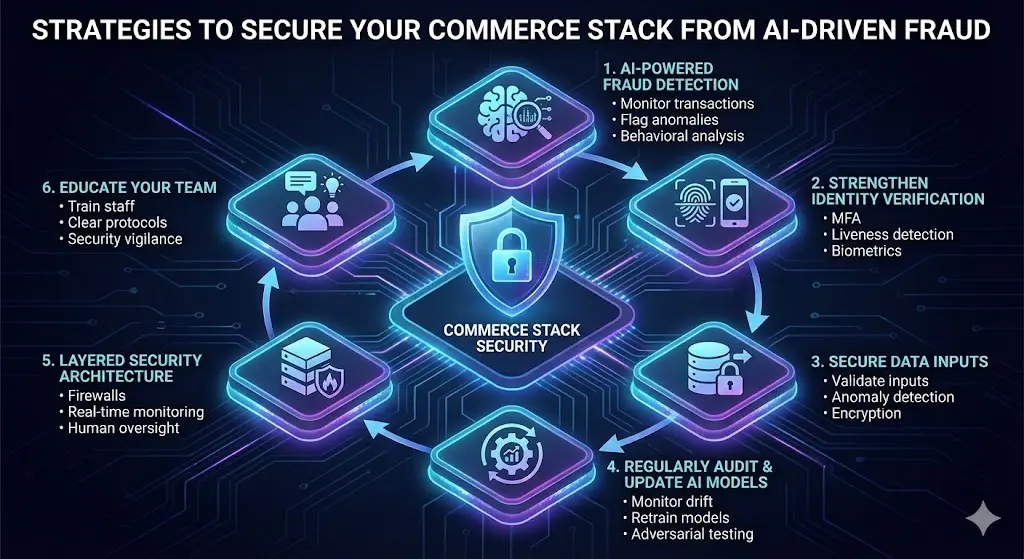
Strategies to Secure Your Commerce Stack
Protecting your agentic commerce stack from AI-driven fraud requires a layered, proactive approach. Here are key strategies:
1. Implement AI-Powered Fraud Detection
Use AI to fight AI. Deploy machine learning models that continuously monitor transactions, identify unusual patterns, and flag anomalies in real-time. Look for:
-
Behavioral anomalies: Sudden spikes in purchases or unusual account activity.
-
Pattern deviations: Changes in purchase behavior, payment methods, or geographic locations.
-
Cross-channel analysis: Correlating activity across multiple systems to detect inconsistencies.
2. Strengthen Identity Verification
Since synthetic identities are a major threat, enhancing verification protocols is crucial:
-
Multi-factor authentication (MFA) for all accounts.
-
Document verification with liveness detection to prevent deepfake attacks.
-
Biometric authentication for high-value transactions.
3. Secure Data Inputs
Many AI algorithms rely on large data inputs. Ensure that your models are resistant to adversarial manipulation:
-
Validate input data for authenticity.
-
Implement anomaly detection on API calls and third-party integrations.
-
Use robust encryption for data in transit and at rest.
4. Regularly Audit and Update AI Models
AI-driven systems are not static. Regularly auditing your machine learning models helps identify weaknesses and improve resilience:
-
Monitor performance metrics for drift or unusual predictions.
-
Retrain models with updated, verified datasets.
-
Conduct adversarial testing to identify vulnerabilities.
5. Layered Security Architecture
No single solution is enough. Combine multiple layers of defense:
-
Firewalls and intrusion detection systems.
-
Real-time monitoring of transactions.
-
Automated alerts for abnormal behavior.
-
Human oversight for high-risk transactions.
6. Educate Your Team
Even in an agentic commerce environment, human awareness matters:
-
Train staff to recognize early signs of AI-driven fraud.
-
Implement clear protocols for investigating anomalies.
-
Encourage a culture of security vigilance alongside automation.
The Future of Secure Agentic Commerce
As AI continues to advance, agentic commerce will become more intelligent, responsive, and autonomous, enabling businesses to operate at unprecedented scale. However, AI-driven fraud will evolve alongside these innovations. Companies that proactively invest in AI-powered security, robust identity verification, and real-time monitoring will have a significant advantage.
In the new cyber frontier, securing your commerce stack is not just about technology—it’s about creating a resilient ecosystem where automation and security work hand in hand. Businesses that master this balance will thrive, delivering seamless customer experiences while staying protected against sophisticated fraud.
Conclusion
The rise of agentic commerce brings both opportunity and risk. AI-driven fraud is not a distant threat—it is already targeting businesses that rely on autonomous systems. To secure your commerce stack, companies must adopt AI-powered monitoring, advanced identity verification, and layered security strategies. Regular audits, data validation, and staff education further strengthen defenses.
By treating security as an integral part of agentic commerce, businesses can confidently harness the power of AI, maximize operational efficiency, and maintain customer trust in an increasingly automated digital world.


