

Headless commerce has emerged as a transformative approach for businesses looking to deliver fast, flexible, and highly customized digital experiences. By decoupling the frontend (presentation layer) from the backend (commerce platform), companies can innovate faster, optimize performance, and create unique customer experiences across channels.
However, migrating to a headless architecture comes with questions, particularly regarding costs. Businesses often struggle to understand what factors influence pricing, how to budget effectively, and what hidden expenses might arise during a migration. In this post, we answer reader questions to provide clarity on headless migration costs and offer practical guidance for planning a successful project.
Q1: What is a Headless Migration and Why is Cost a Concern?
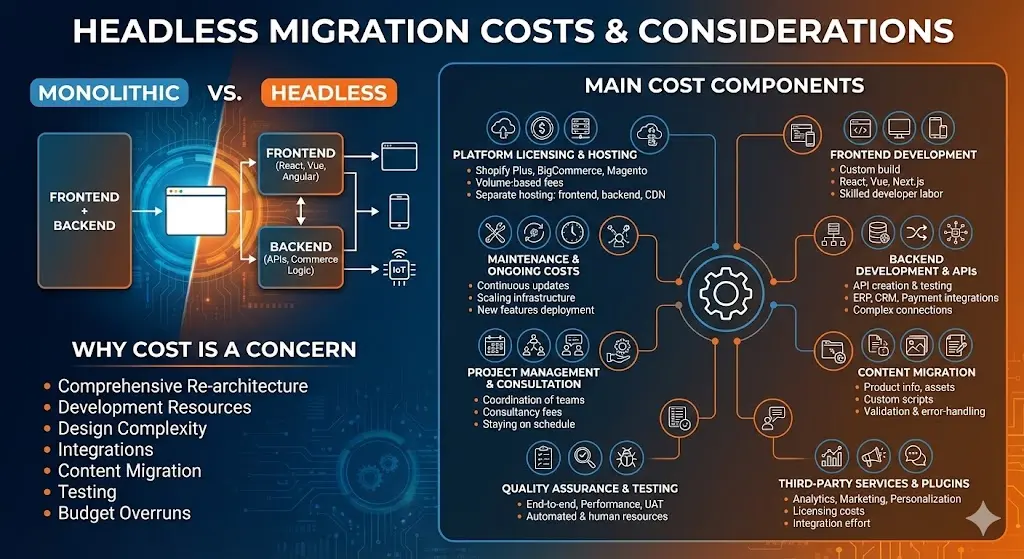
A headless migration involves moving from a traditional, monolithic commerce platform to a headless architecture, where the backend handles business logic, product management, and transactions, while the frontend is fully decoupled and can be built using frameworks like React, Vue, or Angular.
Costs become a major concern because headless migration is not simply a software upgrade; it is a comprehensive re-architecture of your digital storefront. Factors such as development resources, design complexity, integrations, content migration, and testing all influence the final price. Businesses often underestimate these components, leading to budget overruns if proper planning is not undertaken.
Q2: What Are the Main Cost Components in Headless Migration?
When evaluating a headless migration, it’s important to break down the costs into categories:
Platform Licensing and Hosting Costs
Headless commerce often requires a modern backend platform that supports APIs, such as Shopify Plus, BigCommerce, or Magento.
Platform fees can vary widely depending on transaction volume, features, and enterprise requirements.
Hosting costs also change because a headless architecture may involve separate hosting for frontend and backend environments, including serverless functions, CDN services, and cloud infrastructure.
Frontend Development
Unlike traditional platforms where themes are pre-built, headless requires custom frontend development.
The complexity of the user interface, interactivity, and device optimization significantly impacts cost.
Frameworks like React, Vue, or Next.js may require highly skilled developers, increasing labor costs.
Backend Development and API Integrations
APIs are the backbone of headless commerce. Connecting the backend to multiple frontend channels (web, mobile, IoT devices) involves creating, testing, and maintaining APIs.
Integrations with ERP, CRM, payment gateways, and third-party services add complexity and cost.
Content Migration
Moving product information, images, descriptions, and digital assets from the legacy system to a new headless environment requires planning and automation.
Complex content structures may need custom scripts, validation, and error-handling, increasing both time and expense.
Third-Party Services and Plugins
Many businesses rely on analytics, marketing automation, personalization engines, and customer support tools.
Each integration can involve licensing costs and additional development effort to ensure seamless interaction with the headless platform.
Quality Assurance and Testing
Ensuring the new system functions correctly across devices and browsers is crucial.
End-to-end testing, performance testing, and user acceptance testing require both human and automated testing resources.
Project Management and Consultation
A headless migration project often involves multiple teams—developers, designers, business analysts, and IT staff.
Project management and consultancy fees are sometimes overlooked but are essential for coordinating complex tasks and keeping the project on schedule.
Maintenance and Ongoing Costs
Headless systems are modular, so maintenance is continuous.
Updating APIs, scaling infrastructure, and deploying new features after launch can be more expensive than traditional platforms if not planned for.
Q3: How Much Does a Headless Migration Typically Cost?
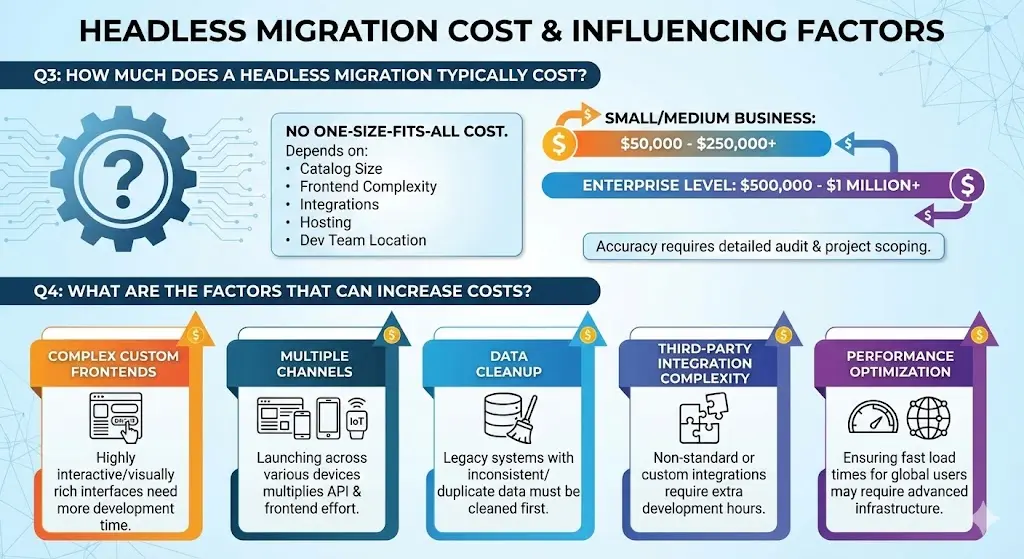
It is difficult to provide a one-size-fits-all number because costs vary widely depending on:
The size of your product catalog and digital assets
The complexity of the frontend experience
Number of integrations with third-party systems
Hosting and infrastructure requirements
Geographic location of the development team
However, ballpark estimates for small to medium businesses range from $50,000 to $250,000 for the initial migration. Enterprise-level projects with global operations, multiple storefronts, and extensive integrations can easily exceed $500,000 to $1 million.
Keep in mind that these figures are estimates. The most accurate way to determine costs is through a detailed audit and project scoping exercise, considering both current systems and desired outcomes.
Q4: What Are the Factors That Can Increase Costs?
Several common factors tend to inflate headless migration budgets:
Complex Custom Frontends: Highly interactive or visually rich interfaces require more development time.
Multiple Channels: Launching headless commerce across web, mobile apps, kiosks, and IoT devices multiplies API and frontend development effort.
Data Cleanup: Legacy systems often have incomplete, inconsistent, or duplicate data that must be cleaned before migration.
Third-Party Integration Complexity: Non-standard or custom integrations require extra development hours.
Performance Optimization: Ensuring fast load times for global users may require advanced infrastructure like CDNs, caching, or serverless functions.
Q5: How Can Businesses Optimize Costs Without Sacrificing Quality?
While headless migrations can be expensive, businesses can take strategic steps to manage costs:
Scope and Plan Carefully
Identify which features are essential for launch and which can be phased in later.
Avoid overcomplicating the initial deployment with non-critical customizations.
Use Existing Tools When Possible
Many platforms provide prebuilt API connectors and frontend components that reduce development time.
Leveraging these tools can lower both time and expense.
Prioritize Data Cleanup Early
Clean, structured data simplifies migration and reduces errors, saving time and money later.
Choose the Right Technology Stack
Selecting a stack that aligns with your team’s expertise can reduce development costs and minimize risk.
Engage Experienced Partners
Working with vendors or consultants who specialize in headless migrations ensures efficiency and prevents costly mistakes.
Phased Rollouts
Launching in stages allows businesses to test features, fix bugs, and optimize performance before full-scale deployment, avoiding large-scale costly errors.
Q6: Are There Long-Term Cost Benefits to Headless Migration?
Yes. While the initial investment may be significant, headless commerce provides long-term cost advantages:
Faster Time-to-Market for New Features: Decoupled frontends allow rapid experimentation without backend changes.
Scalability: Modular systems scale more efficiently than monolithic platforms.
Omnichannel Revenue Opportunities: Businesses can easily extend commerce experiences to mobile apps, kiosks, social media, and IoT devices.
Reduced Future Redesign Costs: Updating the frontend or adding new channels is simpler and less expensive.
In many cases, the long-term flexibility and efficiency of headless architecture offset the upfront migration costs.
Q7: Common Mistakes to Avoid
Underestimating Resource Requirements: Headless projects require specialized developers, and underestimating time or skills can increase costs.
Skipping Data Strategy: Migrating without a clear plan for content and product data often leads to errors and delays.
Neglecting Testing: Inadequate testing can lead to poor user experience, lost revenue, and expensive fixes.
Ignoring Maintenance Costs: Ongoing updates, API changes, and infrastructure scaling should be included in budgets.
Conclusion
Headless commerce migration is a complex, high-stakes project, but with careful planning, businesses can control costs while achieving a modern, flexible commerce platform. By understanding cost components, identifying potential risk factors, and implementing strategic measures, organizations can ensure their migration is both cost-effective and high-impact.
For companies considering headless commerce, the key takeaway is that cost is an investment in agility, scalability, and customer experience. While the upfront expenses can seem significant, the long-term benefits—faster innovation, seamless omnichannel experiences, and reduced redesign costs—often outweigh the initial investment.
By planning meticulously, leveraging existing tools, and engaging experienced teams, businesses can execute a successful headless migration that delivers value, efficiency, and enhanced customer experiences for years to come.
