

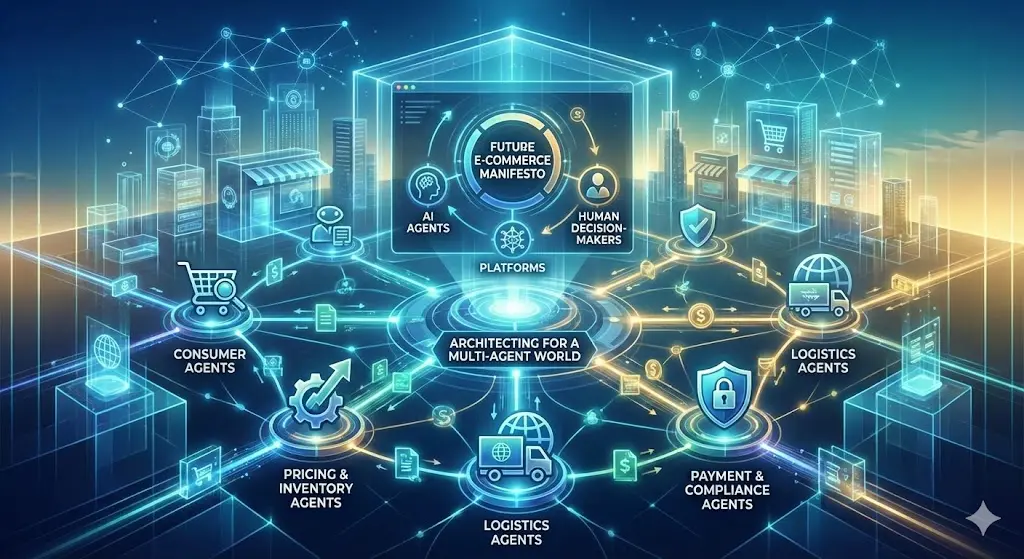
E‑commerce is entering a structural transformation that goes far beyond faster websites, better checkout flows, or incremental personalization. The next phase of digital commerce will be defined by multi‑agent systems—ecosystems where autonomous software agents, AI assistants, platforms, and human decision‑makers interact continuously to discover products, negotiate value, execute transactions, and manage post‑purchase experiences.
This manifesto outlines how e‑commerce must evolve to remain competitive, resilient, and intelligent in a multi‑agent world. It is written as an informational and forward‑looking guide for builders, strategists, product leaders, and organizations preparing for what comes next.
Understanding the Multi‑Agent Shift
Traditional e‑commerce assumes a linear model: a human visits a website, browses products, makes a decision, and completes a purchase. Even with personalization and recommendation engines, the interaction is still largely one‑directional.
A multi‑agent e‑commerce environment breaks this assumption.
In this emerging model:
- AI shopping agents represent consumers
- Pricing and inventory agents represent merchants
- Logistics agents optimize fulfillment
- Payment agents manage authorization and risk
- Compliance and policy agents enforce rules
Transactions are no longer isolated actions. They are negotiated outcomes produced by multiple intelligent actors operating simultaneously.
This shift changes not only how commerce happens, but how systems must be architected.
Why Legacy E‑commerce Architectures Will Fail
Most current e‑commerce platforms were built for static interactions and predictable workflows. They rely heavily on:
- Monolithic application layers
- Synchronous request‑response models
- Human‑centric UX assumptions
- Centralized decision logic
In a multi‑agent world, these approaches become bottlenecks.
When autonomous agents are making decisions in milliseconds—comparing offers, validating trust signals, or adjusting purchasing behavior—systems that require rigid workflows or manual triggers will simply be bypassed.
Future‑ready platforms must assume continuous negotiation, adaptation, and orchestration.
Core Principles of Multi‑Agent E‑commerce Architecture
To build for this future, e‑commerce systems must adopt a new set of architectural principles.
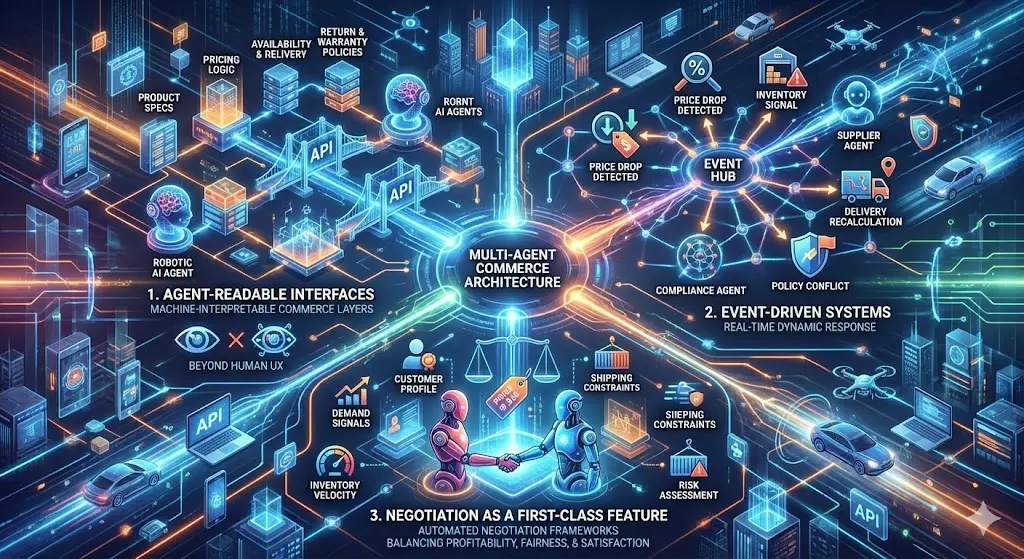
1. Agent‑Readable Interfaces, Not Just Human UX
APIs will become as important as storefronts.
AI agents need structured, transparent, and verifiable access to:
- Product specifications
- Pricing logic
- Availability and delivery constraints
- Return and warranty policies
This means moving beyond visual design toward machine‑interpretable commerce layers that enable agents to evaluate offers without ambiguity.
2. Event‑Driven, Not Page‑Driven Systems
In a multi‑agent ecosystem, commerce is triggered by events, not page views.
Examples include:
- A consumer agent detecting a price drop
- An inventory agent signaling low stock
- A logistics agent recalculating delivery routes
- A compliance agent flagging policy conflicts
Event‑driven architectures allow systems to respond dynamically, enabling real‑time negotiation and optimization without human intervention.
3. Negotiation as a First‑Class Feature
Pricing will no longer be static.
Multi‑agent commerce introduces automated negotiation based on:
- Demand signals
- Customer loyalty profiles
- Inventory velocity
- Shipping constraints
- Risk assessment
Architectures must support rule‑based and learning‑based negotiation frameworks that balance profitability, fairness, and customer satisfaction.
Identity, Trust, and Verification in Agent‑Driven Commerce
When agents transact on behalf of humans and businesses, trust infrastructure becomes critical.
Future e‑commerce systems must embed:
- Verifiable digital identities
- Permissioned access controls
- Transparent audit trails
- Reputation and trust scoring
Agents must be able to prove who they represent, what authority they have, and how decisions were made. Without this, automated commerce becomes vulnerable to abuse, fraud, and systemic instability.
Rethinking Personalization in a Multi‑Agent Context
Personalization will no longer be about recommending products on a homepage.
Instead, personalization becomes preference negotiation between agents. Consumer agents will represent:
- Budget constraints
- Ethical or sustainability preferences
- Brand loyalty rules
- Risk tolerance
- Time sensitivity
Merchants that expose flexible policy engines—rather than rigid offers—will be favored by intelligent agents that seek optimal outcomes for their users.
Supply Chains as Intelligent Agent Networks
E‑commerce does not end at checkout.
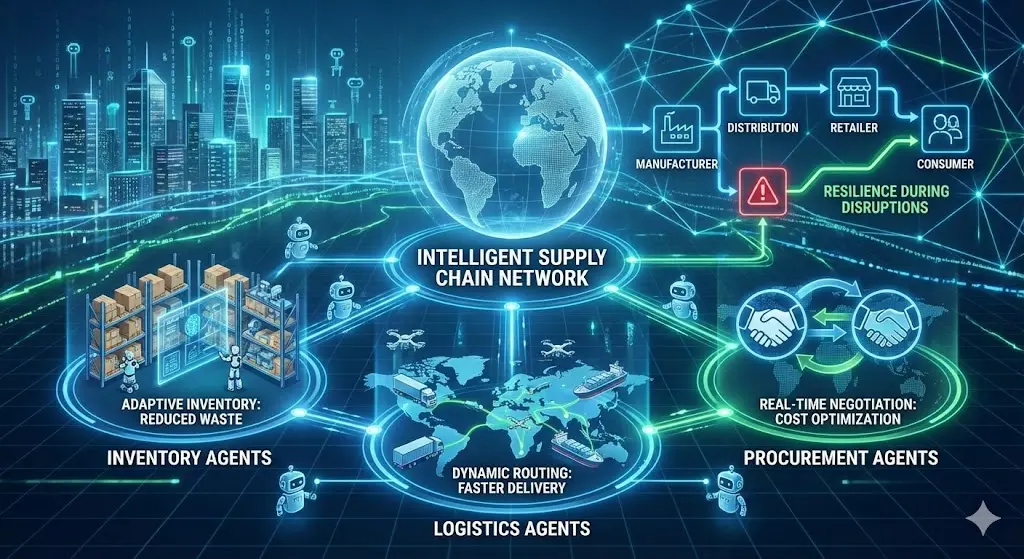
In a multi‑agent world, supply chains themselves become autonomous systems. Inventory agents forecast demand, logistics agents coordinate fulfillment, and procurement agents negotiate with suppliers in real time.
This enables:
- Reduced waste through adaptive inventory
- Faster delivery through dynamic routing
- Cost optimization without manual intervention
- Resilience during disruptions
Architecting commerce platforms that integrate seamlessly with these agent‑based supply networks will be a major competitive advantage.
Governance, Ethics, and Control
Automation at scale introduces governance challenges.
Who is responsible when an agent makes a suboptimal decision? How are disputes resolved? How do organizations ensure alignment with legal, ethical, and brand values?
Future‑ready platforms must include:
- Human override mechanisms
- Transparent decision logs
- Policy enforcement layers
- Ethical constraint frameworks
Multi‑agent commerce does not eliminate human responsibility—it redistributes it.
Measuring Success in the New Commerce Model
Traditional KPIs such as conversion rate or average order value will not be sufficient.
Multi‑agent commerce requires new metrics, including:
- Agent satisfaction scores
- Negotiation efficiency
- Trust stability
- System adaptability
- Long‑term customer alignment
These indicators reflect not just transactions, but the health of the entire commerce ecosystem.
Preparing Organizations for the Transition
Architecting for a multi‑agent future is not only a technical challenge—it is an organizational one.
Companies must invest in:
- Modular system design
- Cross‑functional AI literacy
- Data governance frameworks
- Experimentation and simulation environments
Organizations that treat AI agents as collaborators rather than tools will adapt faster and build more resilient commerce platforms.
Conclusion: The Manifesto in Practice
The future of e‑commerce will not be dominated by the biggest storefronts, but by the most adaptable systems.
A multi‑agent world demands architectures that are flexible, transparent, event‑driven, and trustworthy. It rewards organizations that design for negotiation, intelligence, and long‑term alignment rather than short‑term conversion optimization.
This manifesto is not a prediction—it is a blueprint. The technologies already exist. The question is whether today’s e‑commerce platforms will evolve in time to participate meaningfully in the next generation of digital commerce.
Those who architect now will define the rules later.
