


Modern commerce teams love to blame AI tools when things go wrong. “The model isn’t smart enough.” “The system doesn’t understand our catalog.” “The recommendations aren’t relevant.” But in reality, the biggest threat to AI success has nothing to do with the model you choose — and everything to do with the product data underneath it.
Companies invest millions in AI experimentation, only to discover that their results plateau not because of poor technology, but because their product information management (PIM) data is incomplete, inconsistent, siloed, or structurally weak. In an era where Agentic AI is reshaping digital commerce (Agentic Commerce: Why 2026 Is the AI Tipping Point), clean PIM data has become the most valuable competitive asset.
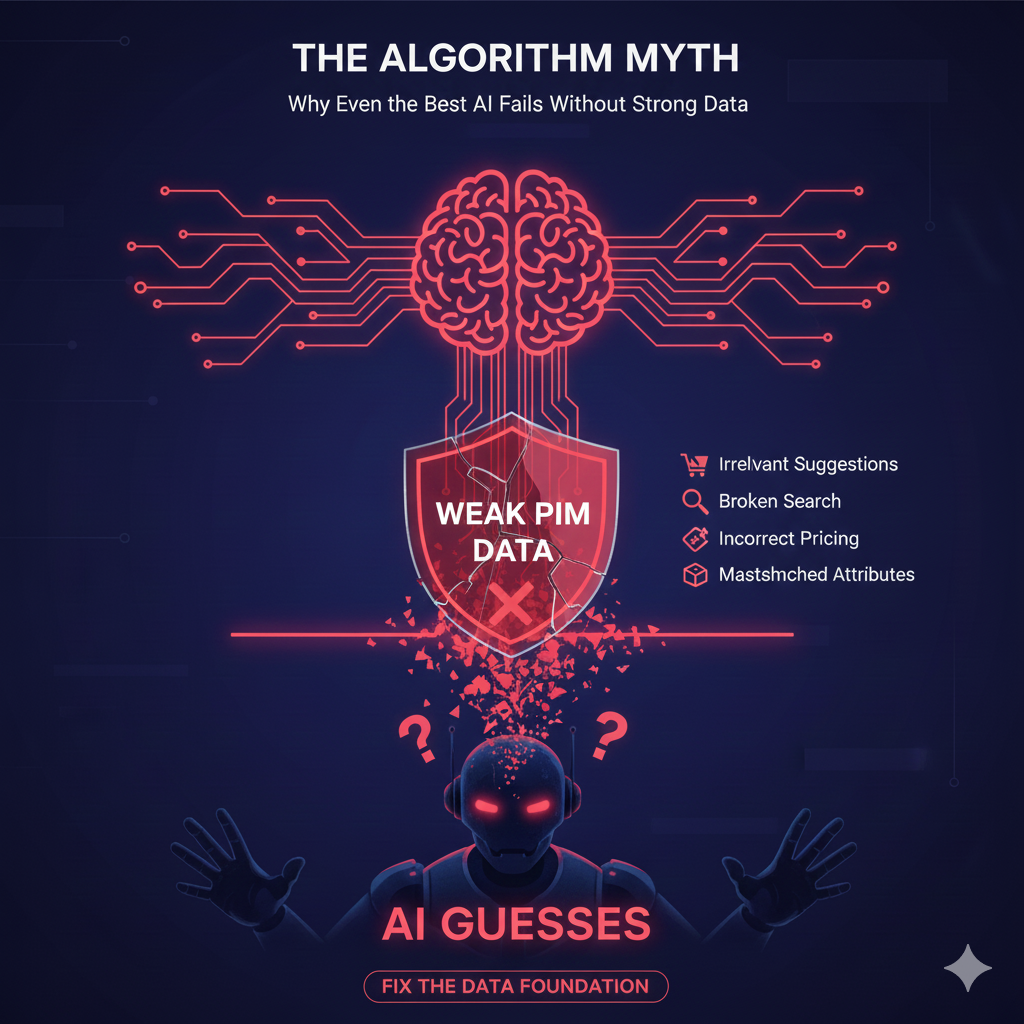
The Algorithm Myth: Why Even the Best AI Fails Without Strong Data
After more than a decade of working with enterprise retailers, B2B distributors, and global brands, one truth has emerged over and over again: AI can only operate at the level of the data it ingests. Whether you are using generative models, agentic systems, or predictive algorithms, the outcome is entirely dependent on the accuracy, depth, and structure of your product information.a
Even the most advanced agent requires context. Without precise details — materials, dimensions, variants, compliance attributes, usage cases — the AI doesn’t “fill in the blanks.” It simply guesses.
This is why so many organizations see:
irrelevant product suggestions
dropped conversions
broken search results
mismatched attributes across channels
incorrect pricing or inventory signals
The failure point is not the intelligence of the model. The failure point is the quality of the PIM data.
If companies want to unlock the full potential of Agentic AI, they must first fix the data foundation those agents rely on.
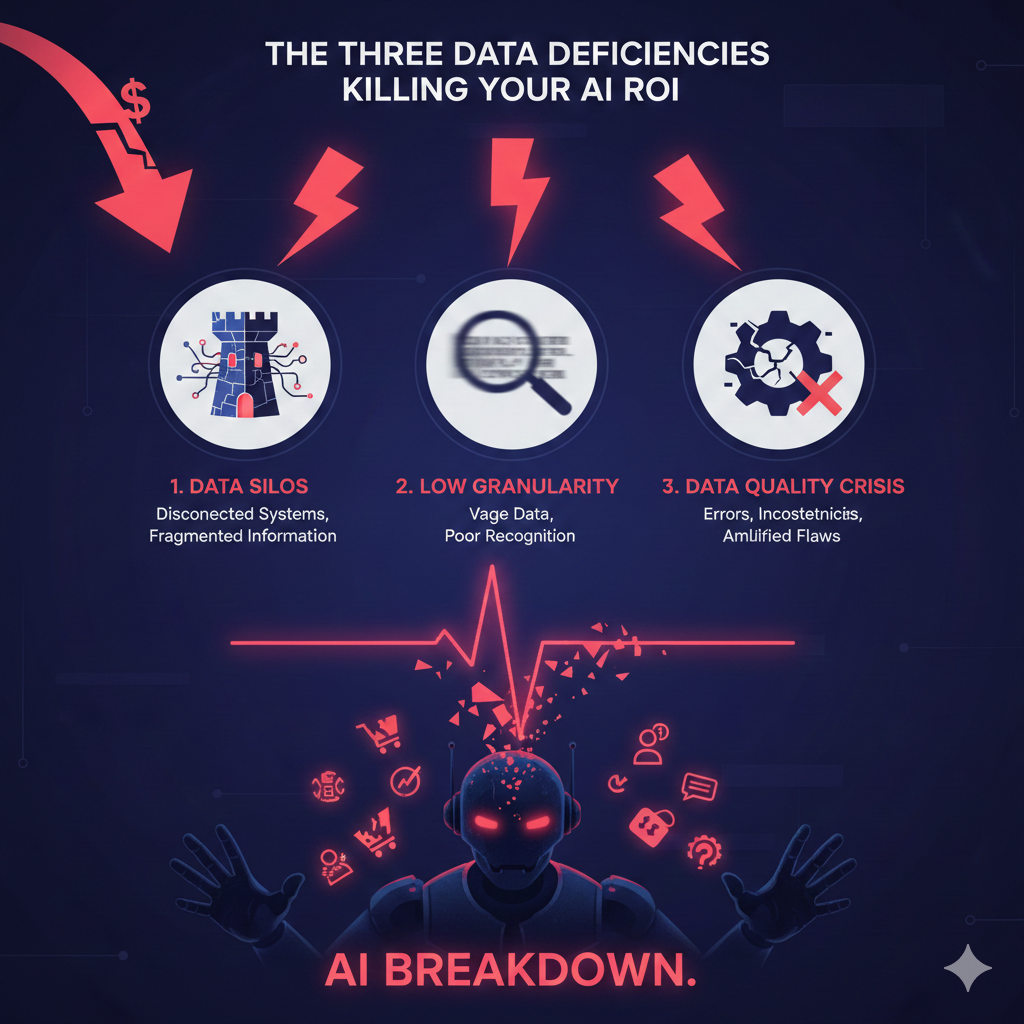
The Three Data Deficiencies Killing Your AI ROI
Most AI breakdowns can be traced back to three foundational problems. These issues are so common that many teams don’t even notice them — until automation magnifies the damage.
1. Data Silos: The Un-Composable Problem
In many organizations, product data is scattered across disconnected systems:
an ERP with partial specifications
a CRM with outdated descriptions
a legacy PIM with inconsistent attributes
supplier spreadsheets that never match internal templates
eCommerce platforms that store their own copies
This fragmentation creates a scenario where no system — including your AI tools — has access to the complete, authoritative version of a product.
Agentic systems cannot work with partial visibility. They need unified, composable, real-time product information.
This is where Composable Commerce (Article 2) becomes essential. By removing rigid architecture, companies can synchronize product data across systems, eliminate redundancies, and give AI agents the holistic view they need to make accurate decisions.
Without composability, silos will continue to dilute any AI investment.
2. Low Granularity: The Visual Search Problem
Retailers are increasingly adopting visual search, AR try-on, and immersive product discovery. However, these technologies fall apart when product data lacks depth.
Consider the difference between:
“leather boots”
vs.“waterproof full-grain leather hiking boot with gusseted tongue, reinforced toe cap, and anti-slip rubber outsole”
The first description tells AI almost nothing. The second gives the model enough structured detail to:
classify the product correctly
understand context and usage
pair it with the right customer intent
recognize it in visual search
generate descriptive and accurate content
In Immersive CX (Article 3), we highlight that modern AI experiences rely entirely on high-granularity product attributes. Without those details, search becomes vague, recommendations become generic, and AR models render incorrectly.
Low granularity is not a minor inconvenience — it is an AI blocker.
3. The Data Quality Crisis: Errors, Inconsistencies, and Missing Fields
Every business carries hidden data debt. Attributes entered manually. Supplier data copied over without validation. Legacy fields left unstructured. Duplicate SKUs. Outdated compliance information. These inconsistencies rarely cause large problems at a human scale.
But with AI?
Every flaw gets amplified.
AI systems trained on inconsistent PIM data can make incorrect decisions, such as:
suggesting the wrong variant
generating text with inaccurate details
misaligning product families
misclassifying items
projecting faulty inventory forecasts
assigning incorrect prices or promotional recommendations
AI behaves with confidence, even when the data is wrong. This creates a silent, compounding risk across the entire commerce workflow.
Data quality is the greatest hidden cost in AI adoption — and the greatest opportunity for improvement.
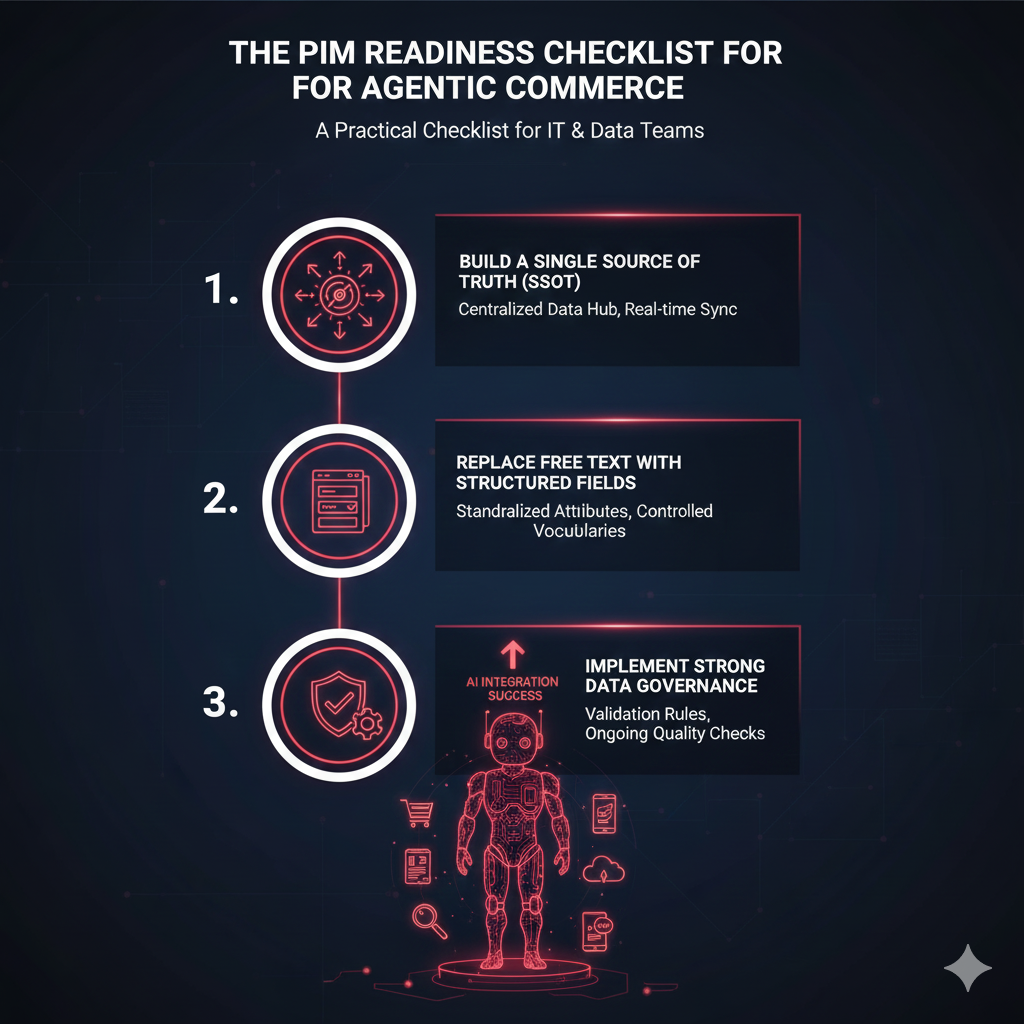
The PIM Readiness Checklist for Agentic Commerce
To support intelligent agents, autonomous workflows, multimodal search, and future operations, organizations must modernize their product data foundation. Below is a practical checklist for IT and Data teams preparing for full AI integration.
1. Build a Single Source of Truth (SSOT)
A central, authoritative PIM system becomes the anchor for all product data. An SSOT ensures:
real-time synchronization
consistent attributes across channels
reduced duplication
better collaboration between teams
predictable data structures for AI reasoning
Without an SSOT, even the most powerful AI cannot access a stable dataset.
2. Replace Free Text With Structured Fields
Unstructured product information is the enemy of clarity. AI performs best when data follows a predictable pattern.
Structured data fields should include:
controlled vocabularies
enforced attribute templates
category-specific taxonomies
standardized units of measurement
variant logic (color, size, material, etc.)
This structure removes ambiguity and gives AI the context it requires to operate accurately.
3. Implement Strong Data Governance
Data governance is not a one-time cleanup — it is an ongoing discipline. Governance ensures data quality remains stable as catalogs grow and channels expand.
Key governance components include:
clear ownership for each attribute group
validation rules at the point of entry
quality metrics (completeness, consistency, accuracy)
automated error detection
scheduled review cycles
When governance is strong, AI reliability rises dramatically.
Fix the Data, Fuel the Future
The future of commerce is autonomous. Agents will classify products, update catalogs, orchestrate workflows, manage demand, and optimize content. But none of this is possible without clean, structured, unified product information.
Companies that prioritize PIM data quality today will own the competitive advantage tomorrow — not because their AI is better, but because their data makes their AI better.
If you want AI that is trustworthy, scalable, and profitable, you must invest in the only foundation that truly matters: data quality for Agentic Commerce.
