

For many creators, publishers, and niche media platforms, sponsored content is the ultimate monetization goal—but also the most misunderstood. While B2C creators often rely on volume and virality, B2B sponsored content operates in an entirely different universe—one where trust, expertise, and strategic positioning matter far more than follower counts.
Landing your first high-value B2B sponsored content deal isn’t about luck, cold emails, or waiting for brands to “discover” you. It’s about engineering demand—positioning your platform as a revenue-generating asset for businesses that think in terms of ROI, pipelines, and long-term brand authority.
This blueprint walks you through the entire process, from mindset to execution, with advanced strategies used by professional publishers and B2B media companies.
Understanding What “High-Value” Means in B2B Sponsorship
Before chasing deals, you must redefine value.
In B2B, a high-value sponsored content deal is not determined by views or likes. It is determined by:
Audience relevance (not size)
Decision-maker access
Industry authority
Long-term visibility
Content credibility
Sales enablement impact
A $5,000 sponsored article that influences purchasing decisions is far more valuable to a B2B brand than a $500 post with 100,000 impressions.
Your goal is not to sell exposure. Your goal is to sell influence.
Step 1: Stop Thinking Like a Creator — Start Thinking Like a Publisher
Most people fail at B2B sponsorship because they approach it like influencers.
B2B brands don’t want:
Shoutouts
Overly promotional copy
Brand worship
Vanity metrics
They want:
Credible narratives
Thought leadership
Contextual authority
Buyer trust
You must reposition yourself as:
A media platform, not a personal brand
An industry voice, not a content creator
A distribution partner, not an advertiser
This shift alone dramatically increases deal size.
Step 2: Define Your Commercial Audience (Not Your General Audience)
Your content audience and your commercial audience are not always the same.
For B2B sponsorship, brands care about:
Job titles
Industries
Company sizes
Decision-making authority
Buying influence
You need clarity on:
Who reads your content professionally
Why they read it
What problems they are trying to solve
What tools or services they already pay for
A niche audience of 5,000 CTOs, marketers, founders, or procurement leaders is infinitely more valuable than 500,000 random readers.
Specificity increases sponsorship pricing.
Step 3: Build Content That Attracts Sponsors Before You Pitch Them
The fastest way to land your first high-value deal is to pre-qualify sponsors through your content.
This means:
Writing about industry challenges companies want to solve
Covering trends aligned with B2B products or services
Publishing deep, analytical, non-promotional content
Demonstrating critical thinking—not hype
Examples of sponsor-attracting content:
Industry breakdowns
Market analysis
Case-study-style articles
Strategy explainers
“How companies solve X” pieces
When your content already aligns with a company’s messaging, your pitch becomes a natural extension—not a cold sell.
Step 4: Create a Sponsored Content Offer That Feels Strategic, Not Salesy
High-value B2B sponsors don’t buy “posts.” They buy outcomes.
Your sponsored content offer should include:
Strategic positioning (why this content matters)
Editorial control balance (not advertorials)
Long-term visibility (not one-day posts)
Distribution strategy
Brand association value
Avoid selling:
“One article for $X”
“Sponsored blog post”
“Brand mention”
Instead, package it as:
Thought leadership collaboration
Industry insight partnership
Research-backed editorial feature
Sponsored analysis or report
Language shapes perceived value.
Step 5: Price Based on Business Impact, Not Traffic
This is where most people undercharge.
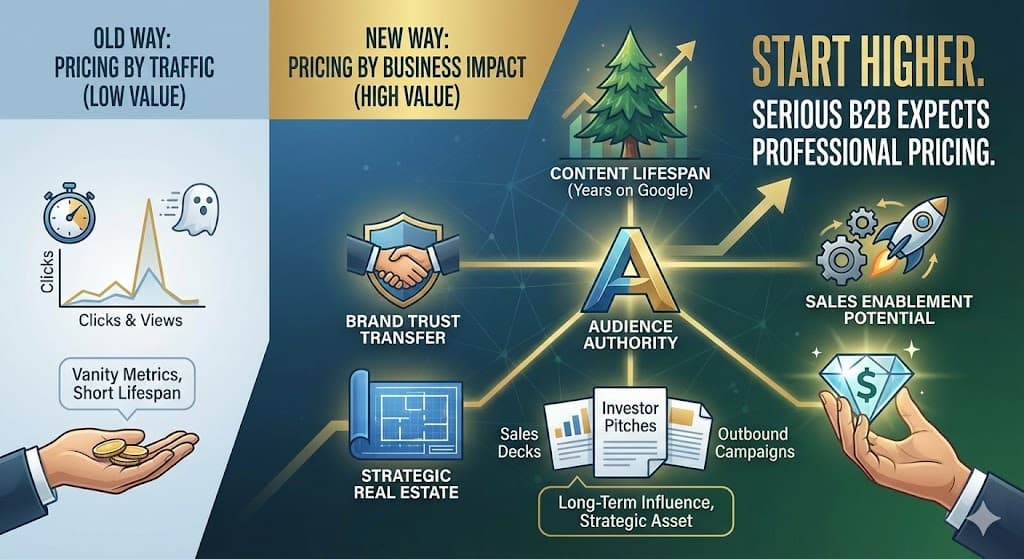
High-value B2B pricing is based on:
Audience authority
Content lifespan
Brand trust transfer
Sales enablement potential
A single sponsored article can:
Live on Google for years
Be shared in sales decks
Be used in investor pitches
Be linked in outbound campaigns
Influence purchasing decisions long-term
You are not selling a post.
You are selling strategic real estate.
Start higher than you’re comfortable with. Serious B2B brands expect professional pricing.
Step 6: Pitch With Context, Not Desperation
Your pitch should feel like a business conversation, not a request.
Effective B2B pitches:
Show understanding of the company’s market
Reference relevant challenges they face
Explain why your audience aligns with their goals
Position content as value creation—not promotion
Avoid:
“We’d love to collaborate”
“We can feature your product”
“We offer affordable rates”
Use:
Strategic framing
Industry language
ROI-oriented thinking
Confidence signals credibility.
Step 7: Deliver Editorial Excellence (This Is Where Repeat Deals Come From)
Your first sponsored piece determines whether you get a second deal.
High-value B2B sponsors expect:
Professional storytelling
Balanced tone (not marketing fluff)
Clear structure
Real insights
Audience-first writing
Your job is not to praise the sponsor.
Your job is to:
Educate the reader
Frame the sponsor as a solution
Maintain editorial integrity
When readers trust your content, sponsors trust you more.
Step 8: Think Beyond One-Off Deals
The real money is not in one post.
It’s in long-term partnerships.
After your first deal, evolve into:
Monthly sponsorships
Content series
Research collaborations
Whitepaper sponsorships
Co-branded thought leadership
Once a brand sees results, they prefer consistency over constant searching.
Common Mistakes That Kill High-Value Deals
Avoid these at all costs:
Undervaluing your platform
Overpromising performance
Writing sales copy instead of editorial content
Accepting full sponsor control
Chasing irrelevant brands
Not thinking long-term
B2B sponsorship rewards patience, positioning, and professionalism.
Final Truth: High-Value Deals Are Built, Not Found
Landing your first high-value B2B sponsored content deal is not about being discovered—it’s about becoming undeniable.
When you:
Publish consistently
Think strategically
Speak your audience’s language
Protect editorial integrity
Understand business value
Brands don’t ask if they should sponsor you.
They ask how.
That’s the shift.
Closing Thought
Sponsored content is not selling out.
When done correctly, it’s value alignment—where your audience learns, your platform grows, and businesses achieve real outcomes.
Build authority first.
Monetize second.
Scale intentionally.
That’s the blueprint.
