

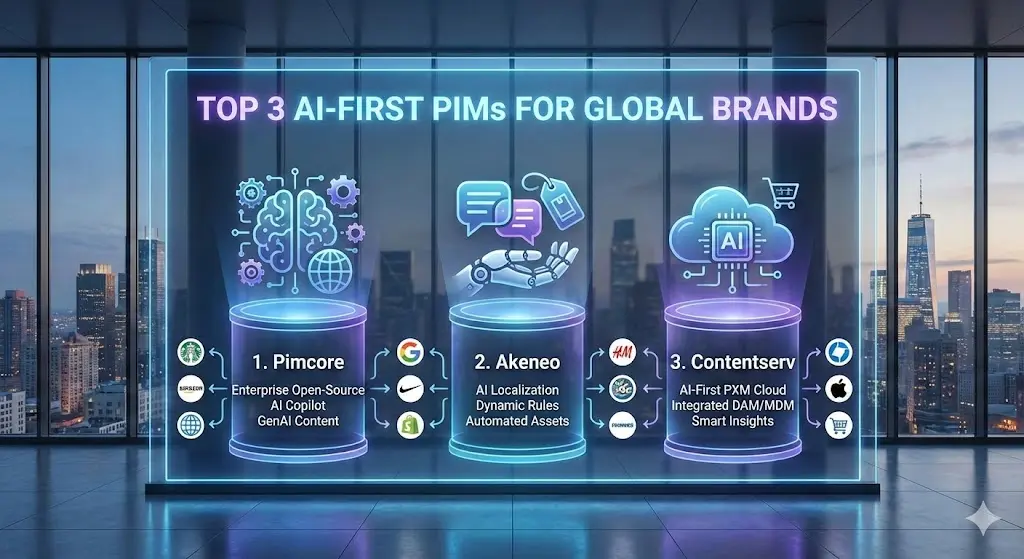
Introduction: Why AI-First PIMs Matter Now
Product Information Management (PIM) has moved far beyond being a back-office data repository. For global brands operating across regions, channels, languages, and regulatory environments, product data is a strategic growth driver. Customers now expect consistent, accurate, localized, and engaging product information wherever they interact with a brand—whether on marketplaces, brand websites, mobile apps, or in-store digital touchpoints.
Traditional PIM platforms were designed to centralize product data and enforce governance rules. While effective for basic consistency, they struggle with scale, speed, and the growing demand for richer content. This gap has led to the rise of AI-First PIM platforms—systems where artificial intelligence is embedded into the core of product data creation, enrichment, validation, and distribution.
An AI-First PIM does not simply automate tasks. It learns from patterns, adapts to catalog complexity, and assists human teams by reducing repetitive work while improving quality and time-to-market. For global brands managing thousands or even millions of SKUs, this shift is transformational.
This article explores the top three AI-First PIM platforms that stand out for global brands, examining how they work, what differentiates them, and which types of organizations benefit most from each.
What Defines an AI-First PIM
Before reviewing specific tools, it is important to clarify what makes a PIM truly AI-first rather than AI-assisted.
An AI-First PIM typically includes:
- Native AI models embedded in the core platform, not bolted on as optional plugins
- Automated product content generation and enrichment at scale
- Intelligent classification and attribute mapping
- Predictive data quality scoring and error detection
- Workflow optimization driven by machine learning
- Support for multilingual and multi-market content creation
These capabilities allow brands to move from reactive data management to proactive product intelligence. Instead of manually fixing issues, teams receive recommendations, automated improvements, and insights that continuously raise data quality.
1. Pimberly: AI-Driven Enrichment at Enterprise Scale
Platform Overview
Pimberly is a cloud-native PIM platform built for brands and retailers with large, complex product catalogs. Its architecture is designed to support high data volumes, multiple channels, and global operations while maintaining strong governance and usability.
What makes Pimberly stand out is its emphasis on AI as a productivity multiplier. Rather than replacing human input, the platform focuses on augmenting teams with intelligent automation that accelerates enrichment and reduces manual workload.
AI Capabilities and Strengths
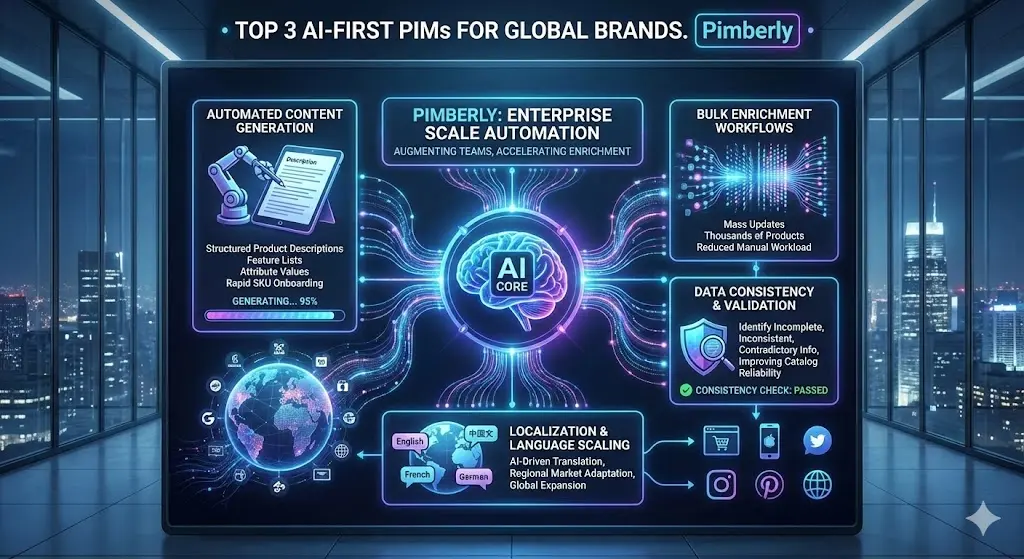
Pimberly’s AI capabilities are deeply integrated into daily product data workflows. These include:
- Automated Product Content Generation: AI generates structured product descriptions, feature lists, and attribute values based on existing data inputs. This is especially valuable when onboarding large numbers of SKUs quickly.
- Bulk Enrichment Workflows: Pimberly allows AI actions to be applied across thousands of products simultaneously, enabling mass updates that would otherwise take weeks or months.
- Data Consistency and Validation: Machine learning models help identify incomplete, inconsistent, or contradictory product information, improving catalog reliability.
- Localization and Language Scaling: AI-driven translation and localization features support global expansion by adapting product content for regional markets.
Ideal Use Cases
Pimberly is well suited for:
- Global brands managing extensive catalogs
- Retailers distributing products across multiple digital channels
- Organizations needing rapid product launches in new markets
- Teams seeking strong governance combined with automation
Why Pimberly Is Truly AI-First
AI in Pimberly is not confined to a single feature. It is embedded across enrichment, quality control, and scalability workflows. This enables organizations to maintain high-quality product data while growing internationally without a proportional increase in operational cost.
2. Akeneo: AI-Augmented Product Experience Management
Platform Overview
Akeneo is one of the most widely adopted PIM platforms globally, known for its flexible architecture and strong ecosystem. Over time, Akeneo has evolved beyond traditional PIM into what it defines as Product Experience Management (PXM), placing equal emphasis on data quality and customer-facing content.
AI plays a growing role in Akeneo’s vision, supporting brands that want to deliver compelling product experiences consistently across markets.
AI Capabilities and Strengths
Akeneo’s AI-driven features focus on practical automation and continuous improvement:
- AI-Assisted Content Creation: The platform helps generate product descriptions and variations aligned with channel requirements and brand guidelines.
- Intelligent Quality Scoring: Products are evaluated based on completeness, accuracy, and readiness for specific channels, allowing teams to prioritize improvements.
- Automated Classification and Attribute Suggestions: Machine learning models assist in mapping products to categories and attributes, reducing onboarding time.
- Workflow Intelligence: AI-enhanced workflows streamline approvals, reduce bottlenecks, and ensure governance across global teams.
Ideal Use Cases
Akeneo is particularly effective for:
- Global retailers and manufacturers with diverse product lines
- Brands operating across marketplaces and direct-to-consumer channels
- Organizations needing flexible integrations with commerce, ERP, and DAM systems
- Teams balancing structured governance with creative product storytelling
Why Akeneo Is AI-First
Akeneo integrates AI into the heart of product experience management. By automating enrichment and highlighting data quality gaps, it allows teams to shift focus from manual data maintenance to strategic brand differentiation.

3. Ergonode: Headless, MACH-Based AI PIM for Modern Commerce
Platform Overview
Ergonode is a modern PIM platform built on MACH principles: microservices-based, API-first, cloud-native, and headless. This architecture makes it particularly attractive to digital-first brands and organizations building composable commerce stacks.
AI within Ergonode is designed to be flexible and extensible, supporting both native capabilities and integration with external AI services.
AI Capabilities and Strengths
Ergonode’s AI features emphasize agility and content intelligence:
- AI-Generated Product Descriptions: Automatically create structured and unstructured content for different sales channels.
- Multilingual Content Generation: Scale product content across regions with AI-assisted translation and localization.
- Smart Classification and Attribute Mapping: AI helps infer product structure and relationships, reducing manual configuration.
- API-Based AI Extension: The platform allows integration with third-party AI models for advanced or industry-specific use cases.
Ideal Use Cases
Ergonode works best for:
- Digital-native and fast-growing global brands
- Organizations adopting headless commerce architectures
- Technical teams requiring deep customization and extensibility
- Businesses operating across multiple e-commerce platforms
Why Ergonode Is AI-First
Ergonode embeds AI into content creation and classification while remaining highly adaptable. Its architecture ensures that AI-driven product intelligence can evolve alongside the broader digital ecosystem.

How AI-First PIMs Transform Global Product Operations
Accelerated Time-to-Market
AI-driven enrichment dramatically reduces the time required to prepare products for launch. Brands can introduce new assortments across regions faster, gaining competitive advantage.
Improved Data Quality at Scale
Machine learning models continuously detect gaps, inconsistencies, and errors, helping maintain accuracy across massive catalogs.
Cost Efficiency and Operational Leverage
By automating repetitive tasks, AI-First PIMs allow teams to scale without linear increases in staffing or overhead.
Enhanced Customer Experience
Consistent, localized, and enriched product content improves discoverability, conversion rates, and customer trust.
Choosing the Right AI-First PIM for Your Brand
Selecting the right platform depends on multiple factors:
- Catalog size and complexity
- Number of regions and languages supported
- Required integrations with existing systems
- Internal technical capabilities
- Long-term scalability and governance needs
No single PIM fits every organization. However, AI-First platforms provide a future-proof foundation that adapts as markets, channels, and customer expectations evolve.
Conclusion: AI-First PIMs as a Strategic Advantage
AI-First PIM platforms represent a fundamental shift in how global brands manage product information. They move beyond static data management into dynamic product intelligence systems that continuously improve quality, efficiency, and customer experience.
Pimberly, Akeneo, and Ergonode each demonstrate how AI can be embedded into PIM in different ways—enterprise-scale enrichment, experience-driven content management, and flexible headless architectures. For global brands navigating complexity and competition, adopting an AI-First PIM is no longer just a technology decision; it is a strategic investment in growth, agility, and long-term relevance.
