


Augmented Reality (AR) has become a game-changer in the industrial sector. From factory floors to heavy machinery showrooms, AR allows engineers, technicians, and clients to visualize equipment in 3D before making deployment or purchasing decisions. However, the adoption of AR in industrial contexts has been hindered by latency issues. Lag during AR interactions can disrupt the user experience, reduce precision, and even lead to operational mistakes.
The combination of 5G networks and edge computing is now solving this problem, enabling real-time, lag-free AR try-ons for complex industrial machinery. This technology empowers industries to visualize, simulate, and interact with equipment in ways that were previously impossible.
Understanding Latency in Industrial AR
Industrial equipment is often large, intricate, and composed of many interactive parts. When AR applications render these machines, they require significant computational resources and fast data transfer. Traditional networks like 4G LTE or standard Wi-Fi struggle to deliver this performance.
Latency—the delay between a user action and the system response—can disrupt AR experiences. Even delays as small as 50–100 milliseconds can make the interface feel unresponsive, causing misalignment of models, jerky visuals, and inaccurate simulations.
For industrial AR, these delays are more than an inconvenience. They can affect assembly planning, maintenance simulations, and training scenarios, where precision is critical. A lagging AR model could lead to misunderstandings of spatial dimensions, misplacement of components, or errors in operational planning.
How 5G Transforms Industrial AR
5G, the fifth generation of mobile networks, provides the speed, reliability, and low latency necessary for advanced AR applications. Its main benefits for industrial AR include:
1. Ultra-Low Latency
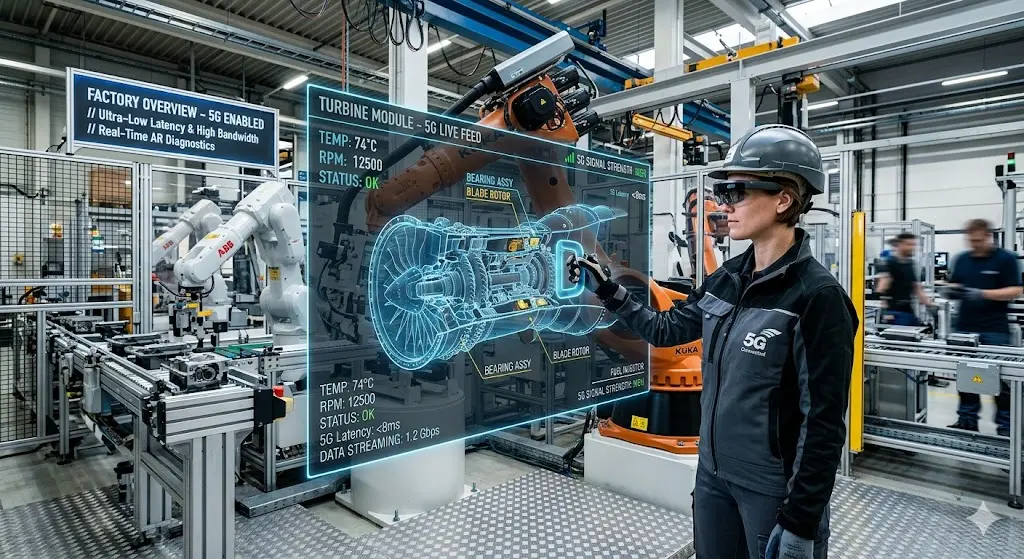
5G networks can achieve latency as low as under 10 milliseconds, allowing near-instantaneous communication between AR devices and servers. This eliminates the noticeable delay that breaks the immersive AR experience. Engineers can manipulate 3D models of equipment smoothly, as if interacting with physical objects.
2. High Bandwidth
Industrial AR often involves streaming high-resolution 3D models, textures, and animations. 5G offers much higher bandwidth than previous network generations, enabling seamless transfer of large datasets without interruptions.
3. Reliable Connectivity
Industrial environments often have multiple connected devices operating simultaneously. 5G ensures network reliability, maintaining consistent AR performance even in dense settings with many users or machines connected.
Edge Computing: Processing Power at the Source
While 5G addresses network latency, edge computing tackles the computational demands of AR. Complex AR applications require real-time rendering of 3D models, simulations, and interactive components. Sending all data to a central cloud server can create bottlenecks, increasing latency.
Edge computing solves this by bringing processing closer to the user. Local edge servers handle heavy computational tasks, reducing the time it takes to render AR visuals.
For example, a factory can deploy edge servers on-site. When a technician uses an AR headset to inspect a robotic arm, the edge server performs the rendering locally. Combined with 5G connectivity, this ensures smooth, lag-free interaction—even for highly detailed industrial machinery.
Benefits Beyond Lag-Free AR Experiences
The combination of 5G and edge computing offers multiple advantages beyond just smooth AR interactions:
Remote Collaboration: Teams across locations can view and manipulate the same AR model in real-time, improving communication and reducing errors.
Cost Savings: Simulate equipment placement, operation, and maintenance without physically moving machines or building prototypes.
Enhanced Training: Technicians can practice assembly or maintenance tasks in AR with realistic feedback, reducing errors during real-world operations.
Improved Customer Experience: Clients can virtually try out industrial equipment before purchase, increasing confidence in investment decisions and reducing post-deployment issues.
These benefits demonstrate that 5G and edge computing are not just technical upgrades—they fundamentally improve industrial workflows and decision-making.
Real-World Applications
Several industries are already leveraging 5G and edge-powered AR:
Manufacturing
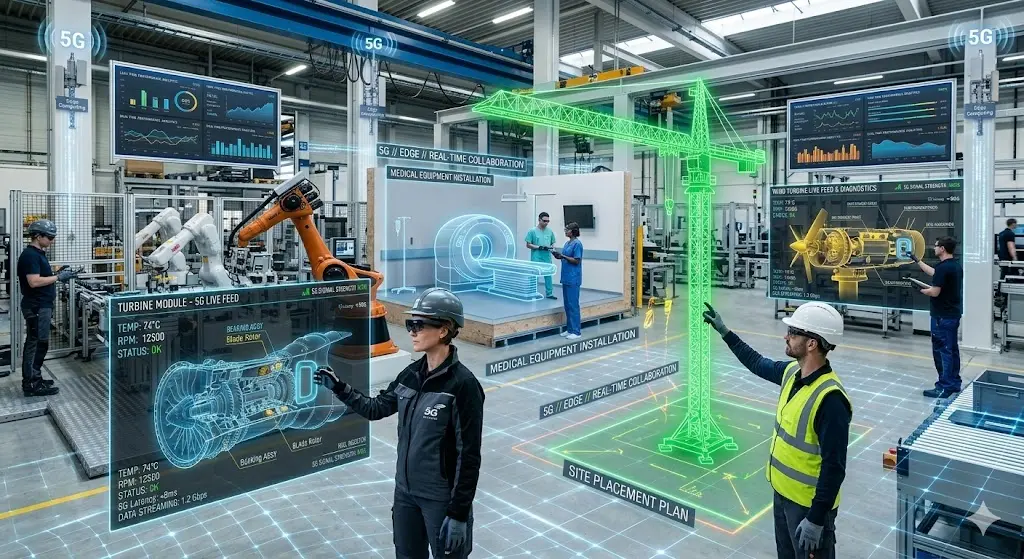
Factories use AR overlays to guide assembly line workers, visualize machine setups, and monitor equipment performance in real-time. Lag-free AR ensures workers can interact with models accurately and safely.
Construction
Project managers can overlay heavy machinery like cranes or excavators onto construction sites to plan optimal placement and avoid safety risks. Real-time AR allows immediate adjustments without physically moving equipment.
Energy & Utilities
Technicians can simulate maintenance on turbines, pipelines, and generators using AR. Edge computing and 5G make these simulations interactive and precise, reducing downtime and operational errors.
Medical Equipment
Large-scale medical devices can be virtually installed and tested in hospitals using AR. This allows staff to plan placement and training without moving heavy machinery, saving time and resources.
Overcoming Implementation Challenges
Despite its advantages, deploying 5G and edge-powered AR comes with challenges:
Infrastructure Costs: Implementing 5G networks and edge servers requires investment in hardware and integration.
Data Security: Industrial AR often involves sensitive operational data, which must be encrypted and securely managed.
Device Compatibility: AR hardware must support low-latency 5G connections and efficiently interface with edge servers.
These challenges are being addressed through modular AR platforms, scalable edge solutions, and partnerships between industrial firms and technology providers.
The Future of Lag-Free Industrial AR
The combination of 5G and edge computing removes the “speed paradox” of AR—where high-fidelity, interactive models were previously limited by network and computational constraints.
AR will become a standard tool for industrial design, training, maintenance, and client demonstrations.
Industrial processes will be more precise, efficient, and immersive.
Companies can make faster, more informed decisions, reducing errors and operational costs.
As 5G coverage expands and edge computing becomes more accessible, AR-powered industrial workflows will evolve from experimental tools into indispensable operational assets.
Conclusion
Lag-free AR try-ons for industrial equipment are now achievable thanks to the synergy of 5G and edge computing. This technological combination enhances visualization, training, collaboration, and customer engagement while addressing latency and processing limitations. Industries adopting this approach gain a competitive edge by improving efficiency, accuracy, and decision-making. The future of industrial AR is not just faster—it’s smarter, safer, and more immersive than ever before.
