


In the evolving landscape of digital commerce, the way consumers interact with products is changing dramatically. Traditional product images and static videos are no longer sufficient to capture attention or provide the confidence buyers need. Augmented reality (AR) and virtual reality (VR) are increasingly critical tools that allow brands to create immersive digital showrooms. These showrooms transform mobile devices into interactive platforms, enabling users to visualize, interact, and explore products in real-world contexts. However, implementing AR/VR on mobile devices presents unique technical and performance challenges that must be addressed for a seamless user experience.
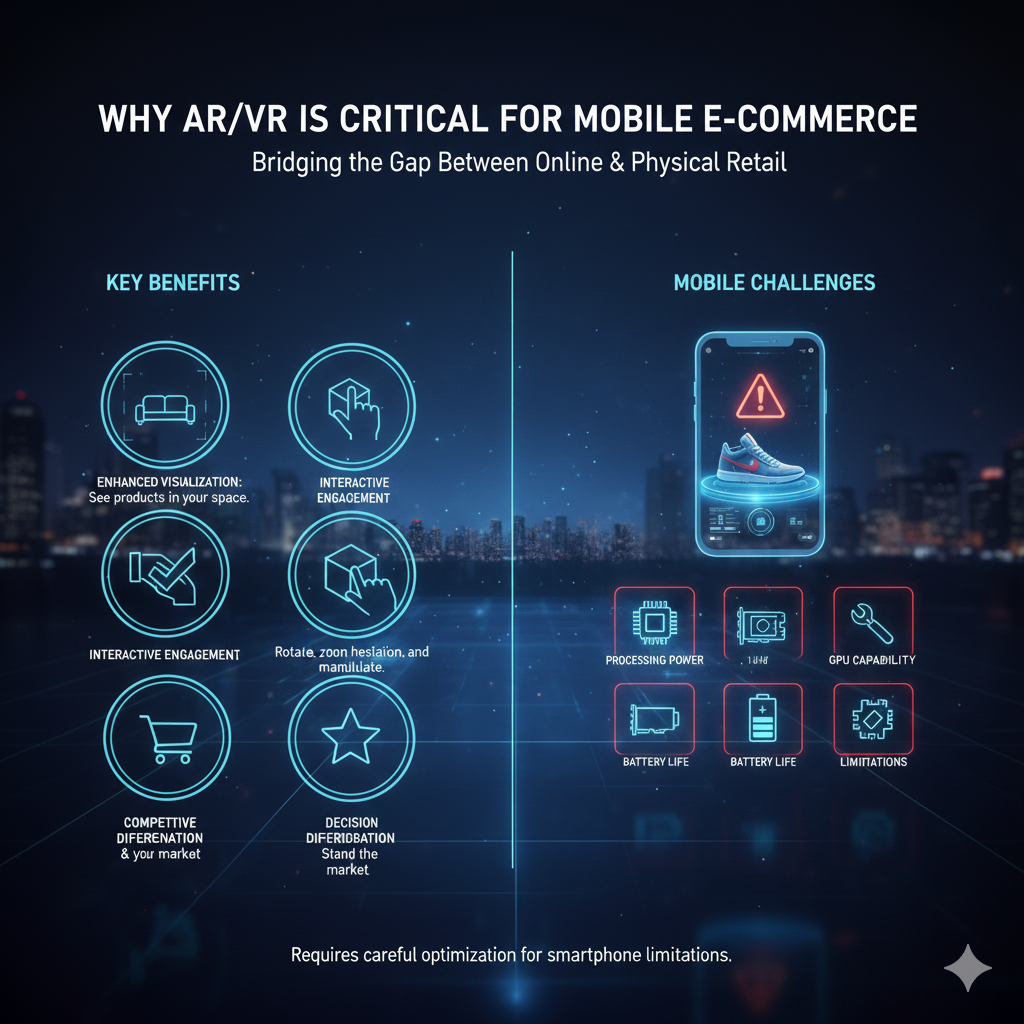
Why AR/VR is Critical for Mobile E-Commerce
Mobile-first AR/VR experiences allow brands to bridge the gap between online shopping and physical retail. Key benefits include:
Enhanced product visualization: AR allows customers to see how products fit in their environment, whether it’s furniture in a living room or a piece of clothing on their body.
Interactive engagement: Users can rotate, zoom, and manipulate 3D objects in real time, providing a tactile sense of the product.
Decision-making confidence: By simulating real-world interactions, VR/AR reduces hesitation and can lower product returns.
Competitive differentiation: Offering immersive shopping experiences differentiates brands in a crowded e-commerce market.
Despite these advantages, mobile AR/VR demands careful optimization because smartphones have limitations in processing power, GPU capability, memory, and battery life.
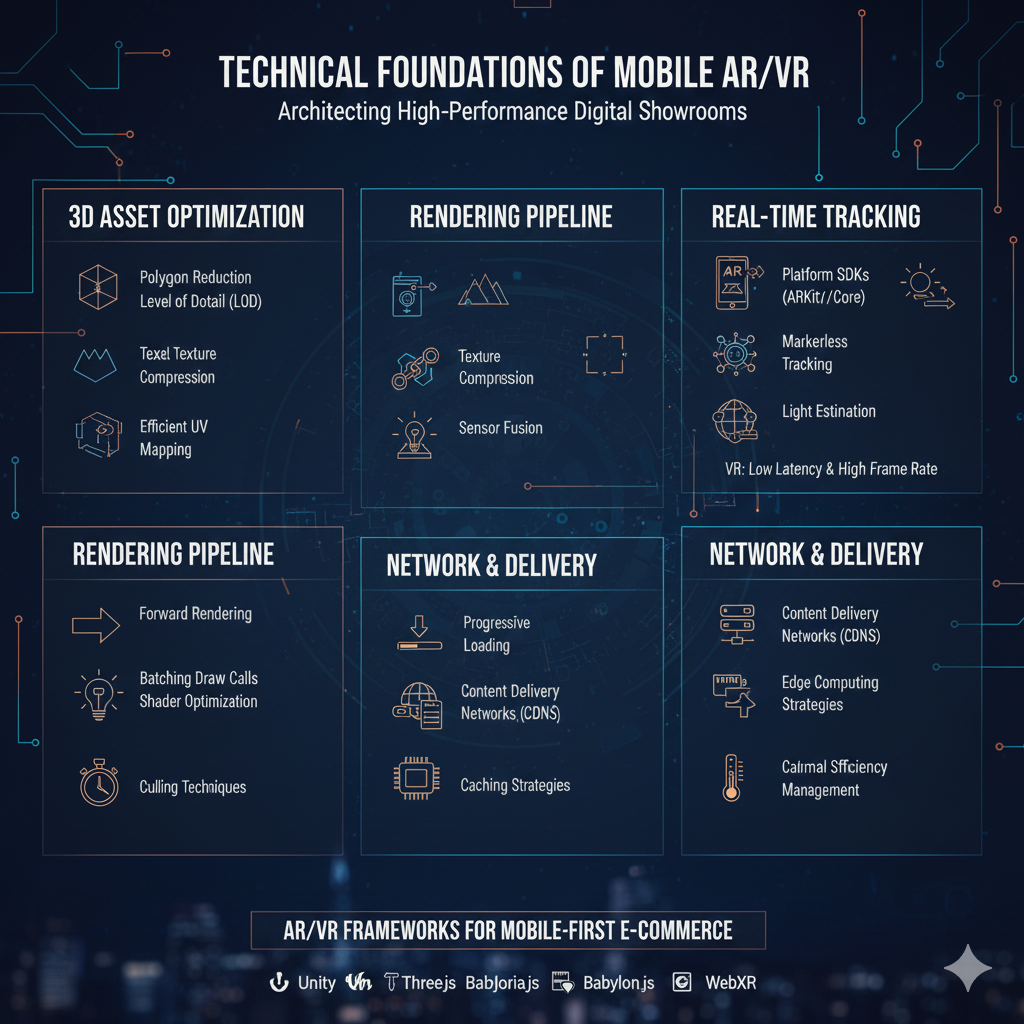
Technical Foundations of Mobile AR/VR
Creating a high-performance mobile AR/VR showroom requires attention to multiple technical layers, from 3D asset preparation to network architecture.
1. 3D Asset Optimization
High-quality assets are essential but must be optimized for mobile devices:
Polygon Reduction: Simplifying the mesh of models to reduce GPU load without compromising visual quality.
Level of Detail (LOD): Dynamically switching between high and low detail versions of the same model depending on distance from the camera.
Texture Compression: Using efficient formats like WebP, ASTC, or ETC2 to minimize memory consumption while retaining clarity.
Efficient UV Mapping: Reducing redundant texture data to improve load times and reduce rendering strain.
2. Rendering Pipeline Considerations
Mobile GPUs are weaker than desktop counterparts, requiring lightweight pipelines:
Forward Rendering: Preferred over deferred rendering for mobile AR/VR due to reduced complexity and faster frame rates.
Batching Draw Calls: Combining multiple objects into single draw calls reduces GPU workload and improves frame rates.
Shader Optimization: Minimize heavy calculations, use baked lighting where possible, and avoid high-overhead effects.
Culling Techniques: Use frustum and occlusion culling to render only visible objects, reducing unnecessary computations.
3. Real-Time Tracking and Spatial Awareness
AR relies heavily on precise tracking to anchor digital assets in the real world:
Platform SDKs: ARKit for iOS and ARCore for Android provide camera tracking, plane detection, and environment understanding.
Markerless Tracking: Detects surfaces and planes without requiring QR codes or physical markers, improving usability.
Sensor Fusion: Combines camera, accelerometer, and gyroscope data for accurate object placement.
Light Estimation: Adjusts virtual objects’ shading and brightness to match real-world lighting for realism.
VR, while less reliant on real-world positioning, requires consistent frame rates and low latency to prevent motion sickness.
4. Network Architecture and Asset Delivery
AR/VR applications often involve large assets, making efficient delivery essential:
Progressive Loading: Load essential assets first, then asynchronously fetch additional content.
Content Delivery Networks (CDNs): Distribute assets globally to reduce latency and download times.
Edge Computing: Offload computation-heavy tasks such as real-time physics or AI inference to nearby servers, improving performance on lower-end devices.
Caching Strategies: Use local caching for frequently used models to reduce repeated downloads and improve responsiveness.
5. Mobile Performance Optimization
Performance is crucial for mobile AR/VR adoption:
Target Frame Rates: Maintain 30–60 FPS to ensure smooth interactions; lower frame rates can disrupt immersion.
Memory Management: Implement object pooling and avoid memory leaks to prevent crashes on devices with limited RAM.
Battery Efficiency: Reduce background computations, minimize continuous GPU usage, and optimize network calls to extend battery life.
Thermal Management: Overheating can throttle performance; monitor GPU/CPU load and optimize accordingly.
AR/VR Frameworks for Mobile-First E-Commerce
Several frameworks facilitate AR/VR development for mobile commerce:
Unity and Unreal Engine: Popular for cross-platform AR/VR, with extensive support for mobile optimization and asset management.
Three.js and Babylon.js: Web-based 3D engines ideal for browser AR experiences, supporting WebXR standards.
Vuforia and Wikitude: Specialized AR SDKs offering image recognition, markerless tracking, and spatial mapping capabilities.
WebXR APIs: Enable VR experiences directly in mobile browsers without requiring app installations.
Choosing the right framework depends on performance requirements, deployment platform, and integration with e-commerce backend systems.
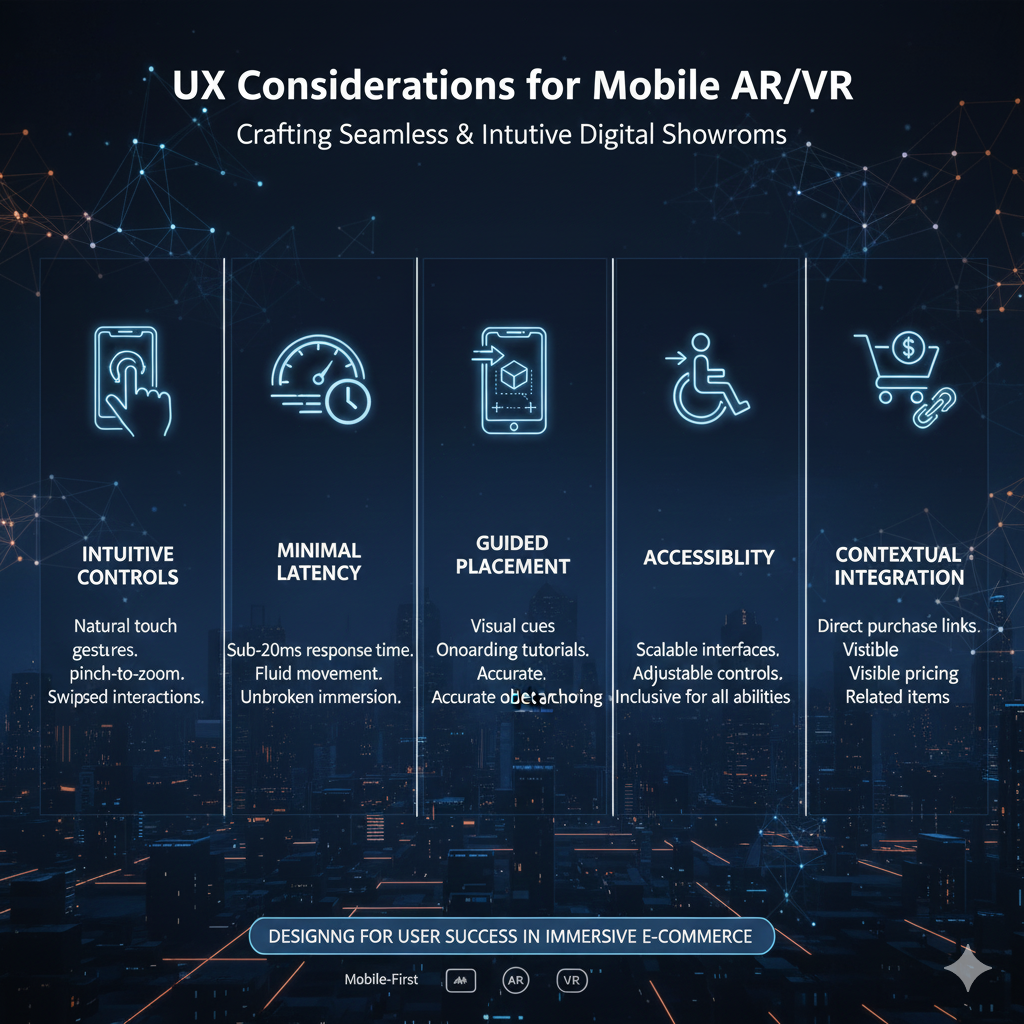
UX Considerations for Mobile AR/VR
Even technically perfect AR/VR experiences can fail if the user experience is poor:
Intuitive Controls: Touch gestures, pinch-to-zoom, and swipe-based interactions must feel natural and responsive.
Minimal Latency: High lag between device movement and asset response breaks immersion. Aim for <20ms latency for AR.
Guided Placement: Visual cues and onboarding tutorials help users place objects accurately and quickly.
Accessibility: Ensure users of varying physical abilities can navigate interactions easily, including scalable interfaces and adjustable controls.
Contextual Integration: Products should be easily linked to purchase options, pricing, and related items without leaving the AR/VR environment.
Case Example: Furniture AR for Mobile
A furniture retailer can implement AR to let users visualize couches, tables, and decor in their own homes:
Optimized 3D models and progressive loading ensure smooth performance on mid-range devices.
Users can rotate, resize, and reposition furniture in real time, simulating how it fits into their space.
Analytics track interactions to suggest complementary products and personalized recommendations.
Integration with the e-commerce backend allows users to make purchases directly from the AR view.
This approach improves engagement, reduces returns, and provides a more confident purchasing experience.
Future Trends
Mobile AR/VR will continue evolving in e-commerce:
WebAR: Allows browser-based experiences, eliminating the need for dedicated apps.
AI-Assisted Interaction: AI can enhance object placement, optimize asset loading, and provide personalized recommendations in real time.
5G and Low-Latency Networks: Faster connections enable higher-fidelity AR/VR content and real-time multiplayer interactions.
AR Commerce Integration: Seamless “buy now” options within AR/VR will streamline conversion funnels and reduce friction.
Cross-Platform Persistence: Cloud-based AR sessions will allow users to save placements across devices, creating continuous experiences.
Conclusion
The mobile-first digital showroom is no longer optional for e-commerce brands—it is a strategic imperative. AR/VR allows consumers to interact with products in immersive, realistic ways that traditional images and videos cannot replicate. Implementing these experiences requires meticulous attention to 3D asset optimization, rendering pipelines, tracking accuracy, network architecture, and mobile performance.
When executed correctly, AR/VR not only enhances engagement but also drives conversions, reduces product returns, and differentiates a brand in an increasingly competitive market. Mobile-first AR/VR is shaping the future of e-commerce, and brands investing in these technologies today are positioning themselves at the forefront of digital retail innovation.
By focusing on technical excellence, performance optimization, and user-centric design, businesses can deliver digital showrooms that transform the shopping experience into something truly immersive, interactive, and memorable.
