


Augmented Reality (AR) try-on has moved far beyond novelty. In categories such as fashion, eyewear, cosmetics, footwear, furniture, and even medical devices, AR is now a serious conversion driver and a critical part of the product discovery experience. However, many implementations fail not because the AR technology is weak, but because the product page UX is not designed to support immersive interaction. A truly effective AR try-on experience requires rethinking the product page as an interactive environment rather than a static catalog entry.
This article takes a deep, advanced-level look at how to design a high-performing, immersive product page optimized for AR try-on—focusing on structure, interaction models, performance, accessibility, and behavioral psychology.
1. Rethinking the Product Page as an Experience Layer
Traditional product pages are linear: images at the top, specifications below, social proof further down, and a purchase CTA. AR breaks this hierarchy. When users can see a product on their face, body, or in their space, the visual experience becomes the primary decision-making tool, not a supporting element.
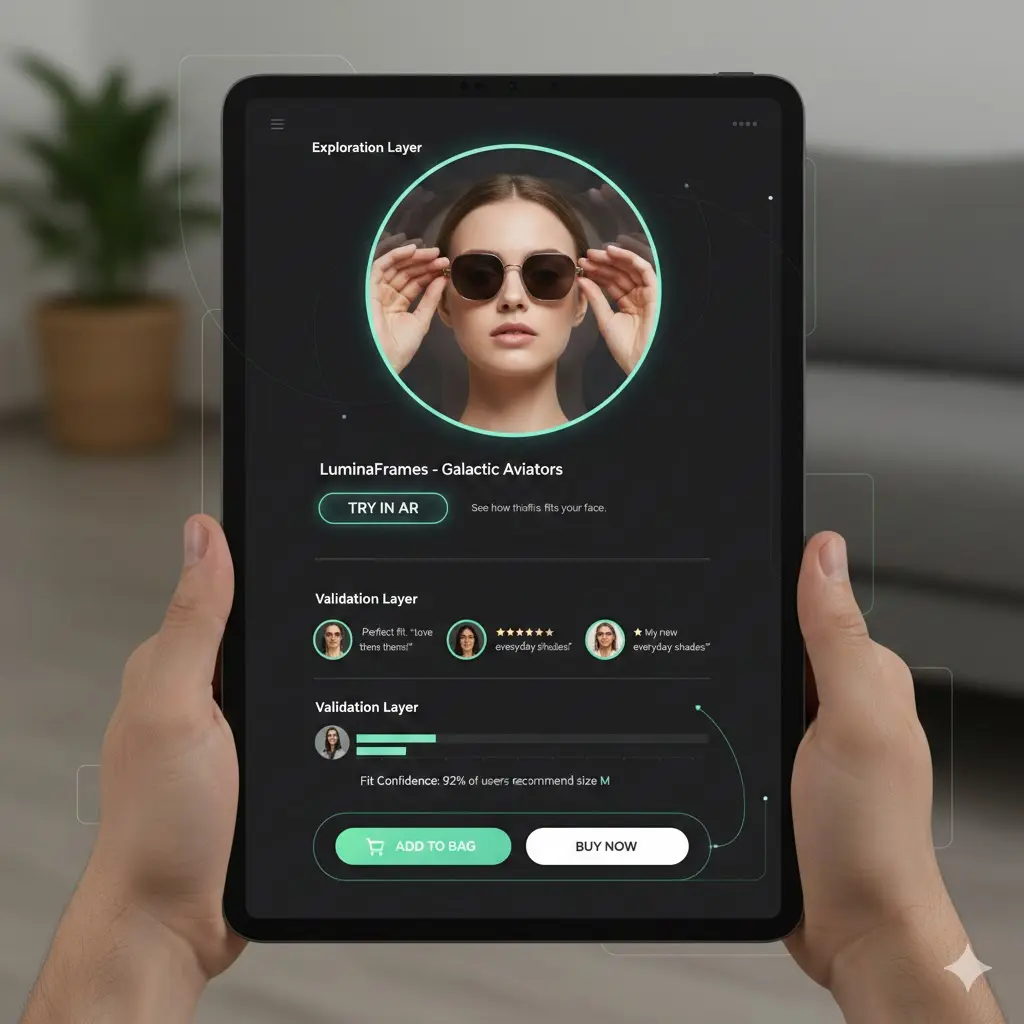
An immersive AR-first product page should be designed around three core layers:
Exploration Layer – where AR try-on lives
Validation Layer – social proof, fit confidence, and reassurance
Action Layer – conversion without breaking immersion
The key UX challenge is allowing users to move between these layers seamlessly, without cognitive overload or context switching.
2. Entry Point Design: When and How AR Is Introduced
One of the most overlooked UX decisions is how users enter the AR experience.
Advanced UX research shows that AR should not always auto-launch. Instead, the product page should dynamically decide based on:
Device capability
User intent signals
Category relevance
Network performance
Best-practice AR entry patterns:
A primary “Try in AR” CTA placed near the product title
Inline AR preview cards that animate subtly to indicate interactivity
Contextual prompts like “See how this fits your face” instead of generic labels
Avoid burying AR behind secondary tabs or icons. If AR is the value differentiator, it must be visually prioritized without overwhelming users who prefer traditional browsing.
3. Designing the AR Canvas: Immersion Without Distraction
The AR canvas is the heart of the experience. Poor design here breaks trust instantly.
Key principles for AR canvas UX:
Full-screen by default, but not full-commitment
Users should enter AR in an immersive mode, but always feel in control. Persistent exit gestures and minimized UI chrome are essential.Minimal UI, maximum feedback
Avoid clutter. Every control must be purposeful—rotate, resize, color change, lighting, or camera switch.Context-aware overlays
Instead of static tooltips, use spatial hints (e.g., “Move closer” appearing near the face or object).Visual stability
Jitter, lag, or drifting objects instantly destroy credibility. UX teams must work closely with engineering to prioritize tracking stability over visual effects.
4. Bridging AR and Product Information Seamlessly
A common UX failure is forcing users to exit AR to check product details. This breaks immersion and increases drop-off.
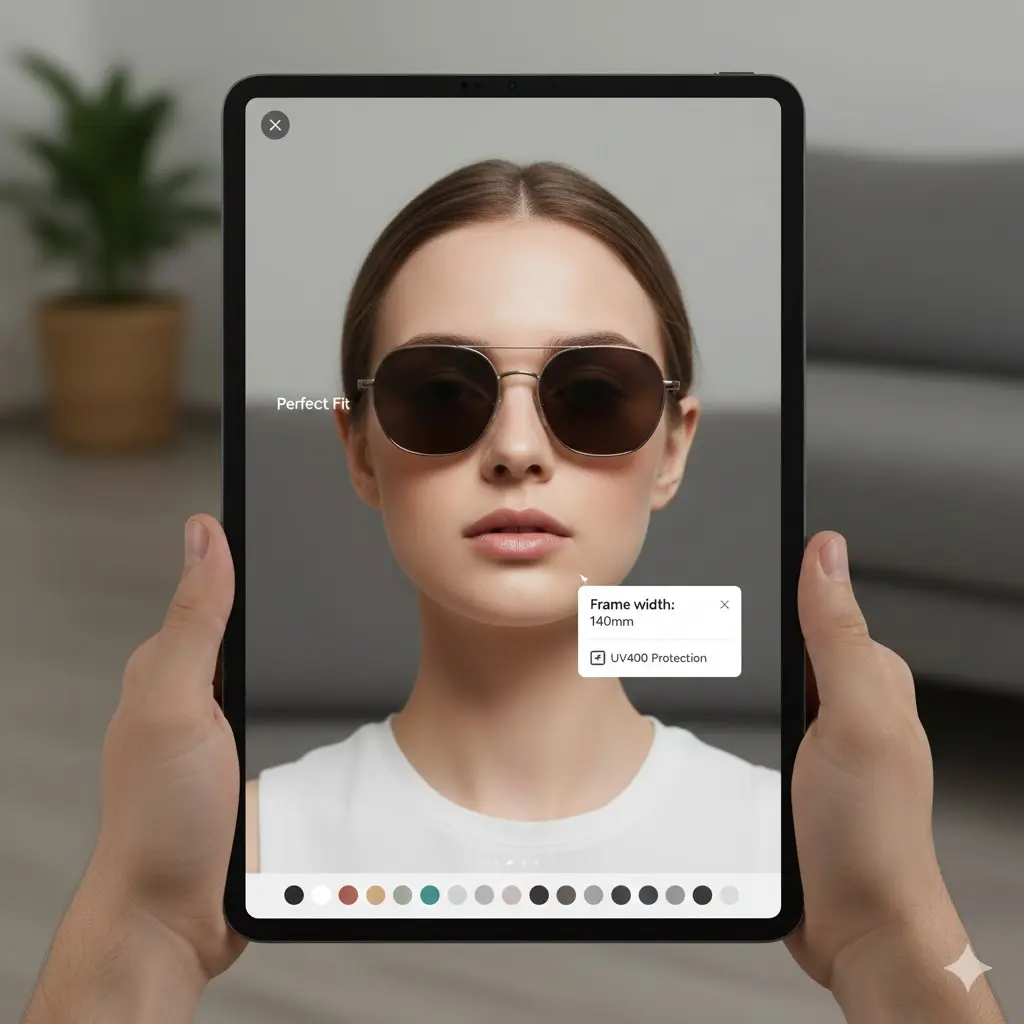
Advanced product pages integrate AR-embedded information layers, such as:
Floating spec markers that appear when tapped
Contextual highlights (e.g., lens width highlighted on glasses)
Real-time size or fit indicators
For example, instead of listing “Frame width: 140mm” below the fold, show a visual fit guide directly on the user’s face during AR try-on.
This approach transforms abstract data into experiential understanding, reducing uncertainty and returns.
5. Fit Confidence and Decision Reinforcement
AR try-on is powerful, but users still question accuracy. The product page must actively reinforce trust.
High-impact UX strategies include:
Fit confidence scores based on face or body mapping
Based on users with comparable features, this size shows a high likelihood of fit satisfaction
Before/after comparison snapshots
AI-generated fit warnings (“This may feel narrow at the temples”)
These elements should appear during or immediately after the AR session, not buried in reviews. Timing is critical—reinforcement works best when the user is emotionally engaged.
6. Social Proof in an Immersive Context
Traditional reviews don’t translate well into immersive environments. Advanced AR product pages adapt social proof to match the experience.
Examples:
AR-triggered review highlights (“People with your face shape rated this 4.8/5”)
User-generated AR snapshots (with consent)
Micro-testimonials anchored to specific features
Instead of long review blocks, use contextual credibility cues that support the user’s current interaction.
7. Conversion Without Breaking Flow
One of the hardest UX challenges is transitioning from exploration to purchase without disrupting immersion.
Effective AR-optimized CTAs:
Remain accessible but unobtrusive during AR
Use progressive commitment (“Save look” → “Add to cart” → “Checkout”)
Reflect user actions (“Add the black version you just tried”)
Advanced product pages also allow:
Cart previews inside AR
Side-by-side AR comparison of variants
Persistent AR state after adding to cart
The goal is continuity. The user should feel like they are moving forward, not exiting an experience.

8. Performance, Latency, and Perceived Speed
In immersive UX, performance is part of design.
Key considerations:
Progressive AR loading with visible feedback
Fallback experiences for low-end devices
Predictive asset loading based on user behavior
Graceful degradation instead of hard failure
Even small delays in AR activation significantly reduce engagement. UX designers must treat performance as a first-class design constraint, not a technical afterthought.
9. Accessibility and Inclusive AR Design
Advanced AR product pages must be inclusive.
Consider:
Clear alternatives for users who cannot or choose not to use AR
Voice guidance and haptic feedback
High-contrast UI elements for visual clarity
Adjustable sensitivity for motion and camera usage
Inclusive design expands reach and protects against alienating users who may otherwise convert through traditional methods.
10. Measuring Success Beyond Conversion
Finally, success metrics must evolve.
In AR-first product pages, key UX metrics include:
AR engagement depth
Time to confidence (not just time on page)
Return rate reduction
Fit accuracy feedback
Post-purchase satisfaction
These insights should continuously inform product page iteration, closing the loop between experience design and business outcomes.
Conclusion: AR Try-On Is a UX Problem First
The perfect immersive product page for AR try-on is not defined by cutting-edge technology alone. It is defined by intentional, human-centered UX design that reduces uncertainty, builds confidence, and respects user flow.
As AR becomes mainstream, the competitive advantage will belong to teams that treat the product page not as a static layout, but as a living, immersive decision environment. When done right, AR try-on doesn’t just show the product—it helps users believe in it.
