
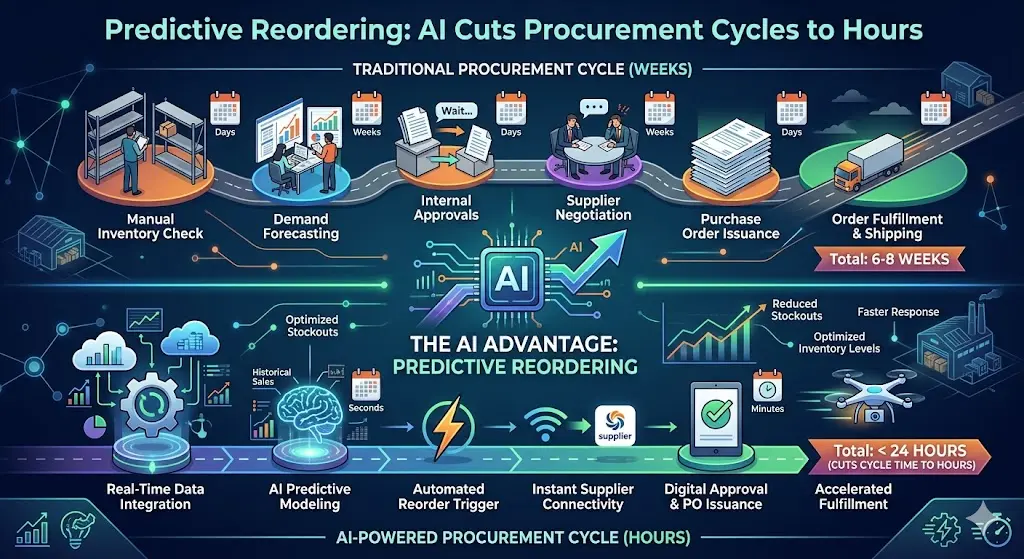
In traditional procurement, supply chain teams often navigate a complex, repetitive cycle. From identifying inventory needs to issuing purchase orders, waiting for supplier confirmation, and scheduling deliveries, weeks can pass before goods or materials are actually available. This lag impacts everything from production timelines to cash flow management, and even the ability to respond to market volatility.
Now imagine a system where intelligent AI agents continuously monitor inventory levels, supplier performance, and demand signals—then autonomously place orders or propose replenishments in real time. This is not a distant futuristic scenario. This is predictive reordering powered by AI agents, and it is transforming how organizations manage procurement.
The Challenge of Traditional Procurement
Even with modern ERP systems, procurement is often constrained by:
- Manual Forecasting: Human planners rely on historical data, intuition, or spreadsheets, which introduces errors and slow reaction times.
- Reactive Ordering: Purchases are often triggered only after stock levels drop below safety thresholds, increasing the risk of production delays or stockouts.
- Complex Supplier Networks: Coordinating with multiple suppliers, each with different lead times, terms, and constraints, creates administrative overhead.
- Approval Bottlenecks: Even when a need is identified, internal approvals can delay order execution by days or weeks.
The result is a cycle where weeks of manual effort and delays separate the recognition of a need from fulfillment. In fast-moving industries, these delays can be costly—both financially and operationally.
How AI Agents Enable Predictive Reordering
AI-driven predictive reordering transforms procurement by introducing autonomous agents that continuously monitor, forecast, and execute supply orders. Here’s how it works:
1. Continuous Demand Monitoring
AI agents integrate with sales, production, and logistics systems to analyze real-time demand patterns. Unlike traditional forecasting, which often relies on monthly or quarterly reports, these agents can detect subtle trends, seasonal shifts, and emerging supply needs instantly.
For example, a sudden spike in component usage due to a promotional campaign can trigger a predictive reorder before stockouts occur, ensuring uninterrupted production.
2. Smart Inventory Forecasting
Using advanced machine learning models, AI agents predict future inventory requirements with high accuracy. They consider multiple variables simultaneously, such as:
- Historical usage patterns
- Supplier lead times
- Shipping delays
- Seasonal demand fluctuations
- Market trends
This enables organizations to maintain optimal stock levels, reducing both excess inventory and shortages.
3. Supplier Performance Evaluation
AI agents continuously track supplier reliability metrics, including:
- On-time delivery rates
- Order accuracy
- Pricing trends
- Compliance with contract terms
By factoring in supplier performance, AI agents can prioritize the best sources and adjust orders dynamically. For example, if a primary supplier is experiencing delays, the agent can automatically reroute the order to a secondary supplier to prevent disruption.
4. Automated Reordering Execution
Once a need is predicted and the optimal supplier identified, AI agents can automatically generate and submit purchase orders, subject to organizational policies. Human intervention is required only for exceptions or approvals beyond defined thresholds. This drastically reduces the time between recognizing a need and completing an order—from weeks to mere hours.
The Business Impact of Predictive Reordering
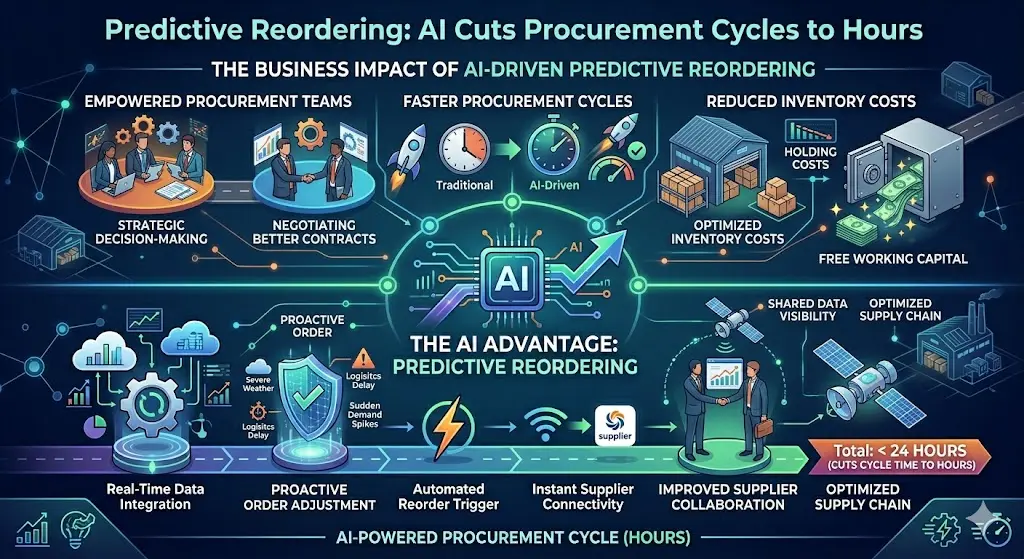
Organizations adopting AI-driven predictive reordering see tangible benefits across multiple dimensions:
Faster Procurement Cycles
The most immediate impact is speed. With AI agents continuously analyzing demand and supplier performance, procurement cycles shrink from weeks to hours. This acceleration ensures production continuity and faster response to market fluctuations.
Reduced Inventory Costs
By predicting needs more accurately, organizations can maintain leaner inventories without risking stockouts. This reduces holding costs, obsolescence, and waste, freeing up working capital for other initiatives.
Improved Supplier Collaboration
AI agents enable more data-driven interactions with suppliers. Predictive orders provide suppliers with better visibility into demand, allowing them to optimize their own operations and strengthen partnerships.
Enhanced Risk Management
With continuous monitoring and predictive insights, AI agents can anticipate supply chain disruptions. For example, if weather events, logistics delays, or sudden demand surges are detected, the system can adjust orders proactively, reducing exposure to operational risks.
Empowered Procurement Teams
By automating repetitive tasks, AI agents allow procurement teams to focus on strategic decision-making—negotiating better contracts, managing supplier relationships, and optimizing the overall supply chain.
Real-World Applications
Predictive reordering is applicable across industries:
- Manufacturing: Ensures production lines have the right components at the right time, minimizing downtime.
- Retail: Enables stores to maintain optimal shelf stock without over-ordering.
- Healthcare: Keeps critical medical supplies and pharmaceuticals available while controlling costs.
- Food & Beverage: Reduces spoilage by aligning orders with real-time demand patterns.
- Technology: Keeps electronics and high-demand components in stock during product launches.
Each application demonstrates how speed, accuracy, and automation combine to create operational agility.
The Technology Behind AI Agents
AI agents leverage a combination of technologies:
- Machine Learning Models: For demand forecasting and inventory optimization.
- Natural Language Processing (NLP): To interpret supplier communications, contracts, and purchase requests.
- Robotic Process Automation (RPA): For integrating with ERP, procurement, and supplier portals.
- Predictive Analytics: To anticipate disruptions and recommend proactive measures.
- Decision Optimization Algorithms: To balance multiple constraints like cost, lead time, and supplier performance.
Together, these technologies allow AI agents to function autonomously while adapting continuously to new data.
Challenges and Considerations
While the benefits are clear, predictive reordering also introduces considerations:
- Data Quality: AI agents require accurate, timely, and comprehensive data. Incomplete or incorrect inputs can lead to suboptimal predictions.
- Change Management: Teams must trust AI decisions, which may require training, transparency, and gradual implementation.
- Policy Compliance: Automated reordering must align with organizational purchasing policies and regulatory requirements.
Addressing these challenges ensures that AI-driven procurement enhances efficiency without compromising control.
The Future of Procurement Cycles
Predictive reordering represents a fundamental shift from reactive to proactive procurement. In the near future, AI agents could manage entire supply chains autonomously, coordinating multiple suppliers, transportation partners, and production schedules in real time. Human oversight will evolve from manual transaction handling to strategic orchestration and exception management.
This transformation promises procurement that is faster, smarter, and more resilient than ever before.
Final Thoughts
AI-driven predictive reordering is more than a technological upgrade. It is a strategic lever that accelerates procurement cycles from weeks to hours, reduces costs, mitigates risk, and empowers teams to focus on high-value work. By continuously monitoring demand, evaluating suppliers, and executing orders autonomously, AI agents redefine what it means to manage a modern supply chain.
Organizations that embrace predictive reordering gain a competitive edge in speed, agility, and operational intelligence—turning procurement from a slow, reactive process into a dynamic, proactive engine for growth.
