


The way customers discover products is changing rapidly. Traditional search engines and marketplaces are no longer the only gateways to visibility. By 2027, AI agents—software systems that autonomously research, compare, and recommend products—are expected to play a major role in how purchasing decisions are made.
In this new environment, success will depend less on how visually appealing your product pages are to humans and more on how clearly your data can be understood by machines. This is where Product Information Management (PIM) systems become critical. If your PIM data is not structured, enriched, and machine-legible, AI agents may overlook your products entirely.
This article explores what machine-legible data means, why it matters, and how to prepare your PIM for the next generation of AI-driven discovery.
The Shift from Human Search to AI Discovery
For decades, digital commerce has been optimized for human browsing:
Keyword-based search
Product images and descriptions
Reviews and ratings
But AI agents operate differently. Instead of scanning pages visually, they:
Parse structured attributes
Compare specifications automatically
Evaluate compatibility and performance
Recommend options based on user constraints
An AI agent doesn’t “see” your marketing copy in the same way a person does. It relies on structured, consistent, and well-defined data.
This means companies must rethink how product data is organized and delivered.
What Does “Machine-Legible Data” Mean?
Machine-legible data is information that software systems can easily interpret without ambiguity. In the context of a PIM system, this involves:
Standardized attribute names
Consistent measurement units
Clear taxonomy and categorization
Structured specifications
Metadata and semantic tagging
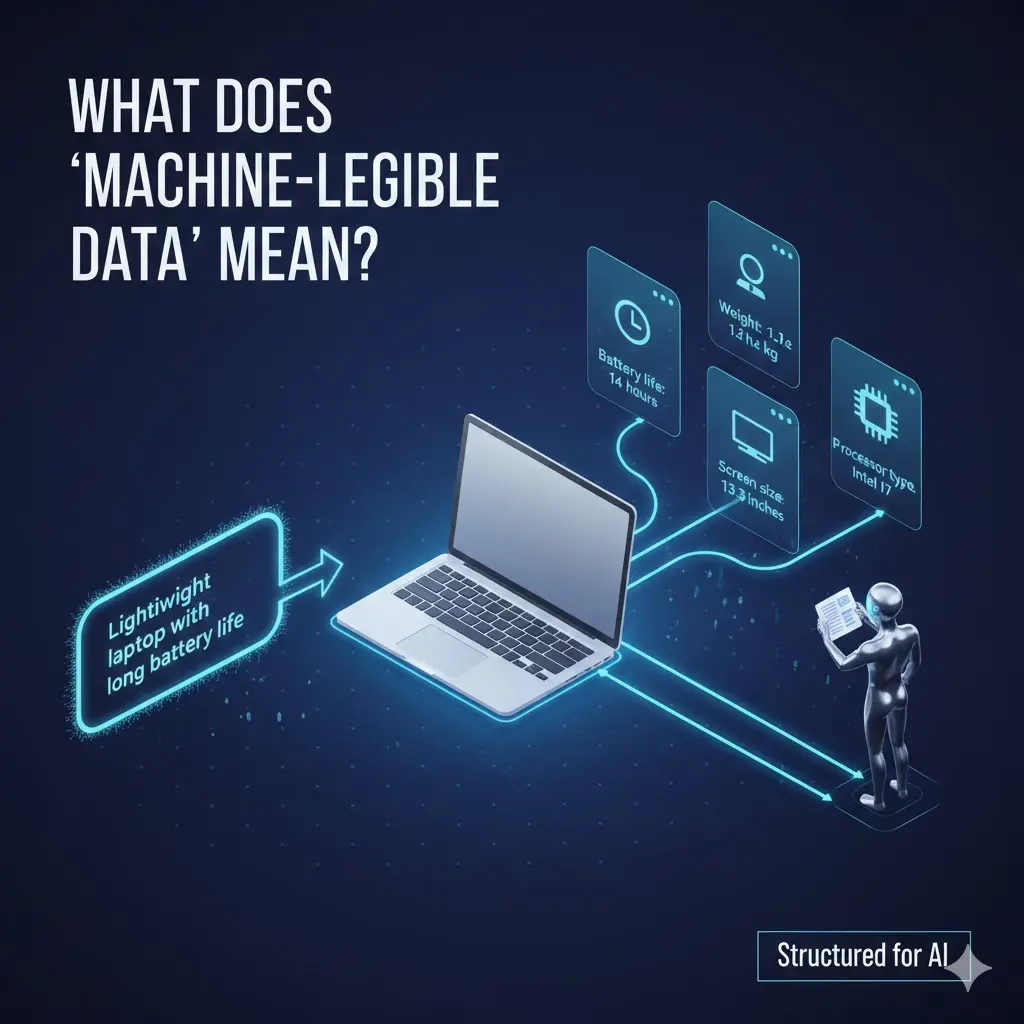
For example, a human might understand:
“Lightweight laptop with long battery life.”
But an AI agent needs:
Weight: 1.2 kg
Battery life: 14 hours
Screen size: 13.3 inches
Processor type: Intel i7
The more structured and normalized your data is, the easier it is for AI systems to process and recommend your products.
Why PIM Will Be the Center of AI Commerce
Your PIM system is not just a database—it is the foundation of digital product intelligence.
By 2027, AI agents will likely connect to:
Retail APIs
Structured feeds
Knowledge graphs
Product catalogs
Companies with well-structured PIM environments will have a significant advantage because their products will be easier for AI systems to analyze and rank.
Organizations that neglect this shift risk becoming invisible in automated recommendation ecosystems.
Key Challenges in Current PIM Data
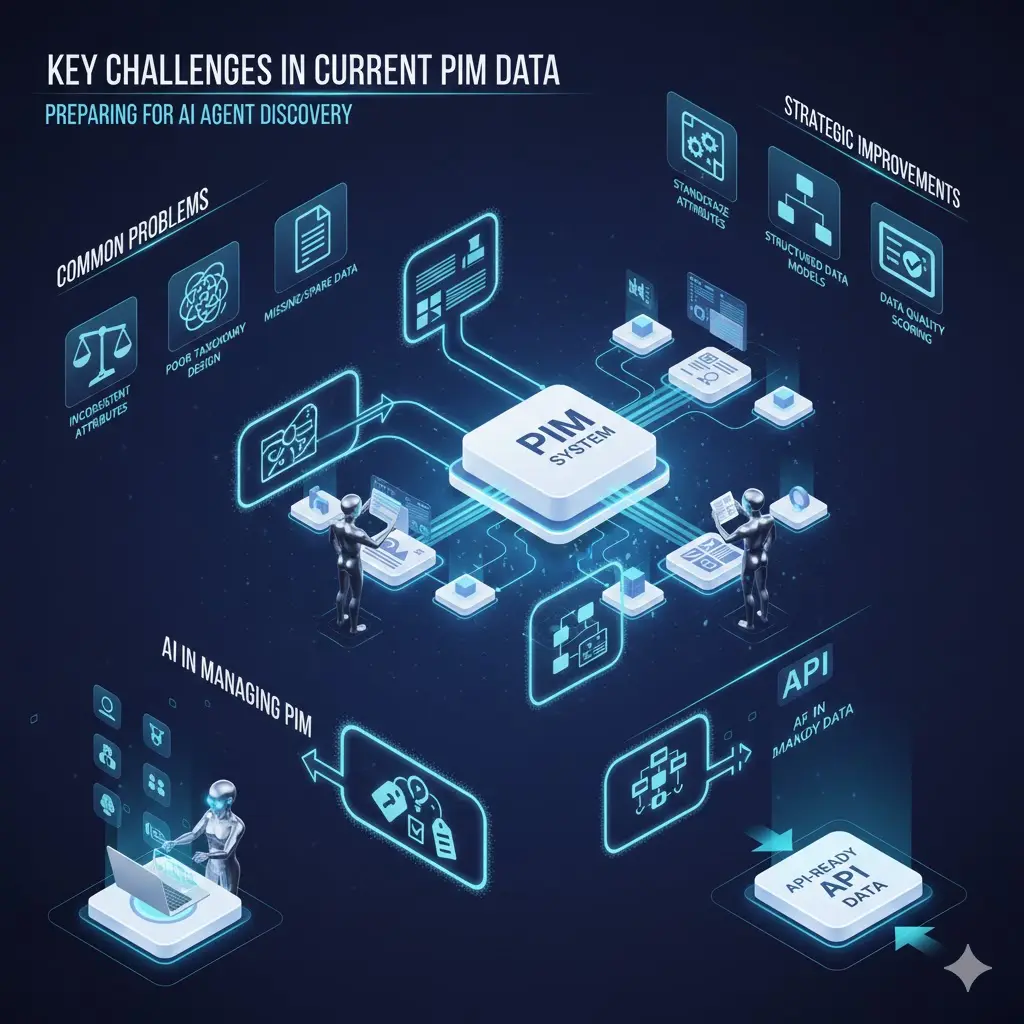
Many companies believe their product data is ready for the future, but common problems still exist:
1. Inconsistent Attributes
Different teams may use slightly different names for the same property:
Weight vs. Product Weight
Battery Duration vs. Battery Life
To a human, these differences seem minor. To an AI agent, they can create confusion or incomplete comparisons.
2. Missing or Sparse Data
Incomplete specifications reduce discoverability. AI agents often prioritize products with richer datasets because they provide clearer decision signals.
3. Poor Taxonomy Design
If categories are not logical or scalable, machines struggle to understand relationships between products.
A strong taxonomy should:
Reflect product hierarchies clearly
Allow flexible expansion
Maintain consistent naming conventions
4. Lack of Semantic Context
Machines need context, not just raw values. For example:
Is “32” referring to gigabytes, inches, or watts?
Is “Pro” a model name or a product tier?
Without semantic clarity, AI systems may misinterpret data.
Preparing Your PIM for AI Agent Discovery
To ensure your product data is machine-ready, companies should focus on several strategic improvements.
Standardize Product Attributes
Start by defining a global attribute framework:
Consistent naming conventions
Standard units of measurement
Mandatory fields for key product types
Governance is essential. Without rules, data quality will deteriorate over time.
Enrich Your Product Data
AI agents favor detailed and complete information. Enrichment can include:
Technical specifications
Compatibility details
Use-case descriptions
Material or component data
The goal is to provide structured answers to the questions customers—and AI agents—are most likely to ask.
Adopt Structured Data Models
Modern PIM strategies increasingly rely on:
Schema-based modeling
Entity relationships
Linked attributes
This allows machines to understand connections between products, accessories, and categories.
For example:
Laptop → Compatible Charger
Camera → Supported Lens Types
Relationship data is extremely valuable in AI-driven recommendations.
Implement Data Quality Scoring
A forward-looking PIM strategy should include automated quality checks:
Completeness scores
Validation rules
Duplicate detection
These systems ensure that data remains machine-readable as catalogs grow.
Make Your Data API-Ready
AI agents will increasingly access product data through APIs rather than scraping websites.
Your PIM should be capable of:
Delivering structured feeds
Supporting real-time updates
Providing scalable endpoints
This ensures your product information can integrate seamlessly into future ecosystems.
The Role of AI in Managing PIM
Interestingly, AI itself is becoming a powerful tool for improving PIM systems.
Organizations are already using AI to:
Normalize inconsistent attributes
Generate enriched product descriptions
Identify missing fields
Recommend taxonomy improvements
By combining automation with human oversight, companies can maintain high-quality product data at scale.
Thinking Beyond E-Commerce
Machine-legible product data will not only affect online stores. It will influence:
Voice assistants
Smart home systems
Autonomous procurement platforms
Industrial supply chains
In many cases, purchasing decisions will be made partially—or entirely—by software agents acting on behalf of users.
This means your product data must be understandable not just to customers, but to machines acting as customers.
Building a Future-Ready Data Culture
Technology alone is not enough. Preparing your PIM for AI discovery requires organizational change.
Successful companies often:
Establish data governance teams
Train staff on structured data principles
Align marketing and technical teams
Treat product data as a strategic asset
When data quality becomes a shared responsibility, long-term improvements become sustainable.
What 2027 May Look Like
By 2027, the product discovery journey could look very different
The AI agent scans structured product feeds from thousands of companies.
Products with incomplete or inconsistent data are filtered out automatically.
Only machine-legible, well-structured listings are recommended.
In this scenario, visibility depends less on advertising and more on data clarity.
Final Thoughts
Machine-legible data is quickly becoming one of the most important competitive advantages in digital commerce. As AI agents reshape how products are discovered, compared, and purchased, companies must ensure their PIM systems are structured, enriched, and API-ready.
Preparing now means:
Standardizing attributes
Enriching product content
Improving taxonomy
Ensuring consistent data governance
Organizations that invest in these areas will not only be ready for AI-driven discovery in 2027—they will lead it.
The question is no longer whether AI agents will influence buying decisions.
The real question is: Will your product data be ready when they arrive?
